If your stylist sets their own prices, buys their own product, and pays you a flat rent, you’re almost certainly looking at a 1099 contractor. If you set the schedule, dictate which shampoo they use, and cut them a check after taking your split, the IRS sees an employee, no matter what your contract says — an issue salons have tackled effectively in case studies like How One Salon Doubled Online Bookings. The fastest way to find out which one applies to you: run the five-question control test below right now, and if two or more answers point to “employee,” stop paying that person on a 1099 until you talk to a CPA or employment attorney.
- W-2 likely: commission stylists on a set schedule using salon-owned product and tools
- 1099 likely: booth/suite renters who pay fixed rent, set their own hours, and buy their own supplies
- Gray zone (audit magnet): “commission contractors” who get scheduled shifts, mandatory training, or salon-branded uniforms while paid on a 1099
- Top risk if you get it wrong: back payroll taxes, interest, and IRS penalties that often dwarf whatever you saved in employer costs
Key Takeaways
Correct classification depends on who controls pricing, scheduling, and product, not on what the contract calls the arrangement, and getting it wrong risks back taxes and penalties that outweigh any short-term payroll savings.
| Point | Details |
|---|---|
| Run the control test first | Check who sets schedule, pricing, product use, and payment routing before assuming a label is correct. |
| Know the tax gap | 1099 stylists owe the full 15.3% self-employment tax, while W-2 employees split FICA with the employer. |
| Avoid the hybrid trap | “Commission contractors” paid on 1099 but controlled like employees are the most common audit trigger. |
| Document everything, consistently | Keep leases, W-9s, insurance proof, or payroll and W-4 records for several years and apply rules evenly. |
| Automate your recordkeeping | LumariPRO connects to POS and QuickBooks to keep timestamped, defensible records for either classification. |
Table of Contents
- W2 Vs 1099 Salon: Key Differences At A Glance
- How Is Worker Classification Determined In A Salon?
- What Do Salons And Stylists Actually Pay In Taxes?
- Booth Renters, Commission Stylists, And The Hybrid Trap
- Building A Compliance Checklist Salon Owners Can Use
- What To Do If You Suspect Misclassification
- Keeping Records That Actually Hold Up To Scrutiny
- Benefits, Health Insurance, And Paid Time Off: What Each Classification Gets
- Do Minimum Wage And Overtime Rules Apply To Salon Contractors?
- Licensing And Liability Insurance: Does Classification Change What You Need?
- Transitioning Between 1099 And W-2 Status
- Recordkeeping That Protects Both Sides Of The Chair
- Why Owners Keep Getting This Wrong
- Staying Compliant Without Drowning In Spreadsheets
- Sources
W2 Vs 1099 Salon: Key Differences At A Glance
The core difference comes down to who pays what, and who controls what. On a W-2, your salon withholds federal and state income tax, Social Security, and Medicare from every paycheck, and matches the FICA contribution dollar for dollar. You also carry unemployment insurance and, in most states, workers’ compensation coverage.
On a 1099, none of that withholding happens. The stylist gets paid gross, then owes self-employment tax on their own, files a Schedule C at tax time, and typically has to send the IRS quarterly estimated payments. They’ll receive a 1099-NEC (or a 1099-K if a third-party payment processor handles their bookings) rather than a W-2.
Statistic Callout: The employer FICA match runs about 7.65% of wages. When a salon misclassifies a stylist as a 1099 contractor to skip that match, the stylist effectively absorbs that cost themselves through self-employment tax, on top of losing the safety net of unemployment and workers’ comp.
- W-2: salon withholds taxes, matches FICA, pays unemployment and workers’ comp
- 1099: stylist self-reports and pays self-employment tax, no employer withholding at all
- Tip handling differs too: W-2 tips get reported through payroll for tax purposes; 1099 tips are the stylist’s own income to track and report on Schedule C
How Is Worker Classification Determined In A Salon?
The IRS doesn’t care what your contract says. It cares what actually happens on the floor. The common-law control test breaks classification into three categories: behavioral control, financial control, and the type of relationship between you and the stylist.
Behavioral control asks who decides how the work gets done. If you set the schedule, require specific techniques, mandate a dress code, or insist on particular product lines, that’s an employee indicator. Financial control looks at who bears the business risk. A stylist who buys their own color, sets their own prices, and can lose money on a slow week looks like a contractor. A stylist who gets a guaranteed hourly floor regardless of bookings looks like an employee. Relationship type covers things like whether the arrangement is ongoing and exclusive, or whether the stylist works for multiple salons and can walk away anytime.
Here’s the part that trips up most owners: a contract labeled “independent contractor agreement” means nothing if the daily reality contradicts it. Courts and auditors look past the paperwork to the actual working conditions.
Run this five-question check on any stylist you’re unsure about:
- Do you set their hours or require them to be on-site during specific shifts?
- Do you dictate which products, tools, or techniques they must use?
- Do you set their service prices or take a percentage that functions like a wage?
- Do you route all client payments through your own point-of-sale system and then pay them out?
- Do they work exclusively for your salon, with no ability to bring in outside clients on their own terms?
Two or more “yes” answers usually mean you’re looking at an employee relationship, regardless of what the paperwork says.
Pro Tip: Don’t just check the boxes once and forget it. Revisit this test every time you change a policy, a schedule requirement, or a payment process. Classification isn’t a one-time decision; it drifts as your operations change.
Some states go further than federal law. California’s AB-5 law applies an ABC test that presumes worker status unless the business proves otherwise on three specific factors, and several other states use similar frameworks. Enforcement intensity varies widely by state, so a setup that flies under the radar in one place can draw immediate scrutiny in another.
What Do Salons And Stylists Actually Pay In Taxes?
The tax math is where classification stops being theoretical and starts hitting your bank account. On a 1099, there’s no split.
Statistic Callout: That gap is the single biggest financial consequence of classification. A stylist earning the same gross revenue pays roughly 7.65% more in payroll-related tax as a 1099 contractor than they would as a W-2 employee, because the employer’s share simply doesn’t exist anymore.
As the owner, your obligations for W-2 staff go beyond the FICA match. You’re depositing withheld taxes on a schedule set by the IRS, paying state and federal unemployment insurance, and in most states, carrying workers’ compensation.
Contractor responsibilities run the other direction. Stylists file a Schedule C, track deductible expenses like product and tool purchases, and generally owe quarterly estimated tax payments to avoid an underpayment penalty.
- W-2 owner costs: withholding deposits, FICA match, unemployment insurance, workers’ comp
- 1099 stylist costs: full 15.3% self-employment tax, quarterly estimated payments, own recordkeeping
Booth Renters, Commission Stylists, And The Hybrid Trap
Three arrangements show up in almost every salon, and only one of them is genuinely low-risk as a 1099.
This looks like contractor status because it operationally is one: the salon owner is functioning more like a landlord than an employer.
A commission stylist on a set schedule, using salon-owned product, following salon pricing, and getting a percentage of each service booked through the salon’s own system is a textbook employee. Paying that person on a 1099 to avoid payroll taxes is the single most common misclassification mistake in the industry.
The hybrid setup is where things get dangerous. This is the “commission contractor,” a stylist paid on 1099 but required to work set shifts, use house product, follow salon-branded protocols, and take clients booked through the salon’s software. The IRS common-law test treats a hybrid arrangement as one of the strongest reclassification signals there is, because the law doesn’t recognize a middle category between employee and contractor.
Watch for these audit triggers specifically:
- Centralized payment processing where the salon collects all client payments and pays the stylist out
- Required use of specific product lines or salon-branded retail
- A fixed weekly schedule enforced with clock-in expectations
- Exclusivity clauses barring outside clients or other salon work
Building A Compliance Checklist Salon Owners Can Use
Once you know which category a stylist falls into, the next job is making the paperwork match reality. For contractors, that means a signed lease or licensing agreement with a fixed rent amount, a separate payment processing setup so client money doesn’t funnel through your books first, and documented proof that the stylist controls their own pricing and schedule. Keep a current W-9 and proof of their own liability insurance on file.
For employees, that means standard payroll setup with tax withholding, a consistent timekeeping system, a signed W-4, and clear documentation of scheduling and supervision. If you offer benefits, spell out eligibility in writing.
- Pull every stylist’s current agreement and compare it against actual daily practice
- Fix any contradiction between the label and the operational facts, not just the wording
- Apply the same rules to every stylist in the same category, no exceptions for favorites
- Have an employment attorney review agreements at least once a year
- Keep payment, scheduling, and contract records for several years in case of audit
Pro Tip: Consistency is what auditors look for. If one “contractor” gets treated like an employee during a busy holiday season, that single exception can undermine your classification for every contractor you have.
What To Do If You Suspect Misclassification
If something on that checklist made you uneasy, don’t wait for a letter from the IRS to act. Start by gathering everything: schedules, payment records, signed agreements, and any internal communications about pricing or product requirements. Pause any practice that clearly contradicts the classification you’re using right now.
Bring in a CPA and an employment attorney before you make changes on your own. In some cases, a voluntary correction program can limit penalty exposure compared to waiting for an audit to find the problem first. Expect that fixing a genuine misclassification could mean back payroll taxes, interest, and IRS penalties, plus potential state-level unemployment insurance liabilities.
If you’re a stylist who suspects you’ve been misclassified, start documenting your schedule, product requirements, and payment routing now. You can raise the issue directly with your salon owner, or contact your state labor department or the DOL for guidance on how to file a complaint.
Keeping Records That Actually Hold Up To Scrutiny
Good intentions don’t survive an audit. Documentation does. A platform like LumariPRO was built specifically for suite renters and independent beauty professionals who need real financial clarity without a corporate back office.
- Real-time dashboards that separate rent income, product costs, and service revenue keep contractor and employee cash flows visibly distinct
- Integrations with POS systems and QuickBooks create a timestamped paper trail of who set which price and when
- Business playbooks and coaching help stylists document pricing decisions and schedule control, the exact factors auditors examine
- Automated recordkeeping means you’re not scrambling to reconstruct six months of payment history if a classification question ever comes up
Benefits, Health Insurance, And Paid Time Off: What Each Classification Gets
This is where the appeal of 1099 status often collides with its real cost. W-2 employees are eligible for whatever benefits package your salon offers, and many salons use health insurance, paid time off, and retirement contributions as a genuine recruiting tool in a tight labor market. Larger salon groups sometimes offer group health plans, while smaller shops might offer a stipend toward individual coverage.
Contractors get none of that by default. A 1099 stylist buys their own health insurance, usually through the ACA marketplace or a spouse’s plan, and any time off is simply unpaid time off. There’s no salon-funded 401(k) match, no sick pay, and no employer-subsidized disability coverage unless the stylist purchases it independently.
This isn’t automatically a bad deal for contractors. Suite renters who charge appropriately for their time can build the cost of self-funded insurance and time off directly into their pricing, something a W-2 employee never has to think about because it’s baked into their paycheck already. The tradeoff is control versus security: contractors gain full pricing and scheduling autonomy but lose the safety net that comes standard with employment.
Owners should be upfront with new hires and renters about exactly which category they’re in and what that means for benefits, because a stylist who assumes they’ll get paid time off, only to discover they’re a 1099 contractor without it, is a fast way to create resentment and turnover.
Do Minimum Wage And Overtime Rules Apply To Salon Contractors?
Wage and hour law only protects employees. The Fair Labor Standards Act sets minimum wage and overtime requirements for W-2 workers, meaning a commission stylist classified as an employee must earn at least the applicable state or federal minimum wage for hours worked, and must receive overtime pay at time and a half for hours beyond 40 in a week if they’re not exempt.
Many states set salon-relevant minimum wage rates well above the federal floor, and some require that commission pay be reconciled against an hourly minimum on slow weeks. If a commission stylist’s take home falls short of minimum wage during a slow pay period, the salon typically has to make up the difference.
None of this applies to a properly classified 1099 contractor. A suite renter who has a slow month simply earns less; there’s no minimum wage floor, no overtime calculation, and no salon obligation to top up their pay. That’s part of why misclassifying an employee as a contractor is so financially attractive on paper: it strips away wage and hour protections along with the payroll tax obligations.
This is exactly the gap that gets salons in trouble. A commission stylist working a fixed schedule, paid on 1099, who has a slow week and earns less than minimum wage has a strong claim that they were misclassified all along, and back wages owed under wage and hour law stack on top of any payroll tax penalties.
Licensing And Liability Insurance: Does Classification Change What You Need?
Your cosmetology or barbering license requirements don’t change based on how you’re paid. State licensing boards care about who’s doing the work and whether they’re properly certified, not whether they receive a W-2 or a 1099. That part stays constant either way.
Liability insurance is a different story, and it’s where classification has real teeth. A W-2 employee typically works under the salon’s general liability and professional liability policies, since the salon is the entity responsible for the work performed on its premises. A 1099 contractor, particularly a suite or booth renter, usually needs their own professional liability coverage, because they’re operating as an independent business and the salon’s policy may not extend to cover their individual client work.

This is a detail a lot of new suite renters miss until something goes wrong. If a client has an allergic reaction to a color treatment and the stylist is a properly classified contractor with no coverage of their own, the salon’s insurance may not respond to that claim at all, leaving the stylist personally exposed. It’s a strong argument for building insurance costs into your service pricing from day one rather than treating it as optional overhead.
Owners running suites should confirm, in writing, whether their master policy covers renters at all, and require proof of individual coverage as a condition of the lease. It protects the stylist, and it also reinforces the contractor relationship by demonstrating the renter is operating as their own independent business, which strengthens your classification position if it’s ever questioned.
Transitioning Between 1099 And W-2 Status
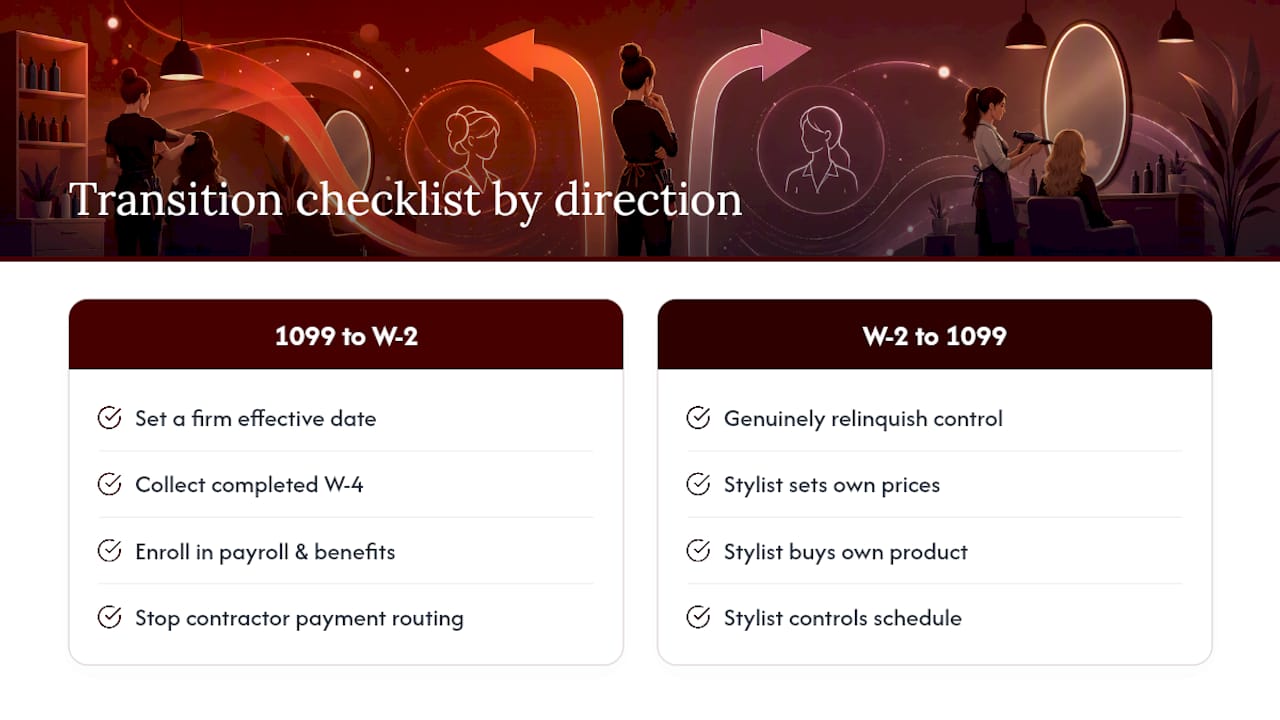
Moving a stylist from one classification to the other isn’t just a payroll software setting. If you’re converting a 1099 stylist to W-2, start by setting a firm effective date, collect a completed W-4, enroll them in your payroll and benefits systems, and stop routing payments through whatever separate contractor process you were using. Communicate the change clearly so the stylist understands their new paycheck structure, including standard withholding, and any benefits eligibility waiting period.
Moving from W-2 to 1099 requires more caution, because this direction draws more scrutiny. You’ll need to genuinely relinquish behavioral and financial control, not just relabel the paycheck. That means the stylist has to actually set their own prices, buy their own product, and control their own schedule going forward. A signed independent contractor or suite lease agreement should spell out the new terms, and you should stop providing the tools and supervision that defined the old employment relationship.
Either direction, document the transition date clearly, notify your payroll provider and workers’ comp carrier, and update your unemployment insurance filings. A mid-year switch without clean records is exactly the kind of gap an auditor looks for, since it raises the question of which rules applied during the transition period itself. Give the change a real effective date, and don’t let old habits, like the owner still setting the schedule after “converting” someone to contractor status, undercut the new classification on paper.
Recordkeeping That Protects Both Sides Of The Chair
Salon recordkeeping needs differ by classification, and mixing up the two is a common paperwork failure. For W-2 employees, retain timesheets, payroll registers, W-4 forms, and any documentation of scheduling decisions and supervision. These records should show a consistent pattern: the same rules applied to every employee, every pay period.
For 1099 contractors, keep the signed lease or contractor agreement, the current W-9, proof of the stylist’s own business insurance, and records showing separate payment processing. If a booth renter uses your booking software but pays you rent independently of client revenue, document that separation clearly, because commingled payment records are one of the fastest ways a contractor relationship starts looking like an employment one on paper.
Retain everything for at least three to four years, longer if your state has an extended statute of limitations for wage claims. Digital records beat paper here, mostly because auditors want timestamps, and a spreadsheet updated after the fact doesn’t carry the same weight as a system that logged the transaction when it happened. This is also where a lot of owners get burned: they have the right agreement on file but no evidence the daily practice matched it, and auditors weigh actual conduct over paperwork every time.
Why Owners Keep Getting This Wrong
Most misclassification isn’t malicious. It’s owners copying a contract template from another salon, or assuming “everyone in the industry does it this way” is a legal defense. It isn’t, and the cost of finding that out during an audit is always higher than fixing it now.
My three priorities for any owner: document the real operational facts today, align your payment and scheduling systems with whichever classification you actually run, and budget for the employer costs a W-2 relationship demands before you commit to it. Run the checklist above, then get a professional to confirm your read.
Staying Compliant Without Drowning In Spreadsheets
Getting classification right on paper is one thing. Keeping the daily proof, the payment records, the scheduling logs, the pricing history, organized enough to hold up if anyone ever asks is a different job entirely, and it’s the one most salon owners fall behind on.

That’s the gap LumariPRO was built to close for suite renters and independent beauty professionals. Instead of assembling records after the fact from memory and scattered receipts, the platform connects directly to your POS system and QuickBooks so pricing, product costs, and payment flows are tracked automatically as they happen, exactly the kind of timestamped documentation that supports a contractor classification or protects a properly run payroll setup. You also get business playbooks and coaching built around the realities of booth and suite economics, not generic small-business advice borrowed from another industry.
If you’re a suite renter trying to prove your pricing and scheduling autonomy on paper, or an owner who wants defensible records without hiring a bookkeeper, take a look at the platform’s features and see what fits your setup.
Sources
- Employment relationship under the Fair Labor Standards Act | U.S. Department of Labor
- ABC test | Legal Information Institute, Cornell Law School
This article is general information, not a substitute for advice from a qualified lawyer. Consult a qualified legal professional about your own circumstances before acting on anything here.
Recommended