Booth rental beats commission once your service revenue clears roughly five thousand dollars per month, and it typically becomes the stronger long-term model above $50,000–$60,000 in annual service revenue. Below that threshold, commission usually nets more after you account for self-employment tax (15.3% on net earnings), booth rent, and the hidden costs most new renters underestimate by $225–$760 per month.
The verdict depends on three numbers: your booth rent, your current commission split, and the size of your client book.
- Rent level: $400–$600/month in smaller markets, $800–$1,600 in mid-range metros, $1,500–$2,500 in top urban areas
- Commission rate: most salon splits run 40–60% to the stylist; a 60% split at high volume is hard to beat
- Client book size: consistent weekly gross of at least 4–5x your weekly rent is the minimum readiness signal
Pro Tip: *Before you sign anything, run three months of your actual weekly gross through the booth rent calculator at Lutily.
Key Takeaways
Booth rental becomes more profitable than commission once your monthly service revenue consistently clears $5,000–$5,500, but only after accounting for self-employment tax, hidden costs, and the full fixed cost stack.
| Point | Details |
|---|---|
| Breakeven threshold | Booth rental typically wins above $5,000–$5,500/month in service revenue; commission wins below it. |
| Self-employment tax | Booth renters pay 15.3% SE tax on net earnings, covering both FICA halves the employer paid before. |
| Hidden cost gap | Booth renters commonly underestimate monthly costs by $225–$760 beyond the rent line. |
| Readiness rule | Your weekly gross should clear 4–5x your weekly rent for 90+ consecutive days before signing. |
| Lumaripro | Lumaripro’s financial dashboards and POS/QuickBooks integrations help booth renters track runway and run breakeven math in real time. |
Table of Contents
- What does booth rental actually mean vs. commission?
- What does a booth renter’s full cost breakdown look like?
- How do taxes and worker classification change your take-home?
- Breakeven scenarios: the math at five revenue levels
- What hidden costs catch new booth renters off guard?
- Are you ready? Decision checklist and contract red flags
- What do day-to-day tools and vendor fees actually cost?
- Pros and cons of booth rental vs. commission at a glance
- What’s your 30–90 day action plan if you go for it?
- How do local regulations and licensing affect your bottom line?
- How do you build clients and what does marketing actually cost?
- Income variability: how stable is booth rental vs. commission?
- An honest take on when booth rental is the right call
- Lumaripro makes the financial side of booth rental less painful
- Sources
What does booth rental actually mean vs. commission?
Three models dominate the U.S. beauty industry, and they split costs, control, and tax treatment in fundamentally different ways.
Booth rental: You pay the salon owner a flat weekly or monthly fee to use a station or suite. You keep all service revenue, set your own prices, choose your own products, and book your own clients. The IRS classifies you as an independent contractor (1099), which means no employer pays half your FICA taxes.
Commission: The salon employs you (W-2 or sometimes a misclassified 1099), handles the overhead, and pays you a percentage of the services you perform. The salon covers rent, utilities, booking software, and often backbar supplies. You trade revenue capture for stability and lower administrative burden.
Salon ownership: You carry all capital costs, all payroll, all lease obligations, and all regulatory compliance. The upside is full margin capture across every chair. The risk is proportionally larger.
The IRS classification point is not a technicality. If a salon owner controls your prices, hours, or which products you must use, the IRS may reclassify you as an employee regardless of what the contract says. That reclassification triggers back payroll taxes, penalties, and interest for both parties.
What does a booth renter’s full cost breakdown look like?
Most stylists focus on the rent line and stop there. The real budget has four layers.
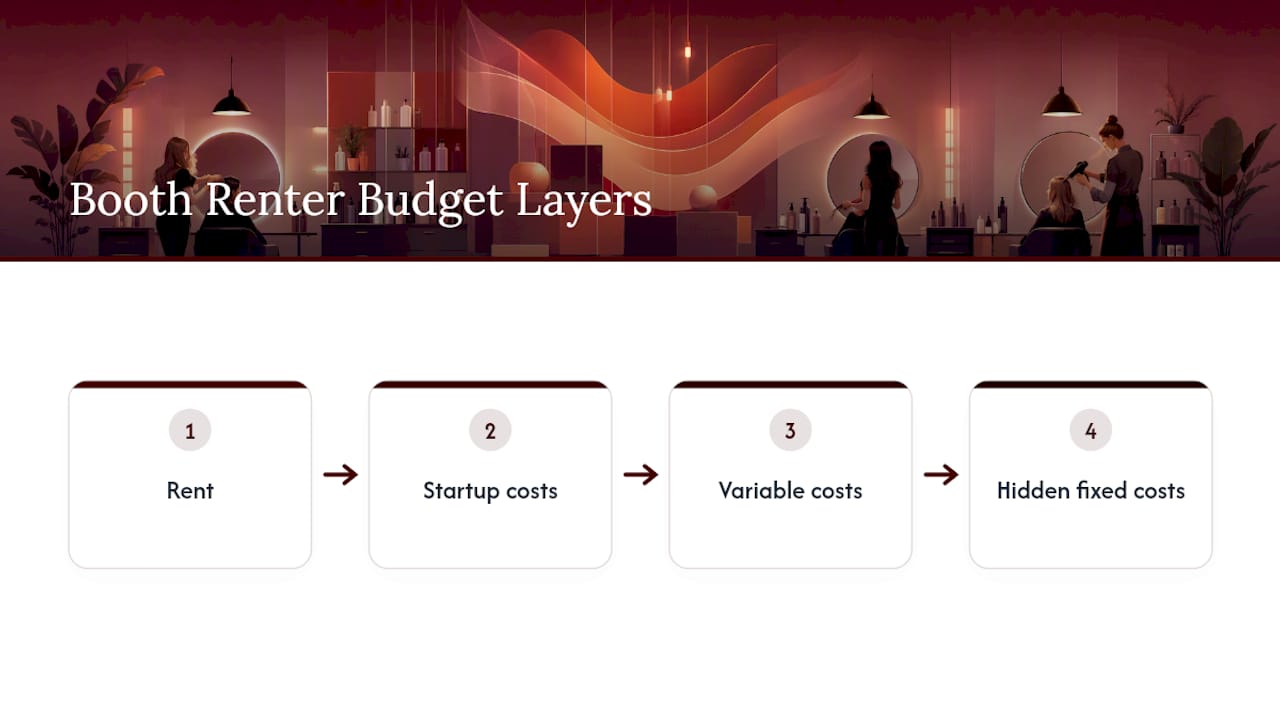
Startup costs
Licensing fees vary by state but typically run $50–$200 for a cosmetology license renewal or new-market transfer. Initial backbar inventory (color, developer, treatments) runs $500–$1,500 depending on your service menu. Basic equipment (styling chair, dryer, shampoo bowl if not provided) can add $1,000–$3,000 if you’re equipping a suite from scratch. Business registration (LLC or DBA) costs $50–$500 depending on your state.
Fixed monthly costs
These don’t move with your revenue, which is exactly what makes them dangerous in a slow month.
- Booth rent: $400–$2,500 depending on market
- Liability and professional insurance: $25–$75/month
- Booking software: $20–$50/month (more on specific platforms below)
- Business phone line or website hosting: $15–$50/month
- Storage or laundry service (if not included): $20–$60/month
Variable costs tied to revenue
Retail inventory (if you sell products) ties up cash and carries shrinkage risk.
Benefits you now pay yourself
No employer contributes to your health insurance or retirement. Individual health coverage through the ACA marketplace averages $400–$600/month for a solo adult depending on age and state. Hidden monthly costs for booth renters commonly run $225–$760 above the rent line alone, which is why “keeping 100% of revenue” rarely means what new renters think it means.
Pro Tip: Keep two months of total fixed costs in a separate savings account before you sign a lease. And use the 30–40% of gross rule as a sanity check: if your booth rent exceeds 40% of your average monthly gross, the math is working against you.
How do taxes and worker classification change your take-home?
The single biggest financial shock for new booth renters is self-employment tax. As a 1099 contractor, you pay both halves: 15.3% on net self-employment earnings, up to the Social Security wage base.
On $60,000 in net self-employment income, that’s roughly $9,180 in SE tax before federal and state income taxes. You can deduct half of self-employment tax from gross income, which softens the impact slightly, but net income is still meaningfully lower compared to a W-2 employee with the same gross revenue.
Quarterly estimated taxes are due in April, June, September, and January. Missing them triggers an underpayment penalty from the IRS.
Statistic callout: The self-employment tax rate is 15.3% on net earnings, covering both the employer and employee portions of Social Security and Medicare. A booth renter earning $70,000 in net income owes approximately $10,710 in SE tax alone, before any federal or state income tax.
What the IRS looks for in worker classification
The IRS uses a behavioral, financial, and type-of-relationship test when assessing whether a “booth renter” is actually a misclassified employee. Red flags include:
- The salon sets your hours or requires minimum hours on the floor
- The salon dictates which products or brands you must use
- The salon controls your client booking or pricing
- You cannot work at other locations or for other clients
- The salon provides all tools and equipment with no rental arrangement
Reviewing IRS Publication 4902 (Tips for Hairdressers and Cosmetologists) is worth your time before signing any rental agreement. It spells out exactly which behaviors preserve independent-contractor status in the beauty industry.
Contract clauses to request or avoid
Request: Fixed rent with no percentage-of-revenue component, written confirmation you set your own prices, explicit right to work other locations, lockable storage, and a clear termination clause with notice period.
Avoid: Mandatory retail purchase minimums, required attendance at salon events, language giving the owner approval rights over your service menu, and any clause requiring you to use only the salon’s booking system under the salon’s account.
Breakeven scenarios: the math at five revenue levels
income tax only for commission employee).
The crossover in this mid-market scenario sits near $60,000–$70,000 in annual service revenue, consistent with the industry estimate of $50,000–$60,000 at lower rent levels. At $800/month rent, the crossover shifts slightly higher. At $400/month rent, it moves closer to $50,000.
Three variables move the crossover most:
- Rent level: Every $200/month increase in rent raises the breakeven by roughly $4,000–$5,000 in annual revenue.
- Commission split: A 60% commission split is much harder to beat than a 40% split. Run your actual split, not the industry average.
- Retail attach rate: Booth renters who sell retail at a 50% markup on wholesale can add meaningful net income that commission employees rarely capture fully.
The practical monthly breakeven for most stylists lands around $5,000–$5,500 in service revenue. Below that, commission wins. Above it, booth rental increasingly pulls ahead.
Pro Tip: Build a simple spreadsheet with your actual rent, your actual commission rate, and your last 90 days of weekly gross. The answer will be more honest than any generic calculator.
What hidden costs catch new booth renters off guard?
Here’s what the number ignores.
- No-shows and cancellations: On commission, a no-show costs you time. On booth rental, it costs you time plus a proportional share of your daily rent. A $150 no-show on a $30/day rent day is a net loss.
- Vacation and sick days: You pay rent whether you work or not. Two weeks off costs $400–$1,200 in rent with zero revenue to offset it.
- Marketing time and spend: The salon’s walk-in traffic and social media presence don’t follow you. Budget $100–$300/month for content, ads, or photography, plus 3–5 hours per week of unpaid marketing time.
- Equipment replacement: Clippers, shears, dryers, and color bowls wear out. Budget $500–$1,000/year for equipment maintenance and replacement.
- Retail shrinkage: Product that walks out the door or expires on the shelf is a direct cost.
- Travel and laundry: If your suite doesn’t include towel service, laundry adds $30–$80/month.
Operational risks worth naming
Salon closures happen. If your landlord closes or sells the salon, your client book is portable but your setup costs are sunk. Landlord policy changes (new required products, new booking systems, new hours) can also erode the independence you paid for. And if the salon owner starts controlling your schedule or pricing, you’re accumulating reclassification risk without realizing it.
Risk mitigation checklist:
- Get your lease terms in writing with a defined notice period (30–60 days minimum)
- Carry your own liability insurance regardless of what the salon holds
- Keep your client list in your own booking system, not the salon’s
- Maintain a two-month operating reserve at all times
- Review your contract annually for any new control language
Are you ready? Decision checklist and contract red flags
Readiness checklist
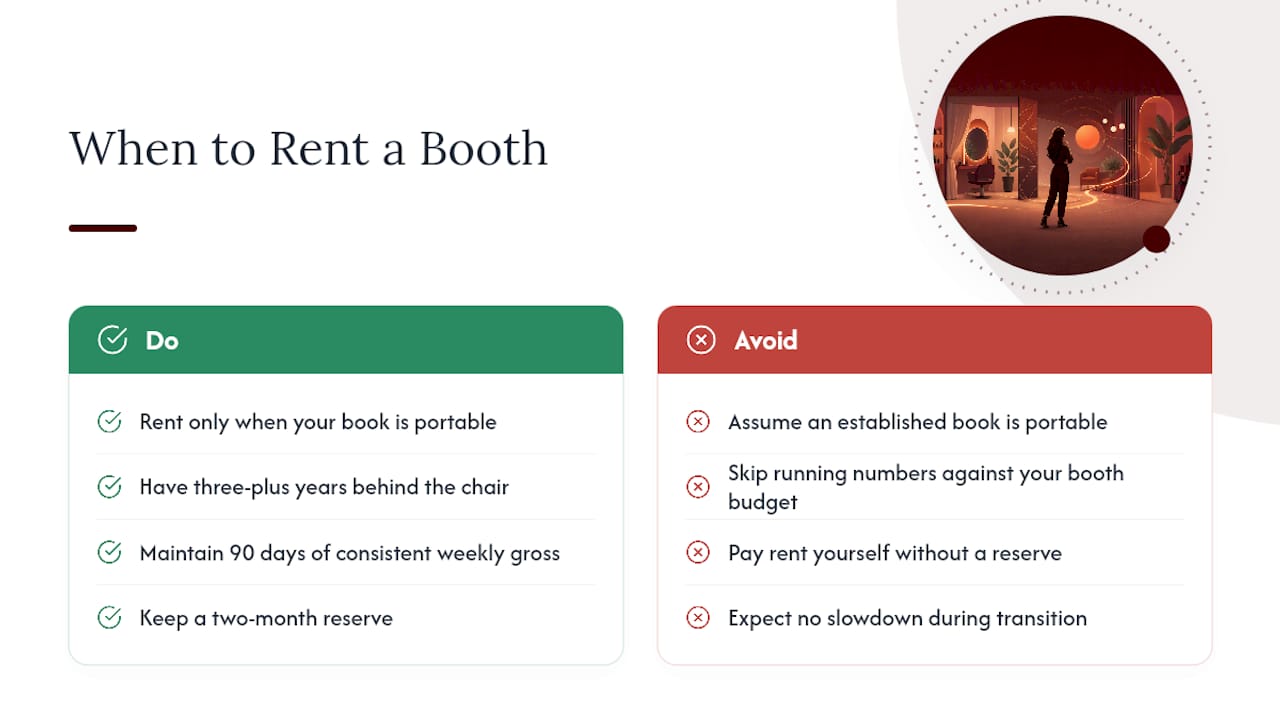
- Your weekly gross has averaged at least 4–5x your weekly booth rent for 90+ consecutive days
- You have two months of total fixed costs saved and liquid
- You’ve priced your services to cover rent, supplies, taxes, and benefits at your current volume
- You have a client communication plan ready (text, email, social) for the transition
- You’ve read your state’s cosmetology board rules on booth rental licensing
Negotiation talking points
- Ask for a one-week trial period before committing to a long-term lease
- Request utilities included in the rent or a clear cap on utility charges
- Negotiate a reduced rate for slow-season months (often January and February)
- Confirm signage rights and whether you can display your own branding
- Ask for lockable storage for your supplies and retail inventory
Red flags to walk away from
- Ambiguous language about who controls your schedule or pricing
- Mandatory retail purchase minimums tied to staying in the space
- Required attendance at salon meetings or events
- A booking system requirement that puts your client data under the salon’s account
- No written termination clause or an unreasonably long notice requirement
What do day-to-day tools and vendor fees actually cost?
Running a booth independently means sourcing every operational service yourself. Here’s what the main categories actually cost.
Booking and scheduling platforms
Four platforms dominate the independent beauty market in the U.S.:
GlossGenius charges a flat monthly fee (typically around $24–$48/month depending on plan) and includes built-in payment processing, a client app, and marketing tools. Its flat-fee model is predictable, which matters when you’re budgeting fixed costs tightly.
Vagaro runs $30/month for a solo professional and adds features (online store, memberships, payroll) at higher tiers. Its marketplace listing can drive new client discovery, which is useful for renters building a book in a new location.
If you already use Square for payments, the integration is seamless and the cost is low at entry level.
Booksy focuses on marketplace discovery and charges around $29.99/month for solo professionals. Its consumer-facing app has strong penetration in urban markets, which can accelerate new client acquisition.
Payment processing
On $6,000/month in service revenue, that’s $156–$210/month in processing costs alone. Factor it in before comparing net take-home.
Insurance
Professional liability (malpractice) and general liability insurance for a solo beauty professional typically runs $25–$75/month. Many salon landlords require proof of coverage before you move in. Skipping it is not a real option.
Must-have integrations
Connecting your POS to QuickBooks (or a comparable accounting tool) eliminates manual data entry and makes quarterly tax prep far less painful. Appointment reminder automations reduce no-shows by a meaningful margin. The Lumaripro platform connects to POS systems and QuickBooks directly, replacing the patchwork of disconnected tools most independent pros cobble together.
Pros and cons of booth rental vs. commission at a glance
Booth rental pros:
- You keep all service revenue above your fixed costs
- Full control over pricing, hours, products, and client relationships
- Your client book is portable; you’re building an asset, not just a job
- Retail margin is yours entirely
Booth rental cons:
- Self-employment tax (15.3%) reduces net income significantly
- No employer-paid health insurance, PTO, or retirement contributions
- Rent is due whether you work or not
- Admin burden: taxes, bookkeeping, marketing, insurance, all on you
Commission is typically the better model early in a career when your book is thin, your weekly gross is inconsistent, or you have low tolerance for financial variability.
What’s your 30–90 day action plan if you go for it?
Days 1–30: financial and legal prep
- Open a dedicated business checking account and a separate tax savings account
- Register your business (LLC or DBA) with your state
- Get professional liability insurance in place
- Pull 90 days of weekly gross data and confirm the 4–5x rent threshold
- Set a weekly revenue target that covers rent, supplies, taxes, and benefits with margin to spare
Days 31–60: operational setup
- Choose and set up your booking platform (GlossGenius, Vagaro, Square, or Booksy)
- Migrate your client list to your own system
- Draft and send a client communication announcing your move (text and email)
- Connect your POS to QuickBooks or a comparable accounting tool
- Negotiate and sign your lease with the clauses above confirmed in writing
Days 61–90: launch and track
- Set your service menu and pricing in your booking system
- Run your first month’s numbers against your pre-launch projections
- Pay your first quarterly estimated tax installment on schedule
- Review your weekly gross vs. rent ratio every Friday
- Use Lumaripro’s financial dashboards to track runway, KPIs, and cash flow in real time rather than guessing at month-end
A two-month operating reserve is your safety net. Don’t sign the lease until it’s funded.
How do local regulations and licensing affect your bottom line?
State cosmetology boards set the rules, and they vary more than most stylists expect. Some states require a separate booth rental license or a facility permit in addition to your cosmetology license. Others require the salon owner to hold a specific establishment license that covers all renters in the space. If your landlord’s establishment license lapses, you may be legally prohibited from working until it’s reinstated, regardless of your own license status.
Zoning matters too. Suite-based rentals in mixed-use buildings sometimes face restrictions on signage, client traffic, or operating hours that don’t apply to traditional salons. Before signing, verify that the space is properly zoned and licensed for the services you plan to offer.
Health and sanitation inspections apply to booth renters as well as salon owners. In most states, you’re responsible for maintaining your station to board standards independently of what the rest of the salon does. A failed inspection can result in a temporary closure that costs you rent with zero revenue.
Licensing renewal fees and continuing education requirements are ongoing costs. Budget $100–$300/year for license renewal and CE credits depending on your state.
How do you build clients and what does marketing actually cost?
The salon’s walk-in traffic, its Google listing, and its Instagram following belong to the salon. When you move to a booth, you start your marketing from your own baseline, which is either an asset (if you’ve been building your personal brand) or a liability (if you haven’t).
Realistic monthly marketing costs for an independent booth renter:
- Content creation: $0 if you shoot your own work on a phone, $100–$300 if you hire a photographer quarterly
- Paid social ads: $50–$200/month on Instagram or Facebook targeting local clients
- Email/SMS marketing: $10–$30/month through your booking platform’s built-in tools
- Google Business Profile: Free, but requires 30–60 minutes/week of active management (responding to reviews, posting updates, uploading photos)
The highest-ROI marketing move for a new booth renter is a direct referral campaign to your existing clients. A personal text to your top 30 clients announcing your move, with a booking link and a small incentive (a complimentary gloss treatment, a retail sample), typically converts at a higher rate than any paid ad.
Client retention is the real marketing metric.
Income variability: how stable is booth rental vs. commission?
Commission income is more stable on a week-to-week basis. The salon manages scheduling, fills gaps with walk-ins, and absorbs slow periods through its broader client base. Your paycheck varies, but the floor is higher when the salon is busy.
Booth rental income is directly tied to your personal production. A slow week, a sick day, a no-show streak, or a seasonal dip hits your gross immediately and fully. There’s no averaging across other stylists’ revenue.
The practical implication: booth renters need a larger financial buffer and more disciplined cash flow management than commission employees at the same gross income level. A commission stylist earning $50,000/year can often manage on a month-to-month budget. A booth renter at the same gross needs a two-month reserve, quarterly tax discipline, and a clear view of weekly revenue trends to avoid a cash crunch.
That variability also works in your favor at the top end. The upside is real. So is the downside.
An honest take on when booth rental is the right call
The conventional wisdom says booth rental is for experienced stylists with established books. That’s mostly right, but it misses a more precise version of the truth.
Booth rental is the right call when your book is portable, not just established. A stylist with 150 loyal clients who follow them anywhere is in a fundamentally different position than one with 150 clients who found them through the salon’s walk-in traffic. The second stylist has a job. The first has a business.
The math also changes based on what you’re giving up. Most stylists don’t know their actual split’s dollar value because they’ve never run the numbers against a realistic booth budget.
That variability is manageable when someone else is paying the rent. It’s stressful and financially dangerous when you’re paying it yourself.
Where booth rental wins clearly: you’ve been behind the chair for three-plus years, your clients text you (not the salon) to book, your weekly gross has been consistent for at least 90 days, and you have a two-month reserve ready. At that point, every month you stay on commission is money you’re leaving on the table.
The transition itself is the hardest part. Not the paperwork, not the taxes. The psychological shift from employee to owner. Budget for a slower first month than you expect, communicate with your clients earlier than feels necessary, and track your numbers weekly from day one.
Lumaripro makes the financial side of booth rental less painful
Running a booth independently means wearing every hat: stylist, bookkeeper, marketer, and tax planner. Most independent pros cobble together three or four disconnected tools and still end up guessing at their cash flow.

Lumaripro is built specifically for suite and booth renters who want real financial clarity without a business degree. The platform connects to your POS and QuickBooks, so your revenue, expenses, and tax estimates update in real time rather than at month-end when it’s too late to adjust. The AI coaching feature is trained on booth and suite economics specifically, meaning it understands your cost structure, not a generic small business template. Business playbooks map directly to the 30–90 day action plan above: pricing strategy, runway modeling, client retention, and KPI tracking, all in one place.
For pros who want to run the breakeven math before signing a lease, or track weekly gross vs. rent ratio after they’ve moved, Lumaripro replaces the spreadsheet guesswork with a live dashboard. See the Lumaripro pricing plans and explore whether the platform fits your stage of independence.
Sources
- Booth Rental vs Commission Salon: Which Pays a New Cosmetologist Better? | Trade Schools Directory
- Booth Rental vs Commission Calculator (2026): Honest Math
- Booth Rent vs Commission Calculator — Compare Your Take-Home Pay | Lutily
Recommended