If you rent a booth or suite, the IRS considers you self-employed, not an employee of the salon. That means you owe self-employment tax and federal income tax on your net earnings, you file everything through Schedule C, and booth rent is deductible when you document it properly. The single biggest move you can make right now: open a separate savings account and start setting aside a substantial portion of every dollar you collect, because quarterly estimated payments come faster than most stylists expect.
TL;DR:
- Self-employed booth renters must pay self-employment tax on about 92% of their net earnings, approximately 15.3%, plus federal and state income taxes.
- Proper documentation, like invoices and separate ledger accounts, is essential to safeguard deductions and avoid IRS scrutiny, especially on booth rent and supplies.
- Quarterly estimated tax payments should cover both self-employment and income taxes, with about 25-30% of income set aside, and automated transfers help prevent underpayment penalties.
- State and local rules vary, requiring booth renters to verify retail sales tax permits, licensing, and specific tax treatments in their jurisdiction; national advice may not apply locally.
- Maintaining accurate records, separate income streams, and a written agreement boosts independence proof and reduces audit risks, while platforms like LumariPRO assist with real-time bookkeeping.
Table of Contents
- Booth Rental Taxes: What You Owe and Where It Goes
- Booth Rental Tax Deductions: Mapping Expenses to Schedule C
- Quarterly Estimated Taxes: Deadlines and How Much to Set Aside
- 1099s and Booth Rental Income: Who Reports What
- Recordkeeping and Written Agreements That Hold Up to Scrutiny
- QBI, S-Corps, and Tax Planning as Your Income Grows
- State and Local Rules Booth Renters Often Miss
- Where Booth Renters Go Wrong Most Often
- Let LumariPRO Handle the Bookkeeping Side of Booth Rental
- Where to Verify These Rules Yourself
- Sources
- FAQ
Booth Rental Taxes: What You Owe and Where It Goes
Booth renters pay two separate taxes on the same income, and understanding the split matters because it changes how much you actually take home. The first is self-employment tax, which covers Social Security and Medicare since you have no employer withholding either for you. The second is ordinary federal income tax, calculated on top of that, plus state income tax in most states.
Self-employment tax runs 15.3% total: 12.4% for Social Security and 2.9% for Medicare. Here’s the part almost every new booth renter misses: you don’t pay that rate on your full net profit. You apply it to most of your net earnings, a built-in adjustment the IRS uses to roughly account for the fact that a traditional employee’s half of these taxes would never have been taxed as income in the first place.
The Social Security portion only applies up to a wage base set by the IRS annually; earnings above that amount do not incur additional Social Security tax. The Medicare tax applies to all earnings, with an additional surtax applicable above defined thresholds for single and joint filers.
Quick math: A stylist who nets $60,000 after expenses pays self-employment tax on $55,410 (92.35% of $60,000), which comes to roughly $8,478 in SE tax alone, before a dime of income tax is calculated.
The forms are consistent no matter your income level. You report gross income and deduct business expenses on Schedule C, which produces your net profit figure. That net profit flows to Schedule SE, where the self-employment tax gets calculated, and both numbers land on your Form 1040. One relief valve: you get to deduct half of your self-employment tax as an adjustment to income, which softens the blow on your income tax calculation even though it does nothing for the SE tax itself.
Here’s a simplified example. Say you gross $70,000 in service revenue and retail sales for the year, and your deductible expenses (booth rent, supplies, insurance, mileage) total $18,000. Your net profit is $52,000. Self-employment tax applies to $48,022 of that, landing around $7,347. Half of that, roughly $3,674, becomes a deduction against your income tax. Then ordinary federal and state income tax apply to what’s left after that adjustment and your standard or itemized deduction.

Booth Rental Tax Deductions: Mapping Expenses to Schedule C
Every dollar you spend running your chair has a home on Schedule C, and putting it in the wrong spot either costs you a deduction or draws unwanted attention if you’re ever audited. Here’s how the common booth renter expenses actually map.
- Booth rent goes on Line 20b (rent for business property). The IRS is explicit that rent paid for property you don’t own is generally deductible in the year you pay it, but you need a paper trail: invoices, canceled checks, or bank statements showing the payment and the period it covers.
- Backbar supplies (color, developer, shampoo you use on clients) go on Line 22, Supplies. These are consumed in the course of delivering a service, not sold to a client to take home.
- Retail inventory you sell to clients does not belong on Line 22. It flows through Cost of Goods Sold on Line 42, which requires you to track beginning inventory, purchases, and ending inventory separately from your consumable supplies.
- Tools and equipment (a new styling chair, a dryer, a laser device) can often be expensed immediately under Section 179 rather than depreciated over several years, which matters if you want the deduction this tax year instead of spread across five.
- Other deductible categories include liability insurance, continuing education and certification renewals, software subscriptions, marketing and website costs, a business-use portion of your phone and internet, laundry for salon linens, and mileage for supply runs or off-site appointments, guided by the mileage and travel rules in IRS Publication 463.
Pro Tip: Tag every purchase the moment you make it. Standing at the beauty supply counter, ask yourself “will this touch a client’s head and stay consumed, or leave the salon in their hands?” That two-second habit is the difference between a clean Schedule C and a messy reconstruction project every April.
The most expensive mistake here isn’t missing a deduction. It’s blending backbar and retail into one lump “supplies” number. When you do that, your gross profit margin on retail sales becomes impossible to verify, and that inconsistency is exactly the kind of red flag that invites deeper scrutiny. Tagging items as backbar or retail at the point of purchase, before they ever hit a spreadsheet, keeps your Cost of Goods Sold clean and your Line 22 supplies figure defensible on its own terms.
A second common error: writing off 100% of a personal cell phone as a business expense because “I text clients on it.” The IRS expects a reasonable allocation between business and personal use, and claiming the full cost when you also use the phone for everything else in your life is the kind of unreasonable-expense pattern examiners are trained to spot.
Quarterly Estimated Taxes: Deadlines and How Much to Set Aside
The IRS expects self-employed booth renters to pay tax as they earn it, not in one lump sum the following April. Miss that, and you owe an underpayment penalty on top of the tax itself.
- Know the four due dates. Estimated payments for the year are generally due in mid-April, mid-June, mid-September, and mid-January of the following year, using Form 1040-ES vouchers or electronic payment through EFTPS or IRS Direct Pay.
- Calculate both taxes together. Your quarterly estimate needs to cover self-employment tax and income tax combined, not just one or the other. A lot of renters underpay because they only budget for income tax and forget the 15.3% self-employment layer sitting underneath it.
- Use the 25% to 30% rule as a starting point. Setting aside roughly a quarter to nearly a third of every dollar you collect, before you spend any of it on rent or product, covers most booth renters in low to moderate tax brackets. Higher earners in high-tax states may need to push closer to 35%.
- Lean on safe harbor to avoid penalties. Pay at least 90% of your current year’s tax liability, or 100% of last year’s total tax (110% if your prior-year adjusted gross income topped $150,000), spread evenly across the four due dates, and the IRS generally won’t assess an underpayment penalty even if you owe more at filing time.
- Automate the habit. Open a dedicated tax savings account, set an automatic transfer for every deposit or payout you receive, and review the balance against your running income every quarter before you file.
1099s and Booth Rental Income: Who Reports What
Booth rental creates a two-way reporting relationship that surprises a lot of renters the first year they’re in business. You may owe someone a 1099. The salon may owe one to you, or may owe nothing at all, depending on how the money moves.
- If you pay $600 or more in rent during the year to a landlord who isn’t a corporation, you’re generally required to issue that landlord Form 1099-MISC with the amount in Box 1.
- A salon owner typically only issues Form 1099-NEC to non-employee service providers the salon itself pays directly, such as a contract cleaner or a bookkeeper, not for client revenue that passes through the salon to a booth renter.
- Failing to collect a landlord’s W-9 before paying rent, or never reconciling what you paid against what the salon reports receiving, creates a documentation gap that can raise reclassification questions in an audit.
- Build a simple habit: request a W-9 before your first rent payment, issue any required 1099 by the January deadline, and keep a copy of every rent invoice alongside your payment records.
Recordkeeping and Written Agreements That Hold Up to Scrutiny
A written booth rental agreement is the single strongest document you can produce if the IRS or a state agency ever questions whether you’re truly independent or should have been classified as an employee. Experts who work with independent contractors consistently point to the absence of a signed lease as the fastest way to make that classification fragile. The agreement should spell out the flat rent amount, the payment schedule, what’s included (chair, sink access, product storage), and confirm that you control your own hours, pricing, and client relationships.
Beyond the lease itself, your bookkeeping needs structure. A workable chart of accounts separates Income:Services from Income:Booth Rent and from any retail sales, so your profit picture for each revenue stream stands on its own. Capture receipts as you go rather than reconstructing a shoebox of paper in March, and tag every purchase as backbar or retail the moment it happens.
- Monthly invoices or rent receipts that match your bank records line by line.
- A separate ledger for retail Cost of Goods Sold, distinct from consumable supplies.
- Mileage logs for supply runs, updated weekly rather than guessed at year end.
- A single folder (digital or physical) with everything your CPA needs at tax time: profit and loss, mileage log, 1099s issued and received, and receipts for any equipment purchase over a few hundred dollars.
Pro Tip: Reconcile your books monthly, not annually. Twelve small ten-minute check-ins catch a miscategorized expense while you still remember what it was for. One annual scramble almost never does.
QBI, S-Corps, and Tax Planning as Your Income Grows
Once your booth rental business is consistently profitable, two planning questions start to matter: whether you qualify for the Qualified Business Income deduction, and whether an S-corp election could lower your tax bill.
The Section 199A QBI deduction lets many self-employed people deduct up to 20% of their qualified business income. Booth renters typically fall into personal service categories that the IRS treats as a Specified Service Trade or Business, and SSTB status means the deduction phases out entirely once taxable income crosses the top of the applicable range. Staying under that threshold, or planning deductions to manage where you land relative to it, is worth real attention as your income climbs.
S-corp election is the other lever some higher-earning booth renters consider. The idea: pay yourself a reasonable salary subject to payroll tax, and take remaining profit as a distribution not subject to self-employment tax. It can genuinely reduce your SE tax bill, but it also adds payroll administration, a reasonable-compensation requirement the IRS enforces closely, and separate corporate filings. It rarely makes sense below a certain profit level, and it should never be a decision made without a CPA reviewing your specific numbers first. Real-time bookkeeping and income forecasting are what make that conversation productive instead of a guess.
State and Local Rules Booth Renters Often Miss
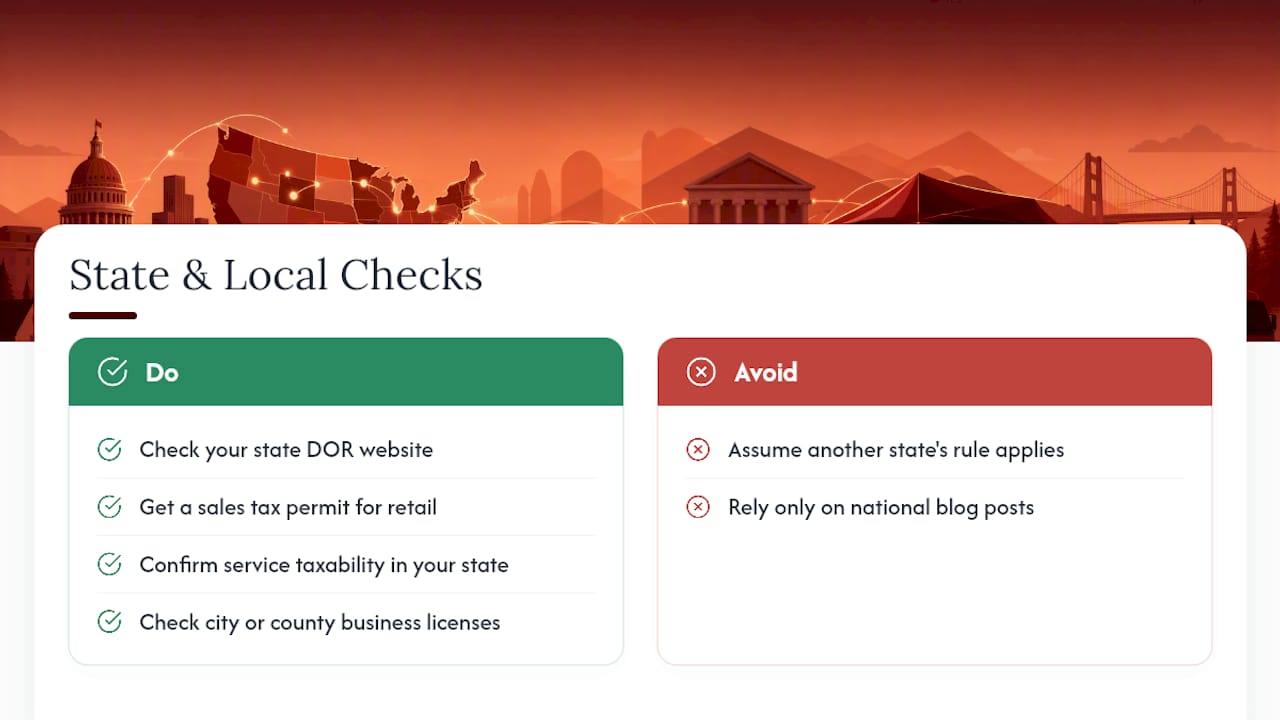
Federal rules are consistent nationwide, but state and local treatment of booth rental varies enough that a rule you read online for one state may not apply in yours. If you sell retail product, most states require a sales tax permit, while the taxability of the service itself (a haircut, a manicure) differs from state to state.
Some states also tax booth rental income differently at the business level. Washington, for example, treats chair and booth rental under its Business and Occupation tax classification, with its own guidance for beauty and wellness services. That is a state-specific rule, not a national one, and it’s exactly why your own state Department of Revenue website, not a national blog post, should be your first stop for retail sales tax permits, service taxability, and any city or county business license you might need on top of it.
Where Booth Renters Go Wrong Most Often
The mistakes I see repeated most in this business aren’t complicated tax questions. They’re basic habits skipped in year one that compound for years afterward. No written agreement. Backbar and retail lumped into one number. Rent paid in cash with no invoice trail. A landlord never asked for a W-9. Every one of these is fixable in an afternoon, and every one of them is what an examiner looks for first.
The renters who stay out of trouble share the same three habits: they reconcile their books monthly, they keep a dedicated tax savings account that gets funded automatically, and they separate their income streams from day one instead of sorting it out later. Dashboards and Schedule C tagging templates can help implement that workflow, for the days you’d rather be behind the chair than behind a spreadsheet.
— Oliver
Let LumariPRO Handle the Bookkeeping Side of Booth Rental
Some platforms connect directly to your POS system and QuickBooks, then tag your income and expenses against Schedule C categories in real time, so you can see your estimated tax set-aside before the quarter ends instead of guessing after it’s over.

This type of platform may pair dashboards with business playbooks and coaching tailored for suite-based professionals, rather than generic small-business advice borrowed from a different industry. If you’re deciding whether you’re managing your booth rental finances well or flying blind, model what better bookkeeping does to your take-home pay with the ROI calculator, or get a full picture of the platform on the LumariPRO platform overview page. Ready for a more structured setup before your next quarterly deadline hits? Book a complimentary fit assessment and see what a guided bookkeeping routine actually looks like for your chair.
Where to Verify These Rules Yourself
For primary-source confirmation, check the IRS pages on self-employment tax, Schedule C, and rent-expense deductibility, plus your own state Department of Revenue for local rules on sales tax and business licensing. If you’re setting up a booth rental business and need marketing or booking support alongside your tax setup, salon marketing resources cover that side of the business.
This article is general information, not a substitute for advice from a qualified financial advisor. Consult a qualified financial professional about your own circumstances before acting on anything here.
Sources
- Self-Employment Tax (Social Security and Medicare Taxes) | Internal Revenue Service
- Small business rent expenses may be tax deductible | Internal Revenue Service
- Chair and booth rental | Washington Department of Revenue
FAQ
How Do Booth Renters Pay Taxes?
Booth renters pay federal income tax and self-employment tax (15.3% on 92.35% of net earnings) by filing Schedule C and Schedule SE with their Form 1040, plus quarterly estimated payments throughout the year.
What States Don’t Allow Booth Rental?
Booth rental legality and licensing rules vary by state, and some states impose specific salon or cosmetology board restrictions on the arrangement. Check your state’s cosmetology board and Department of Revenue directly, since rules change and no single national list stays accurate.
Do I Need a Business License to Rent a Booth?
Most states and many cities require some form of business registration or license for a booth renter operating as a sole proprietor, on top of your cosmetology license. Requirements vary by city and county, so confirm with your local licensing office.
How Much Tax Do I Pay on Rental Income in the US?
Booth rent you pay to your landlord is a deductible business expense, not taxable rental income to you. Your own net earnings from services and retail sales are what get taxed at the 15.3% self-employment rate plus ordinary income tax.
Can I Deduct the Booth Rent I Pay?
Yes. Booth rent is deductible on Schedule C Line 20b as long as you keep invoices or bank records showing the payment and the rental period it covers.