The two fastest levers to get there are automated multi-touch reminders and requiring deposits or card on file for new clients and high-value services.
TL;DR:
- Automated reminders sent at booking, 48 hours, and 24 hours can reduce no-show rates by up to 40 percent, especially when including personalized details.
- Most salon no-shows are caused by forgetfulness, making timely text reminders significantly more effective than policies alone.
- Implementing waitlists and same-day booking options can recover up to 20 percent of lost revenue caused by last-minute cancellations or no-shows.
Table of Contents
- How to Calculate Your Salon No-Show Rate
- What No-Shows Actually Cost Your Salon
- Why Clients No-Show (and How to Spot the Pattern)
- Proven Tactics to Cut Your Salon’s No-Show Rate
- Your 30/60/90-Day Rollout Plan
- What Actually Moves the Needle on No-Shows
- Put These Tactics on Autopilot With Lumaripro
- Sources
How to Calculate Your Salon No-Show Rate
The formula is simple: divide missed appointments by total booked appointments, then multiply by 100. Run it monthly, and you catch drift before it becomes a habit baked into your schedule.
The tricky part isn’t the math. It’s deciding what counts.
- No-show: the client never contacts you and never arrives. Count it.
- Late cancel: the client cancels inside your notice window (usually under 24 or 48 hours). Most salons track this separately but treat it the same for policy purposes.
- Reschedule: the client cancels with enough notice and rebooks. Don’t count this against your rate. It’s normal business, not a loss.
Lumping reschedules in with true no-shows inflates your number and makes a healthy salon look like it’s bleeding revenue when it isn’t.
Where do you sit against everyone else? Across appointment-based industries generally, the pooled average no-show rate runs around 20 to 23%, with salon-specific benchmarks often landing in the mid-teens to mid-twenties depending on how a shop measures and enforces policy. That range is wide because a salon with no reminders and no deposit requirement behaves nothing like one running a three-touch reminder sequence with a deposit on file.
| No-show rate | What it signals |
|---|---|
| — | Strong systems: automated reminders, deposits, and an enforced policy are working |
| — | Healthy, with room to tighten reminder timing or add deposits for high-risk bookings |
| 10% to 20% | Average, but leaking real revenue every month |
| Above 20% | A structural problem: no policy, no deposits, or reminders that aren’t landing |
Pull these data points from your booking system or POS before you calculate anything: total bookings for the period, cancellations broken out by notice given, no-show count, client type (new versus returning), and service length. Most modern booking platforms tag these automatically, but if yours doesn’t separate late cancels from no-shows, that’s the first fix to make.
What No-Shows Actually Cost Your Salon
The math is uncomfortable on purpose. Multiply your appointment count by your average ticket price by your no-show rate, and you get your monthly loss in plain dollars.
An industry example puts this in perspective: a salon doing $18,000 a month in revenue with a 20% no-show rate loses roughly $3,600 a month, or about $43,200 a year.
But the dollar figure is only part of the damage.
- Idle staff pay: stylists on commission or salary still get paid for the chair time nobody filled.
- Lost retail attachment: no client in the chair means no product recommendation, no add-on sale.
- Reduced daily throughput: a 60-minute gap rarely gets filled same-day, which caps how many total clients you can serve.
- Morale: stylists who build their day around bookings that vanish start to disengage, and turnover in this industry is expensive.
Same percentage, wildly different stakes. That’s why your target no-show rate should scale with your ticket size, not just industry averages.
Why Clients No-Show (and How to Spot the Pattern)
Most no-shows aren’t defiance. They’re forgetfulness, and that single fact should shape almost everything about your prevention strategy.
- Forgetfulness: the most common cause by far, especially for appointments booked weeks out.
- Conflicting plans: something came up, and rebooking felt like more effort than just not showing.
- Cost hesitation: the client got nervous about the bill and avoided the conversation entirely.
- First-time clients: no relationship yet, no social pressure to show, lowest accountability.
- Long or multi-step services: color corrections, extensions, and other multi-hour bookings see higher no-show rates because the time commitment feels bigger to back out of.
Once you know the causes, pattern spotting gets easier. Segment your no-show data by client tenure (new versus returning), service type and duration, day of week and time slot, and booking channel (online self-booking versus a phone call with your front desk). You’ll usually find late-afternoon slots and Monday openings carry the highest risk, and first-time online bookers no-show at a noticeably higher rate than regulars who called in.
Pro Tip: Tag repeat offenders directly in your booking system with a simple flag after two no-shows in a rolling 90-day window. That flag should automatically trigger a deposit requirement on their next booking, no manual decision needed.
Proven Tactics to Cut Your Salon’s No-Show Rate
This is where most of the real work happens, and it comes down to five moving parts: reminders, deposits, policy, recovery tactics, and sequencing.
Build a three-touch reminder sequence
A confirmation-at-booking, 48-hour, and 24-hour reminder sequence is the industry standard, and it’s associated with the biggest single reduction in missed appointments. Reminders work because forgetting is the primary driver of no-shows, not defiance or dissatisfaction.
Timing and channel matter:
- Confirmation (immediately after booking): sent by email, confirms date, time, service, and stylist.
- 48-hour reminder: sent by SMS, includes a one-tap confirm or reschedule link.
- 24-hour reminder: sent by SMS, repeats the essentials, adds a direct message like “Reply YES to confirm or tap here to reschedule.”
- Optional 2-hour reminder: for high-value or first-time bookings only, to catch last-minute forgetting.
Reminders that include the client’s name, service, and stylist name, plus a one-tap action, outperform generic blasts.
Require deposits where the risk is highest
Deposits work best when targeted, not applied blanket-wide. Industry guidance suggests requiring a deposit of 20 to 30% of the service price for:
- First-time clients booking any service.
- Any service over 90 minutes or priced above your average ticket.
- Clients already flagged for a prior no-show.
Exempt long-standing regulars with a clean history. Forcing a deposit on someone who’s been in your chair every six weeks for three years creates friction without solving a problem that doesn’t exist for that client.
Put your cancellation policy where it can’t be missed
Your policy needs to live in three places: the online booking page, the confirmation email, and a printed card at checkout. Sample language that works without sounding punitive:
Recover the slot when a no-show happens anyway
Even with every tactic running, you’ll still lose some slots. Automated waitlists solve most of that leak: when a client cancels or no-shows, the system texts your waitlist in order until someone grabs the opening. Same-day booking windows, opened specifically for last-minute fills, capture walk-in-adjacent demand that would otherwise go to a competitor down the street. Train your front desk on a short outreach script for gaps that don’t fill automatically: “Hey, we just had an opening at 2pm today. Want to grab it?”
Sequence it right
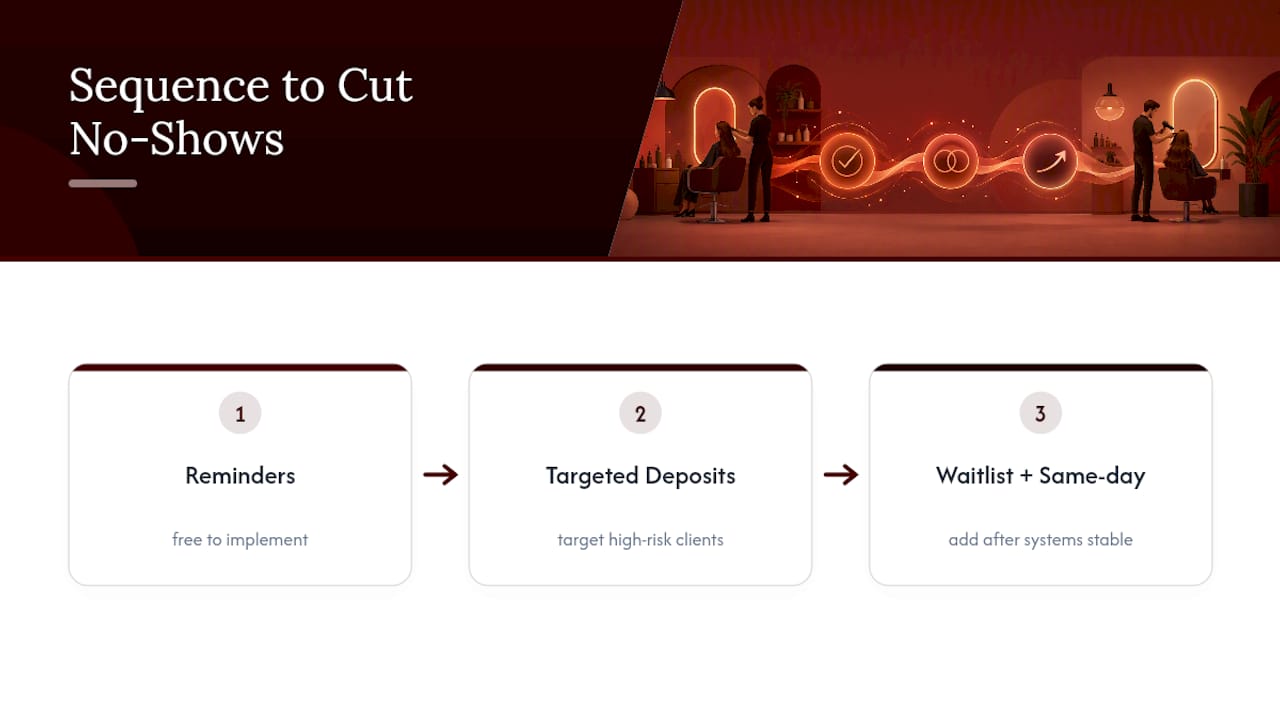
Start with reminders. They’re free to implement in most booking software and carry zero client friction. Add deposits next, targeted only at your highest-risk segments. Layer in the waitlist and same-day booking once your reminder and deposit systems are stable. Combining all three produces a far bigger drop than any single tactic run alone.
Your 30/60/90-Day Rollout Plan
Trying to fix everything in week one is how salons abandon good policy halfway through. Stagger it.
- Days 1 to 30: Calculate your baseline no-show rate using the formula above. Turn on automated confirmation, 48-hour, and 24-hour reminders in your booking system.
- Days 31 to 60: Roll out a deposit policy for new clients and high-value or long-duration services. Publish your cancellation policy on your booking page and in every confirmation email.
- Days 61 to 90: Enable waitlist automation and open same-day booking windows. Start flagging repeat no-show clients for mandatory deposits on future bookings.
Paste-ready booking page policy line:
Reminder templates by touchpoint:
- Confirmation (email): “You’re booked! [Service] with [Stylist] on [Date] at [Time]. Reply to this email if you need to make changes.”
- 48-hour (SMS): “Hi [Name], reminder: your [Service] appointment is in 2 days at [Time]. Tap to confirm or reschedule: [link].”
- 24-hour (SMS): “See you tomorrow at [Time] for your [Service] with [Stylist]! Reply YES to confirm or tap here to reschedule: [link].”
- 2-hour (SMS, high-value/first-time only): “Quick reminder: your appointment is at [Time] today. We’re looking forward to seeing you!”
Track three numbers going forward: your no-show rate month over month, your fill rate for last-minute cancellations, and the dollar amount of revenue recovered versus your baseline calculation. If your rate hasn’t moved after 60 days of reminders alone, that’s your signal to escalate straight to deposits rather than waiting out the full 90-day window.
What Actually Moves the Needle on No-Shows
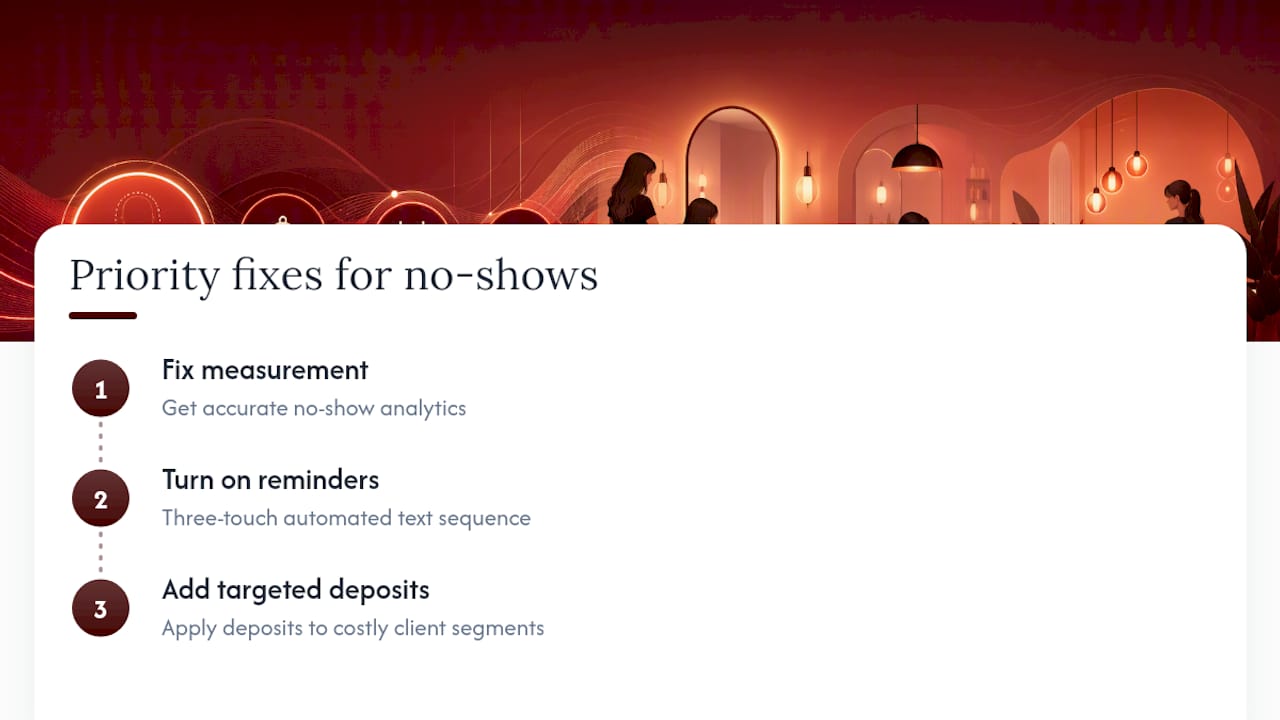
The three things I’d prioritize, in order: fix your measurement first, because you can’t manage a number you’re calculating wrong. Turn on the three-touch reminder sequence second, because it’s the cheapest fix with the fastest payoff. Add targeted deposits third, only once you know exactly which client segments are actually costing you money.
Most salon owners skip straight to punishing policy language because it feels like control. It rarely is. The data consistently points back to forgetfulness as the real enemy, which means a well-timed text does more work than a strict cancellation fee ever will.
Where a platform like Lumaripro fits into this is straightforward: real-time analytics that surface your no-show rate and patterns without manual spreadsheet work, automation playbooks built around the reminder and deposit sequencing described above, and POS and QuickBooks integrations that connect the dollar impact directly to your actual books instead of an estimate.
— Oliver
Put These Tactics on Autopilot With Lumaripro
This is a platform built specifically for suite renters and independent beauty professionals who need the no-show fixes above running automatically, not managed by hand between clients. Instead of stitching together a booking app, a separate reminder tool, and a spreadsheet to track your rate, you get real-time dashboards that show your no-show rate, your fill rate, and your recovered revenue in one place, connected directly to your POS and QuickBooks.
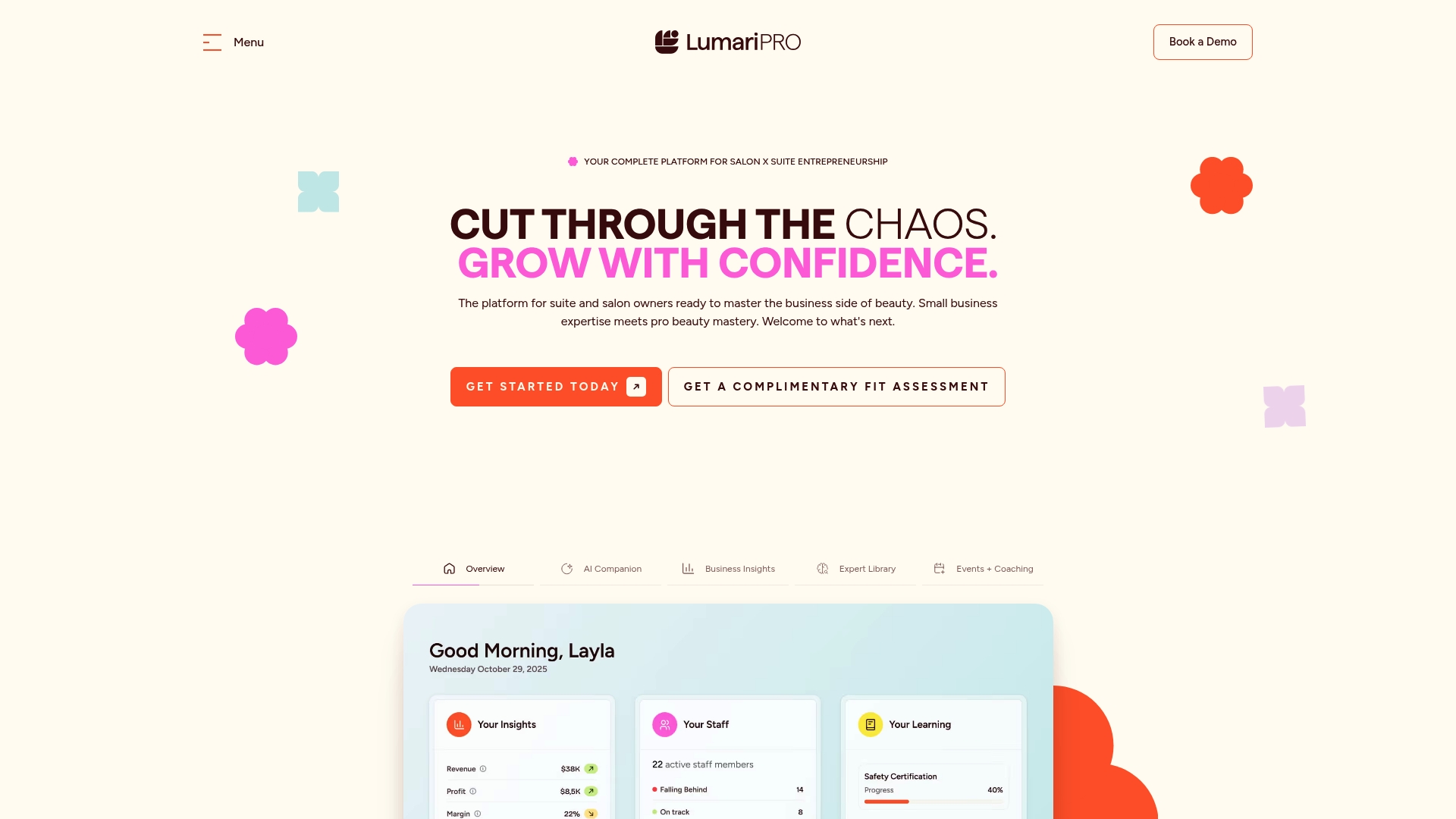
The platform includes business playbooks built around exactly the sequencing covered in this article: reminder timing, deposit thresholds by service value, and policy templates you can drop into your booking page today. If you want to see what a lower no-show rate is actually worth in your salon, run your numbers through the ROI calculator and check the platform overview to see how the automations connect to your existing systems.
Sources
The no-show rate ranges and prevention tactics above draw from a handful of sources worth knowing directly. The systematic review on reminder interventions backs the 20 to 40% reduction figure for reminder systems. The pooled analysis of appointment no-show rates supports the industry benchmark ranges. The PLOS ONE reminder wording study grounds the specific 11.1% to 8.4% reduction example. The TRTC cost data supports the dollarized revenue-loss examples, and Prefero’s benchmark guide supports the three-touch reminder recommendation.