Rebooking rate is the percentage of clients who schedule their next appointment before they leave your chair, and it’s the single best predictor of whether your book stays full six months from now. The average salon lands between 30% and 40%; good operators hit 50% to 60%; the top tier runs 65% to 80%. If your number is below 40%, you’re leaking revenue every single week.
Three moves fix this fast:
- Assume the book. Stop asking “would you like to book?” Say “let’s get you on the calendar for your next color.”
- Automate at 80% of the service interval. If a color lasts six weeks, the reminder fires at week five.
- Track it by stylist, not just by salon. Averages hide your weakest link.
Rebooking rate is a newer term for what old-school salon consultants called “pre-book rate.” Both describe the exact same metric, and you’ll see them used interchangeably throughout this guide.
Key Takeaways
| Point | Details |
|---|---|
| Know your benchmark | Average sits at 30–40%, good salons hit 50–60%, elite operators reach 65–80%. |
| Fix checkout first | An assume-the-book script at checkout catches more clients than any automation ever will. |
| Time reminders correctly | Fire SMS reminders at 80% of the service interval, then follow up at 24 hours and 3 days. |
| Track by stylist, not just salon | Salon-wide averages hide which team members need direct coaching. |
| Use a platform to sustain it | Lumaripro connects POS and QuickBooks data into dashboards that track rebooking by stylist and service without manual spreadsheets. |
Table of Contents
- What Rebooking Rate Salon Metrics Actually Measure
- Salon Rebooking Rate Benchmarks by Service Type
- How to Calculate Rebooking Rate and What to Track Alongside It
- Turning Checkout Into Your Best Rebooking Moment
- Automated Reminders That Actually Get Clients Back in the Chair
- Standing Appointments Push Rebooking Toward 100%
- Building a Team That Rebooks Without Being Told
- What Belongs on Your Monthly Rebooking Dashboard
- Winning Over Clients Who Won’t Commit
- How a Platform Like LumariPRO Moves the Needle on Rebooking
- The Levers That Actually Move Rebooking Numbers
- Put the Playbook on Autopilot With LumariPRO
- Frequently Asked Questions
- Sources
What Rebooking Rate Salon Metrics Actually Measure
Rebooking rate is calculated as clients who book their next visit before leaving, divided by total clients served, multiplied by 100. If 40 out of 100 Saturday clients leave with a future appointment on the books, that’s a 40% rebooking rate for the day.
The number matters because of what it does to revenue. A 10-point improvement in rebooking rate typically correlates with a 15% to 20% lift in annual revenue, and it lowers what you spend chasing new clients to fill empty slots. Harvard Business Research has long shown that keeping existing customers drives disproportionate profit growth compared to constantly hunting for new ones. A modest retention gain often does more for your bottom line than a marketing campaign.
Here’s the distinction that trips up a lot of owners:
- Rebooking rate is a leading indicator. It tells you what’s about to happen.
- Retention rate (whether a client returns within 90 or 180 days) is a lagging indicator. It tells you what already happened, when it’s too late to fix.
Chase rebooking first. Retention follows.
Salon Rebooking Rate Benchmarks by Service Type
Averages hide a lot. A nail salon and a color-heavy hair studio will never post the same number, because their services carry different natural rebooking cycles and price points.
Four tiers, roughly:
- Below 30%: a structural problem. No consistent checkout process, no automation, no accountability.
- 30% to 40%: the industry average. Functional, but leaving money on the table.
- 50% to 60%: good. Front desk and stylists are aligned on the habit.
- 65% to 80%: elite. Prebooking is baked into culture, not left to memory.
Service-specific targets look different because maintenance windows differ:
| Service | Typical Interval | Realistic Rebooking Target |
|---|---|---|
| Color / highlights | 5 weeks | 60% |
| Haircut only | 10 weeks | 40% |
| Blowout | 1–2 weeks | 50–70% |
| Facial | 6 weeks | 60% |
| Nails | 2–3 weeks | 55% |
| Waxing | 3–4 weeks | 50–65% |
| Lash fill | 2–3 weeks | 60–80% |
A boutique studio built on relationship loyalty tends to sit higher across the board than a high-volume, walk-in-friendly operation, simply because clients already expect a personal follow-up conversation.
How to Calculate Rebooking Rate and What to Track Alongside It
The formula stays simple: clients who book their next visit at or shortly after checkout, divided by total clients served in that period, times 100. If you served 220 clients last month and 96 left with a future appointment, that’s a 43.6% rebooking rate.
Report it in three windows:
- Weekly, to catch a slump before it compounds.
- Monthly, for the number you compare against benchmarks.
- Stylist-level, because salon software vendors recommend tracking by salon, stylist, and service type since averages mask who actually needs coaching.
Track alongside it: average days between visits (climbing? clients are drifting), recovery rate after cancellations (are lost slots getting rebooked or just vanishing?), and client lifetime value, which is the metric rebooking rate is quietly driving the whole time.
Turning Checkout Into Your Best Rebooking Moment
Checkout is the highest-leverage 90 seconds in your entire client relationship. The client is happy, the result is fresh, and they’re standing at the desk with their wallet out. Miss this window and you’re relying on memory, and memory loses to a busy week every time.
The script matters more than most owners think. Compare:
- Weak: “Do you want to book your next appointment?”
- Strong: “Let’s lock in your next color for six weeks out, before the good afternoon slots fill up.”
The second version assumes the booking happens and gives a reason to act now. Train stylists to say this while walking the client to the desk, not after they’ve already reached for their coat.
The workflow should be a clean handoff: stylist recommends the interval and mentions it to the front desk by name (“Sarah’s due back in six weeks for color”), front desk pulls up the calendar immediately, and the client leaves with a text confirmation before they’re out the door.
Small incentives sweeten the ask without cheapening the brand. A points system that credits prebooking, a $5 retail credit for booking before leaving, or early access to preferred time slots all work. Operators who make prebooking a salon-wide habit and layer in small client rewards report moving rates from the mid-50s into the 70% to 80% range within a few months of consistent execution.
Pro Tip: Have stylists write the next appointment date on the client’s receipt or aftercare card by hand. It sounds small, but a written date feels more binding than a verbal mention.
Automated Reminders That Actually Get Clients Back in the Chair
Checkout catches most clients, but not all of them commit on the spot. That’s where automation picks up the slack, and timing is everything.
For a six-week color client, that’s week 4.8 or roughly day 34. Too early and it feels irrelevant; too late and they’ve already booked somewhere else or decided to stretch it another month.
Channel matters too. SMS consistently drives higher open and click rates than email for appointment-based businesses, which makes it the default for time-sensitive rebooking nudges. Email works as a backup layer, especially for clients who haven’t opted into texts.
A simple sequence:
| Timing | Channel | Message Focus |
|---|---|---|
| 80% of interval | SMS | “You’re due back soon, here are open times” |
| 24 hours after no response | SMS | Direct link with 2-3 pre-selected slots |
| 3 days after no response | Personalized note plus booking link |
Reaching out within 24 hours with pre-selected time slots, followed by a short 3-day check-in, recovers a meaningful share of clients who intended to rebook but simply forgot.
Standing Appointments Push Rebooking Toward 100%
Standing appointments solve rebooking permanently for the clients who take them, because the client never has to decide to book again. It’s already on the calendar every four, six, or eight weeks.

Pitch it as a convenience, not a commitment: “Want me to just hold your usual Thursday slot every six weeks so you never have to think about it?” Most clients say yes because it removes friction from their life, not because of a discount.
Membership models take this further. A monthly blowout membership, a quarterly facial subscription, or a nail maintenance plan all convert irregular visitors into locked-in recurring revenue. Price it to cover roughly the same margin as your average visit frequency, and reserve it for clients who already show a pattern of returning every few weeks. Pulling a one-time client into a membership too aggressively erodes trust faster than it builds loyalty.
Building a Team That Rebooks Without Being Told
Consistent behavior across your whole team requires more than a memo. It requires practice, visible numbers, and a reason to care.
A short training session covers the ground:
- Review the assume-the-book script until every stylist can say it naturally, not robotically.
- Role-play three common client pushbacks (busy schedule, not sure yet, wants to see how the color holds up).
- Walk through the front-desk handoff so stylist and receptionist never contradict each other.
- Set a personal rebooking goal for each stylist based on their current baseline plus a realistic stretch.
Track individual numbers openly. A whiteboard or dashboard showing each stylist’s monthly rebooking percentage creates friendly competition without singling anyone out unfairly.
Incentive ideas that hold up over time:
- Small bonus or commission multiplier once a stylist crosses a rebooking threshold, like 60%.
- Public recognition, a shoutout in the team meeting, a spot on a leaderboard.
- Avoid tying incentives purely to volume of bookings without regard to service fit. That pushes staff toward overbooking clients into appointments they don’t need, which damages trust.
Disciplined daily measurement paired with real coaching is what separates salons that talk about prebooking from ones that actually improve it.
What Belongs on Your Monthly Rebooking Dashboard
A dashboard only helps if it’s simple enough to check every week without dreading it. Five fields cover what you need:
| Field | Why It Matters |
|---|---|
| Salon-wide rebooking rate | The headline number for trend tracking |
| Stylist-level rebooking rate | Identifies who needs coaching |
| Service-level rebooking rate | Reveals which services are underperforming |
| Average days between visits | Early warning sign of client drift |
| Recovery rate after cancellations | Shows if lost slots get refilled or vanish |
Run a 30/60/90 review cadence: at 30 days, check if new scripts are being used consistently; at 60 days, compare stylist numbers against baseline; at 90 days, decide whether to expand what’s working or adjust incentives.
Winning Over Clients Who Won’t Commit
Some clients resist booking ahead no matter what you say, and pushing too hard backfires. The goal is a lower-friction yes, not a harder pitch.
Common objections and quick responses:
- “I’m not sure of my schedule yet.” “No problem, let’s grab a tentative slot. I’ll text you three days before, and you can cancel free if it doesn’t work.”
- “I want to see how this holds up first.” “Totally fair. Let’s book six weeks out. If you need to push it, just let us know.”
- “I’ll just call when I’m ready.” “I get it, but our afternoons fill up fast. A soft hold costs you nothing and I’ll confirm by text.”
Micro-commitments work better than hard sells: a soft hold, a tentative slot with a confirmation text, or an opt-in for an express standing appointment. Limited-time booking incentives, like a small credit for booking within 48 hours, can nudge fence-sitters without turning into a permanent discount that erodes your pricing.
Pro Tip: Never frame a tentative slot as pressure. “No charge if plans change” removes the one objection that stops most hesitant clients from saying yes.
How a Platform Like LumariPRO Moves the Needle on Rebooking
A salon that layers a booking platform, a staff playbook, and real coaching typically sees rebooking rates climb over a 90-day pilot, not overnight. The lift comes from combining three things most independent owners never have time to build alone: automated reminder sequences, stylist-level dashboards, and scripted training that gets used consistently instead of once.
The gap between “we should improve rebooking” and “we did improve rebooking” is almost always execution, not strategy. Owners already know the tactics. What’s missing is the daily tracking and the accountability system that turns a script into a habit.
Adoption steps stay straightforward: run a short pilot with one or two stylists, connect your existing POS system, train the full team on the script, then measure at the 90-day mark before rolling it out salon-wide.
The Levers That Actually Move Rebooking Numbers
Most owners chasing rebooking overcorrect toward technology and undercorrect on habit. Online booking widgets and automated texts help, but they’re a backstop, not a strategy.
The traps I see most: treating stylist-level data as optional, letting scripts drift because “everyone has their own style,” and assuming a booking app alone fixes a culture problem. It doesn’t.
Measure weekly. Test one script change at a time.
Put the Playbook on Autopilot With LumariPRO
Everything in this guide, the scripts, the reminder timing, the stylist dashboards, works better when it’s not something you’re managing manually in a spreadsheet at midnight. Lumaripro is built for exactly this: an all-in-one platform for suite renters and independent beauty professionals that connects to your existing POS and QuickBooks setup, replacing guesswork with real dashboards on the metrics that actually predict revenue, starting with rebooking rate.
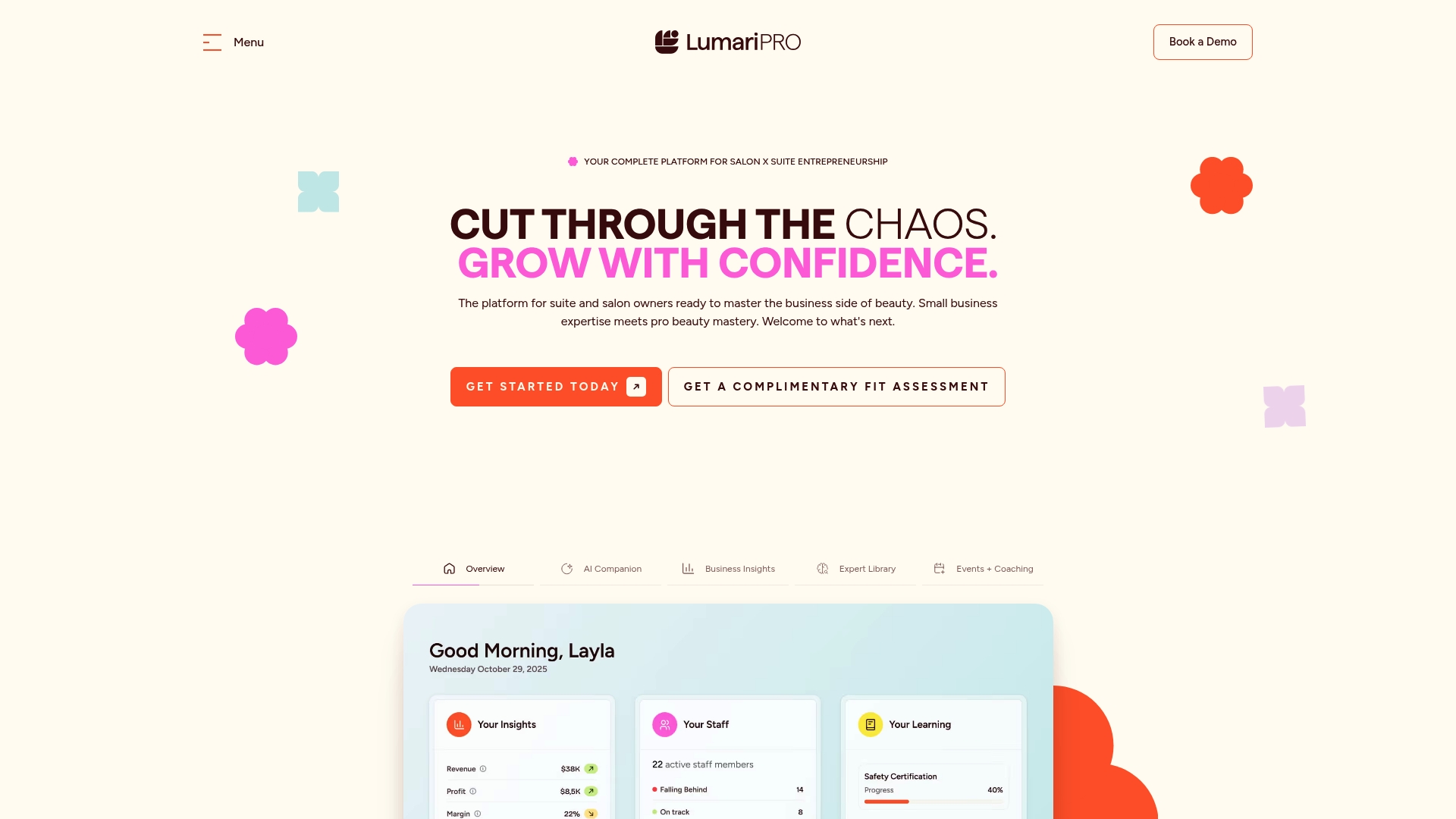
Inside the platform, you get AI-powered coaching trained specifically on suite-based beauty economics, prebuilt playbooks for checkout scripts and automation sequences, and stylist-level tracking that shows exactly who needs a coaching conversation this month. If loyalty rewards or client incentive programs are part of your rebooking strategy, pairing them with a partner program like Crisan’s Salon Partnership initiative can add another layer of client value without extra overhead.
Check out the full platform breakdown to see how the dashboards and automations fit your current setup, or go straight to pricing to start a pilot on your own book this month.
Frequently Asked Questions
What is a good rebooking rate for a salon?
How is salon rebooking rate different from retention rate? Rebooking rate measures whether a client books their next visit before leaving; retention rate measures whether they actually return within a set window later. Rebooking rate is the leading indicator that predicts retention.
What’s the fastest way to improve rebooking percentage? Fix the checkout script first.
Should salons use SMS or email for rebooking reminders? SMS generally outperforms email for appointment reminders in open and click rates, making it the better primary channel, with email as a backup for clients who haven’t opted into texting.
For the clients enrolled, yes, because the next visit is already scheduled and doesn’t require a new decision each time. The challenge is converting enough frequent clients into standing bookers without discounting so heavily that it hurts margin.
Sources
- Harvard Business Review — The value of keeping the right customers
- Rework — Rebooking Strategies for Salons: Filling Your Chair Before Clients Leave
Recommended