Publish this: services are non-refundable, but you’ll fix any issue free within 7 to 10 days of the original appointment. Deposits refund only with sufficient advance notice, typically 24 to 48 hours. No-shows get charged in full. That’s the entire policy, and it belongs on your booking page, your confirmation text, and your intake form, not buried in a PDF nobody opens.
TL;DR:
- Refunds for services are non-refundable, but clients can receive a free redo within 7 to 10 days of the appointment if issues arise.
- Deposits are refundable with proper 24 to 48 hours notice, but no-shows are charged in full, and automatic reminders help enforce this.
- Retail product returns are accepted only for unopened items within 7 to 14 days; used products cannot be refunded for safety reasons.
- Refunds on prepaid packages are calculated at the single-service rate, not the discounted bundle price, to prevent loss of discounts.
- Automated booking tools and clear documentation decrease chargebacks and ensure policy enforcement is consistent across all clients.
Table of Contents
- Salon Refund Policy Checklist and Copy-Ready Templates
- How Should You Handle Cancellations, No-Shows, and Deposits?
- Should You Offer a Redo or a Refund?
- What Are the Rules for Product and Gift Card Returns?
- How Do You Calculate Refunds on Packages and Prepaid Services?
- What Documentation Prevents Chargebacks?
- How Do Booking Tools Make Enforcement Consistent?
- Why Fair, Firm Policies Actually Protect Client Relationships
- Turning Policy Into Practice With LumariPRO
- Sources
- FAQ
Salon Refund Policy Checklist and Copy-Ready Templates
Before you write a word of client-facing copy, confirm you’ve got these eight pieces in place. Missing even one is usually where disputes start.
- Notice window for cancellations (24 or 48 hours)
- Deposit rules: when it’s required, when it’s refundable
- Redo window for service corrections (7 to 10 days is standard)
- Product return rules for opened versus unopened items
- Gift card and package terms (non-refundable, transfer conditions)
- What documentation you collect at every visit
- Chargeback response plan
- Where the policy is displayed (booking page, receipt, signage)
Three templates cover most independent salons:
- Basic 24-hour policy: “Cancellations require 24 hours’ notice. Late cancellations are charged 50% of the service price; no-shows are charged in full. Services are non-refundable, but we offer a complimentary redo within 7 days if you’re not satisfied.”
- Tiered policy with exceptions: “Standard bookings require 24 hours’ notice. Group bookings, bridal parties, and services over 90 minutes require 48 hours’ notice and a non-refundable deposit. All completed services include a 10-day adjustment window.”
- Client-first guarantee: “Your satisfaction matters. If something’s off, come back within 10 days and we’ll make it right at no charge. If a redo can’t resolve it, we’ll issue a refund or credit at our discretion.”
Adjust the tone to match your clientele. A downtown blowout bar can sound casual. A bridal-focused suite needs firmer, more formal language around deposits.
How Should You Handle Cancellations, No-Shows, and Deposits?
Pick your notice window based on how hard the slot is to refill. A basic haircut can run on about 24 hours’ notice since walk-in demand covers most gaps. Longer, more involved services often require at least 48 hours’ notice due to difficulty in rebooking on short notice.
The most common structure charges 50% of the service price for late cancellations and 100% for no-shows. If that feels harsh for a first-time client, offer an alternative: a rebooking credit instead of a hard charge, valid for 30 days. It keeps goodwill intact while still discouraging habitual no-shows.
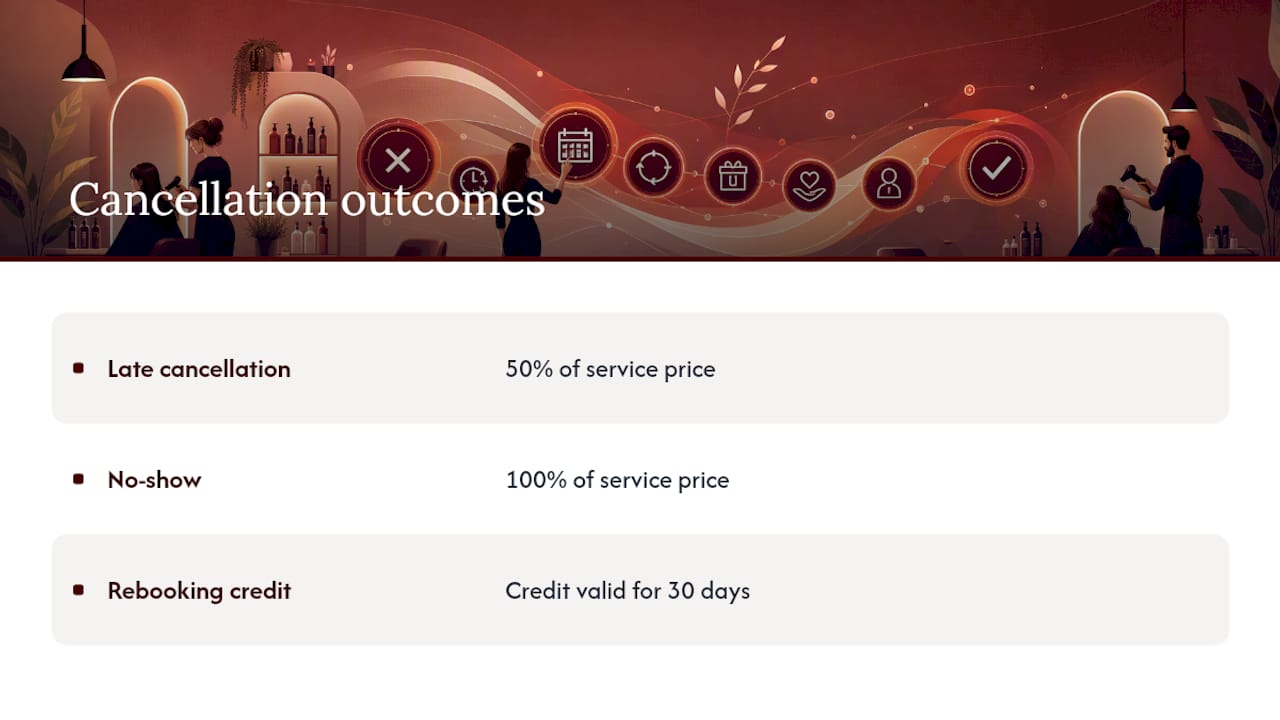
Deposits are commonly required for longer services or those needing special-order products. Refund deposits in full when a client reschedules with proper notice; forfeit them for no-shows. Bridal and event deposits are typically non-refundable and non-transferable unless you agree otherwise in writing, since those slots often can’t be resold at all.
Automation does the enforcement for you. Require a card on file for any service over a set dollar threshold, and let your booking software send automatic reminders 48 and 24 hours out.
Pro Tip: *Put the cancellation window in the confirmation text itself, not just the policy page. Something like, “Reminder: your appointment is Thursday at 2 PM.”
Should You Offer a Redo or a Refund?
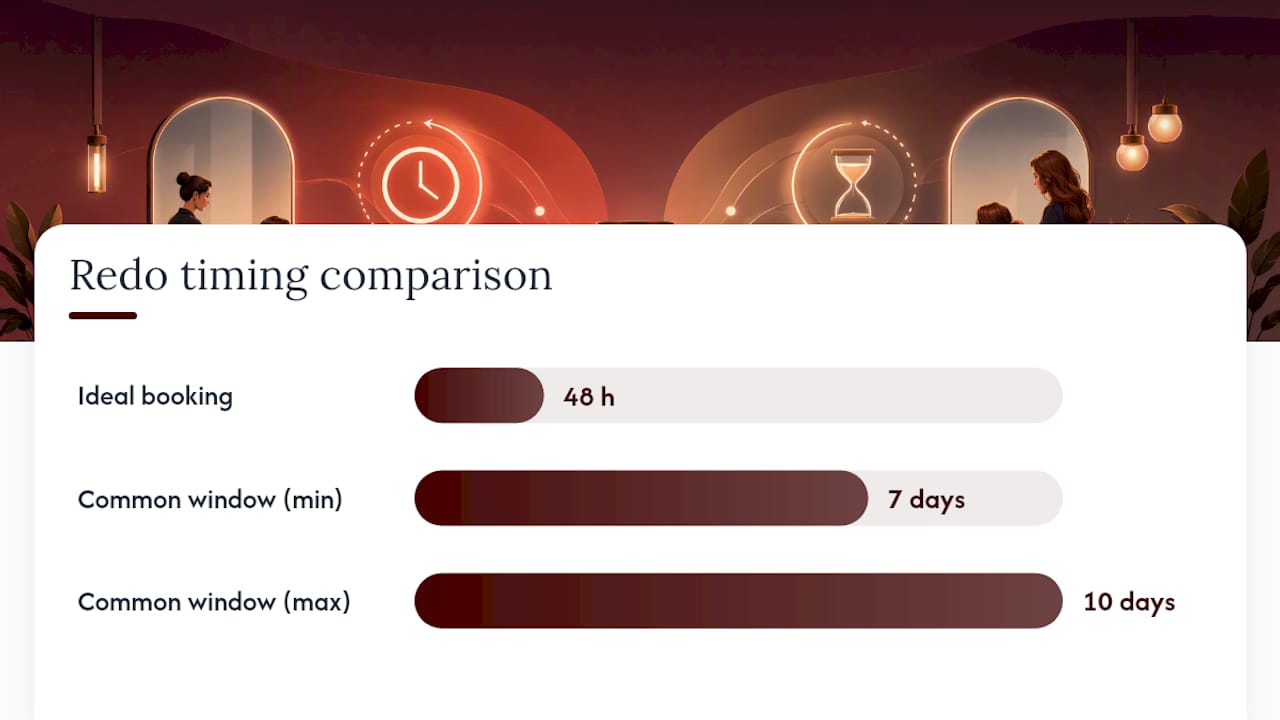
Default to fixing it, not refunding it. Most salons don’t refund completed services at all, they offer a complimentary redo within a fixed window, commonly 7 to 10 days. That protects your time and payroll from being treated as a return policy while still giving unhappy clients a real path to resolution.
A refund becomes appropriate in three situations: the result clearly diverged from what was discussed at consultation, a redo attempt still didn’t fix the problem, or the client had an allergic or skin reaction that makes a second service unsafe. Outside those, redo first, always.
The operational sequence should run the same way every time:
- Document the complaint immediately, including what the client says went wrong.
- Book the redo inside your stated window, ideally within 48 hours of the complaint.
- If the redo fails, escalate to a refund or service credit, decided by the owner or manager, not the original stylist.
- Record the outcome in the client’s file so the next visit isn’t a repeat argument.
Pro Tip: Give front-desk staff a script: “I’m so sorry that’s not what you expected. Let’s get you back in within the next few days, on us, so we can get it right.” That single sentence defuses most complaints before they become chargebacks.
What Are the Rules for Product and Gift Card Returns?
Retail works differently than services, and the rule is hygiene, not preference. Unopened products can usually be returned within 7 to 14 days for a full refund. Once a product is opened, used, or has a broken seal, it’s exchange or store credit only, never a cash refund, because there’s no way to verify it’s safe to resell.
Gift cards follow their own logic:
- Non-refundable for cash under most state rules, but transferable to another person.
- Record the redemption date and remaining balance every time one is used.
- Disclose expiration terms clearly at the point of sale, since some states restrict or ban expiration dates entirely.
Defective retail, a broken flat iron, a pump that doesn’t dispense, goes back to the supplier under their warranty terms. Don’t absorb that cost yourself; most professional brands offer a straightforward exchange process for verified defects.
How Do You Calculate Refunds on Packages and Prepaid Services?
Calculate refunds at the standard single-service rate rather than at discounted package rates. A client who bought a five-session package at a bundled discount and used two sessions gets refunded for the three remaining sessions at your regular price, not the per-session package price. Otherwise, you’re eating the discount twice.
- Membership cancellations: allow a pause option before a full cancel; refund only unused prepaid amounts.
- Multi-session deposits: transferable if the client reschedules within your policy window, forfeited for no-shows on the final session.
- Always show the math in writing so the client sees exactly how the number was reached.
Example: A $500 five-session package runs $100 per session. If the regular single-session price is $130, two used sessions cost $260 at full rate, leaving $240 refundable, not $300.
What Documentation Prevents Chargebacks?
Chargebacks usually don’t get won on argument. They get won on paperwork, and the salons that keep it consistently win far more disputes than the ones that rely on memory.
Keep these on file for every appointment:
- Consultation notes, ideally with the client’s stated goal in their own words.
- A signed consent form for anything chemical, corrective, or higher-risk.
- Before and after photos, dated and timestamped.
- An itemized receipt showing service, price, and any product used.
- A copy of the confirmation SMS or email, which proves the policy was disclosed.
- Card-on-file authorization logs for deposits and no-show charges.
On the payment side, clear statement descriptors and itemized receipts matter more than most owners realize. If your business name shows up vague or unfamiliar on a bank statement, clients are more likely to dispute a charge simply because they don’t recognize it.
When a chargeback does land, build an evidence packet immediately: the signed consent, the photos, the receipt, and a timeline of what happened. Send it to your payment processor within their stated response window, usually 7 to 10 days, since missing that deadline is an automatic loss regardless of how strong your case is.
A short, visible policy does real work here. Salons that display their refund terms clearly, at booking, in confirmations, and at the front desk, report fewer disputes overall, simply because clients had a documented path to resolution before they ever called their bank.
How Do Booking Tools Make Enforcement Consistent?
Policy only works if it’s enforced the same way every time, and that’s hard to do by memory. Automated reminders and mandatory card-on-file rules cut no-shows before they happen, while integrated payment logs make the pro-rata math on packages a lookup instead of a calculation.
- Automated 48 and 24-hour reminders with the cancellation terms included
- Card-on-file requirements triggered automatically for services over your set price
- Appointment and payment history logged in one place for dispute evidence
- Deposit records tied directly to the booking, not a separate spreadsheet
Why Fair, Firm Policies Actually Protect Client Relationships
The salons that struggle with refunds aren’t the ones with strict policies. They’re the ones with no policy at all, forcing every dispute to be negotiated from scratch under pressure. A fix-first, refund-when-necessary approach isn’t a compromise. It’s the version that keeps clients loyal while keeping your books predictable.
Train every staff member to say the same three things: acknowledge the complaint, offer the redo, name the window. Consistency is what makes a policy feel fair instead of arbitrary.
— Oliver
Turning Policy Into Practice With LumariPRO
Writing the policy is the easy part. Enforcing it the same way every week, with every client, is where most independent owners lose money without noticing. There are platforms designed to turn your cancellation and refund rules from a page on your website into something your booking system actually runs on.

Some platforms connect to your POS and accounting systems so deposit records, package balances, and payment history live in one dashboard instead of three disconnected tools. Automated reminders can enforce your notice windows without you having to chase anyone by text. When a dispute does come in, your appointment and payment logs are already organized instead of scattered across email threads and paper receipts.
If you’re tired of guessing whether your refund policy is actually saving you money or just sitting on a page nobody reads, start with the platform overview to see how the dashboards track deposits, cancellations, and package balances in real time. Owners who want a closer look at fit for their specific business can book a complimentary fit assessment to walk through it directly.
Sources
- How to create an effective salon cancellation policy — The Salon Business
- Salon Refund Policy: The fair system I use — Lutily Blog
- Refunds and Redo Policy — Havana Hair Salon
- Payment processing best practices for beauty businesses | Xolapp
FAQ
Can I get my money back from a hair salon?
Usually not in cash once a service is completed. Most salons offer a complimentary redo within a set window, typically 7 to 10 days, and reserve refunds for cases where the redo doesn’t fix the problem or the client had a reaction.
How long can I go back to the salon if I’m not satisfied?
Most policies give clients 7 to 10 days after the original appointment to request a complimentary adjustment. Check your salon’s posted policy since some extend this for corrective color or extensions.
What is a typical salon refund policy?
The common structure is: no cash refunds on completed services, a free redo within 7 to 10 days, refundable deposits with 24 to 48 hours’ notice, and full charges for no-shows. Retail products follow separate rules based on whether they’ve been opened.
How do I request a refund at a salon?
Contact the salon within their stated adjustment window, describe the issue clearly, and ask for the redo they typically offer first. If documentation shows the redo attempt still failed, most salons will then discuss a refund or credit.
Are gift cards refundable at a salon?
Generally no. Gift cards are typically non-refundable for cash but transferable to another person, and salons should disclose any expiration terms clearly at the time of purchase.