A usable salon budget assigns every dollar coming in to three buckets: fixed costs, variable costs tracked as a percentage of revenue, and target profit. Pull last month’s P&L or sales report right now, or grab a budgeting tracker, and run those three percentages before you read another word.
TL;DR:
- Full-service salons with larger teams spend significantly more on overhead, often exceeding $20,000 monthly, mainly due to payroll and larger space costs.
- Maintaining fixed costs under 15% of revenue and variable costs within industry benchmarks helps ensure profitability and manageable margins.
- Accurate pricing requires calculating true service costs and applying desired profit margins rather than copying competitor prices blindly.
- Using an automated platform connected to POS and accounting software can save hours per month by updating reports and insights in real time.
- Starting with one key benchmark, such as payroll percentage, and building a simple, consistent tracking habit improves financial oversight over time.
Table of Contents
- What Does a Monthly Salon Budget Look Like?
- Fixed vs. Variable Expenses: What to Track and Where to Find It
- What Percentage of Revenue Should Each Expense Category Be?
- How Do You Calculate Salon Pricing and Break-Even?
- Building a Monthly Budget and Rolling Forecast
- Spreadsheet or Salon Software: What Should You Actually Use?
- How LumariPRO Turns This Workflow Into a Dashboard
- A Practical Note on Starting Small
- Ready to Stop Rebuilding Your Budget Every Month?
- Sources
- FAQ
What Does a Monthly Salon Budget Look Like?
Your budget range depends almost entirely on one variable: how much overhead you’re carrying alone versus splitting with a team. A suite renter pays for one chair, one room, and one set of utilities. A full-service salon owner is covering payroll for a dozen people, a lease on a commercial space, and insurance that scales with headcount.
That structural difference shows up directly in the numbers. Suite renters typically run monthly expenses of $2,000 to $6,000. Mid-size salons with a handful of employees land between $8,000 and $20,000. Full-service salons with larger teams and bigger footprints often spend $20,000 to $40,000 or more each month, according to salon expense benchmarking data. Payroll is the biggest driver of that spread. In a suite, payroll is just your own draw. In a full-service shop, it’s a line that can consume between about one-third and three-fifths of revenue once you add commissions and employer taxes.

Here’s the preview of where this is headed: if your fixed costs run several thousand dollars a month and your average ticket is around eighty dollars, you need roughly fifty services just to break even, before a dollar of profit shows up. That math holds whether you’re a suite renter with a small fixed number or a salon owner with a much bigger one. The formula doesn’t change. Only the inputs do.
A suite renter with monthly fixed costs in the low thousands and an average ticket in the mid-sixties needs around forty to fifty services to break even. A three-stylist shop with fixed costs in the low tens of thousands and a mid-seventies average ticket requires service volumes scaled accordingly across the team. Neither number tells you if you’re profitable. It just tells you where zero is.
Fixed vs. Variable Expenses: What to Track and Where to Find It
Fixed costs stay the same whether you serve 20 clients or 200 this month. Variable costs move with your revenue, and that’s exactly why you should budget them as percentages instead of flat dollar amounts.
Fixed costs to track:
- Rent or suite fee (check your lease or rental agreement)
- Business insurance premiums
- Loan or equipment lease payments
- Recurring software subscriptions (booking, POS, payroll)
- Utilities if not bundled into rent
Variable costs to track:
- Payroll and commissions (your payroll summary report)
- Backbar and product used in services (inventory reports)
- Retail cost of goods sold (POS sales-by-category report)
- Credit card processing fees (merchant statement)
- Laundry, disposables, and small supplies (often buried in miscellaneous spend)
Most of these numbers already live in reports you’re generating. Your POS system tracks sales by category and processing fees. Your payroll provider tracks wages, commissions, and the employer tax burden that often gets left out of budget math entirely. The category that quietly wrecks accuracy is the last one: laundry, gloves, cotton rounds, and the $12 software add on nobody remembers subscribing to. Left untagged, these recurring small costs push your product or supply percentage above target without you noticing why, a pattern common enough that expense-tracking guides flag it specifically.
What Percentage of Revenue Should Each Expense Category Be?
Industry benchmarks give you a fast way to judge whether a line item needs attention right now, or whether it can wait until next month’s review.
| Category | Healthy range | Warning sign |
|---|---|---|
| Payroll & staff | roughly one-third to half of revenue | above about half |
| Rent & utilities | around 8 to 15% of revenue | above about 15% |
| Product & backbar | around 5 to 10% of revenue | above about 12% |
| Marketing & software | around 3 to 8% of revenue | no fixed ceiling, but watch ROI |
| Owner profit/reinvestment | around 10 to 20% | below about 8% for multiple months |
These ranges come from salon budgeting benchmarks built around what independent owners actually report. Total expenses in a healthy salon usually land between roughly two-thirds and four-fifths of gross revenue, which leaves roughly one-fifth to one-third as net profit before taxes in the best-run shops, and a smaller margin around single digits to mid-teens percentage in shops carrying more debt or a heavier payroll load.
Retail deserves its own mention here.
How Do You Calculate Salon Pricing and Break-Even?
The math behind pricing isn’t complicated. It’s just skipped constantly, which is why so many services get priced by guessing what a competitor charges instead of what the service actually costs to deliver.
- Add up your true cost per service. Combine the stylist’s payout or commission, the product cost for that specific service, and an allocated share of your fixed overhead (fixed costs divided by estimated monthly service volume).
- Apply the profit margin formula. Minimum price = (stylist payout + product cost + allocated overhead) ÷ (1 minus your desired profit margin). If your target margin is 20%, you divide total cost by 0.80.
- Calculate break-even volume separately. Total fixed costs ÷ average ticket price = the minimum number of services needed each month just to cover fixed costs, before variable costs or profit enter the picture.
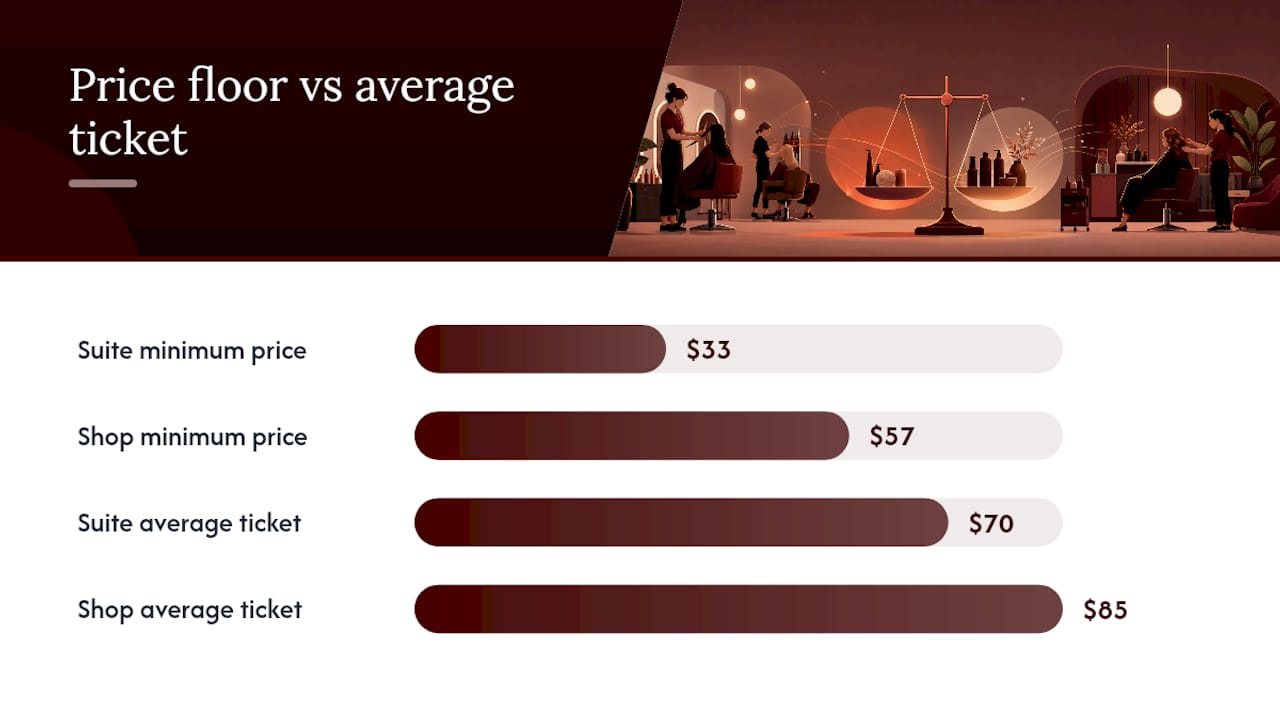
Two quick examples make this concrete. A suite renter with $3,200 in monthly fixed costs and a $70 average ticket needs 46 services to break even. If her cost per haircut (product plus her own time value) runs $25, and she wants a 25% margin, her minimum price is $25 ÷ 0.75, or roughly $33 just to hit that margin on cost, well below what she should actually charge once overhead is folded in.
A three-stylist shop with $11,500 in fixed costs and an $85 average ticket needs 136 services a month to break even, split across the team. If a color service costs $40 in stylist payout and product, and the owner wants a 30% margin, minimum price is $40 ÷ 0.70, about $57, a useful floor to check the real menu price against.
Building a Monthly Budget and Rolling Forecast
A budget that lives in your head doesn’t survive a slow month. The fix is a repeatable monthly cadence, not a bigger spreadsheet.
- Collect your reports. Pull sales by category, payroll summary, and your P&L for the month just closed.
- Reconcile actuals. Match what your POS and bank statements say against what you expected. Discrepancies here are where budgets quietly drift.
- Log assumptions with a date and confidence level. If you’re assuming a 10% bump for a holiday push, write down who made that call, when, and how confident they are in it.
- Set your fixed cost lines for the coming month. These rarely change, so this step should take minutes.
- Apply your variable percentages to a revenue forecast. Use a 3-month rolling average of past revenue as your baseline, then adjust for known seasonality, since salon revenue tends to dip in January and August and peak near year-end.
- Run a base case and a downside case. What happens if revenue comes in 15% under forecast? Knowing the answer before it happens is the entire point of forecasting.
Keeping an assumption register, rather than trusting memory, makes disagreements about the numbers rare because the source and date are already written down, a habit forecasting guides for salons treat as a baseline requirement, not an extra step.
Pro Tip: *Pick one KPI to watch closely this month, not five.
Spreadsheet or Salon Software: What Should You Actually Use?
The tool matters less than whether it produces the four reports a budget actually needs. A minimal tracker built in a spreadsheet needs four things: income broken out by service and retail streams, a fixed-cost section, a variable-cost section expressed as percentage rows, and a column that flags cash timing, since revenue booked isn’t the same as cash in the bank on rent day.
Spreadsheet templates give you full control and cost nothing, but they require manual entry every month and someone has to remember to do it. Integrated salon POS and bookkeeping software automates the pull from sales and payroll, cutting the manual work, though you’re trusting the integration to categorize things correctly, which is worth spot-checking against your bank statement the first few months.
Whichever route you choose, confirm it can generate:
- Sales by category (service vs. retail, broken out by type)
- Payroll summary including employer-side taxes, not just gross wages
- Product cost and inventory tracking
- A profit and loss statement by period, not just year-to-date
How LumariPRO Turns This Workflow Into a Dashboard
The six-step cadence above is exactly what an industry-specific platform is built to shorten. An industry-specific platform can connect directly to POS systems and QuickBooks, pulling sales, payroll, and product cost data into one dashboard instead of requiring a manual pull from separate reports every month.
The financial insights update in something closer to real time, so checking your payroll or product percentage doesn’t wait for month-end. Paired with AI-powered coaching and business playbooks built around suite rental and independent salon economics, the platform replaces some of the guesswork in forecast assumptions with numbers pulled straight from your own reports.
A Practical Note on Starting Small
Most owners overcomplicate this on the first attempt and quit by month two. Start with one benchmark, not five. Check your payroll percentage against last month’s numbers, put a date on your calendar for the same check next month, and use a tracked template so you’re not rebuilding the wheel every 30 days.
— Oliver
Ready to Stop Rebuilding Your Budget Every Month?
Everything in this guide, the reconciled reports, the variable percentages, the rolling forecast, works whether you build it in a spreadsheet or hand it to software. The difference is time: a manual pull from four separate reports takes hours a spreadsheet owner repeats every single month, while a platform built around suite and salon economics pulls that same data automatically.

Some platforms connect to your POS and QuickBooks so the payroll, product, and sales percentages update without a manual entry session, and pair that with AI coaching and playbooks built specifically around booth rental and independent salon numbers, rather than generic small-business advice. If you want to see how your own pricing and revenue assumptions play out, run them through the ROI calculator or book a complimentary fit assessment to see whether the full platform fits how you actually run your books.
Sources
For deeper benchmarking, see the salon budgeting guide from Beauty Playbook and the expense breakdown from SalonBiz. For marketing spend efficiency specifically, salon SEO services can help you judge whether that 3-8% marketing line is earning its keep.
- How to budget for a salon: A no-nonsense guide for owners
- Hair salon monthly expenses: A complete guide (+ Free spreadsheet)
- Salon budget, cash flow, and forecast planner | ScissorPedia
FAQ
How Much Does It Usually Cost to Run a Salon?
Monthly costs vary widely by model: suite renters typically spend $2,000 to $6,000, mid-size salons run $8,000 to $20,000, and full-service salons often spend $20,000 or more, with payroll usually the largest single expense.
How Can a Stylist Realistically Earn $100,000 a Year?
Running your own numbers through a break-even calculation shows exactly how many services at your current pricing get you there, and tools like LumariPRO’s platform are built to model that math against your real revenue.
Recommended