A launch- and lender-ready salon business plan must include an executive summary, your three core financial numbers (startup cost, break-even clients per week, and year-one owner draw), a staffing model, a priced service menu, a 90-day marketing plan, an operations and compliance checklist, monthly financial statements, and an appendix with supporting documents. That’s the whole list. Everything else is elaboration.
Start there. LivePlan’s free sample templates cover hair salon, hair and beauty salon, and barbershop models, so you can download a working scaffold today instead of building from a blank page.
Your plan must include:
- Executive summary (one page, numbers first)
- Business model and legal structure
- Service menu with prices and average ticket
- Market analysis and three nearest competitor profiles
- 90-day client acquisition plan
- Staffing model (solo, commission, booth rental, or employee payroll)
- Startup cost total (itemized)
- Monthly P&L, cash-flow forecast, and balance sheet
- Break-even clients per week
- Year-one owner draw estimate
- Operations checklist (permits, licenses, insurance, policies)
- Appendix (lease, contracts, supplier quotes, licenses)
Key Takeaways
A viable salon business plan starts with three numbers: startup cost, break-even clients per week, and year-one owner draw. Validate those before you commit to a lease or a lender conversation.
| Point | Details |
|---|---|
| Start with three numbers | Calculate startup cost, break-even clients per week, and year-one owner draw before writing anything else. |
| Use the one-page scaffold | Fill twelve blocks first; expand to a full lender packet only if you need outside funding or a commercial lease. |
| Benchmark your assumptions | Target chair utilization of 60–75%, rebooking rate of 35–50%, and rent below 10–12% of gross revenue. |
| Build runway into the ask | Fund 3–6 months of fixed operating costs as working capital on top of your startup cost total. |
| Lumaripro operationalizes the plan | Lumaripro connects to POS and QuickBooks to replace manual spreadsheets with live dashboards and coaching built for suite operators. |
Table of Contents
- What does a salon business plan look like from one page to lender-ready?
- How do you write an executive summary that convinces lenders and landlords?
- Company overview: what’s your business model and how much do you need?
- How do you build a service menu and pricing that feed your forecasts?
- How do you analyze your local market and build a client acquisition plan?
- What staffing model and operations details belong in your plan?
- What financial statements do lenders expect, and how do you build them?
- What benchmarks should you use when building realistic forecasts?
- What does a realistic startup budget look like?
- Where do you find downloadable templates and how do you adapt them?
- What’s the launch timeline and lender-readiness checklist?
- How do you write the plan faster and keep it useful after opening?
- What most salon owners get wrong in their business plan
- Lumaripro turns your salon plan into a running business
- Sources
What does a salon business plan look like from one page to lender-ready?
The fastest way to start is a one-page scaffold built around twelve blocks: concept, why you and why now, location, services and prices, staffing model, hours and capacity, startup cost, monthly fixed costs, break-even clients per week, year-one owner draw, first 90-day marketing plan, and top risks. Fill those twelve blocks and you have a working owner’s plan in an afternoon.
The lender-ready version expands each block into a full section with supporting data, month-by-month financials, and an appendix. Here’s how to decide which version you need:
Use the one-page scaffold if:
- You’re planning a solo suite or booth rental with no outside funding
- You want to test assumptions before committing to a lease
- You need a quick gut-check on whether the numbers work
Build the full lender-ready plan if:
- You’re applying for an SBA loan, bank financing, or investor capital
- You’re signing a commercial lease and the landlord wants a plan
- You’re hiring employees and need to document payroll and compliance
Pro Tip: Write the one-page scaffold first regardless of which version you need. The twelve blocks force you to confront the three numbers before you fall in love with the concept. If break-even requires 40 clients a week in a market where you know 12 people, the plan needs revision before the branding does.
How do you write an executive summary that convinces lenders and landlords?
Lenders and landlords scan the executive summary and financials first. A strong executive summary answers one question in under 60 seconds: “Should we keep reading?” That means numbers before narrative.
Paragraph one: concept and positioning. State what kind of salon you’re opening, whom it serves, and what makes it different from the three salons within a mile. One sentence on mission, one on market gap, one on your relevant background.
Paragraph two: the numbers. Revenue target for year one, total funding ask, and how long your runway lasts. Lenders want to see that you’ve done the math, not that you’re optimistic.
Paragraph three: keys to success. Two or three specific, measurable factors (rebooking rate target, average ticket, occupancy ramp) that explain why this location and this model will hit those numbers.
Mini-template you can copy:
Pro Tip: Tailor the same summary three ways: for an investor, lead with revenue trajectory and exit potential; for a landlord, lead with your client base and traffic projections; for personal planning, skip the funding ask and focus on the break-even timeline.
Company overview: what’s your business model and how much do you need?
The business model you choose changes every number in your plan. Four main models exist, and each has a different financial profile.
Solo stylist-owner in a suite: lowest overhead, no payroll complexity, but revenue is capped by your own chair hours. A suite-focused plan centers on tenant-mix, room-tier pricing, and occupancy ramp as the primary early cash-flow drivers.
Commission staff salon: you pay stylists 40–50% of service revenue. Higher revenue ceiling, but payroll, scheduling, and turnover risk all increase. The plan needs a detailed staffing budget and a clear policy on commission tiers.
Booth or chair rental: stylists pay you a weekly or daily rate. Predictable income, no payroll, but you’re a landlord as much as a salon owner. The plan should model occupancy assumptions and what happens if two chairs go vacant for a month.
Full-service with employee payroll: the most complex model. You control the brand and client experience, but you carry full employer tax obligations. Self-employed salon owners and those running payroll need to account for self-employment tax obligations covering Social Security and Medicare, which affect both owner draw planning and employee cost modeling.
Legal structure and site selection
Most solo operators start as a sole proprietor or single-member LLC. An LLC adds liability protection with minimal added complexity. An S corp election can reduce self-employment tax once net profit consistently exceeds roughly $50,000, but adds payroll administration. State your chosen structure in the plan and note why.
For location, document four criteria: foot traffic count or proxy (nearby anchor tenants, Google Maps review volume for neighboring businesses), parking availability, rent per square foot compared to local market rates, and the demographic profile within a 2–3 mile radius. A location that fails two of those four criteria is a risk worth naming in the plan.
Funding checklist (tie each dollar to a use):
- Build-out and permits
- Furniture, fixtures, and equipment (FF&E)
- Initial retail inventory
- Technology (POS, booking software)
- Pre-opening marketing
- Working capital (3–6 months of fixed costs)
- Contingency (10–15% of total)
How do you build a service menu and pricing that feed your forecasts?
Start with five to eight services, not twenty. A focused menu is easier to price correctly, easier to staff for, and easier to explain to a new client. Pick the services that represent your highest volume and highest margin, then add one or two premium offerings that anchor the price ladder.
To calculate average ticket:
- List your top five services and their prices
- Estimate the percentage of appointments each represents
- Multiply price by percentage, sum the results
If 50% of your appointments are haircuts at $65, 30% are color services at $140, and 20% are treatments at $85, your weighted average ticket is $98. That number feeds directly into your break-even formula.
Retail revenue typically adds 8–12% on top of service revenue for well-run salons. Budget it conservatively at 5% in year one and treat anything above that as upside.
Variable costs to track per service:
- Backbar product cost (color, chemicals, treatments): typically 5–10% of service price
- Disposables (gloves, foils, towels): 1–3%
- Payment processing fees: 2.5–3% on card transactions
- Commission paid to the stylist (if applicable): 40–50%
These costs belong in your contribution-margin calculation. A $140 color service with $14 in product, $4 in disposables, $4 in processing fees, and $63 in commission leaves $55 in gross contribution before rent and overhead. Run that math for each service category before you finalize prices.
Pro Tip: Add-on packages (a deep-conditioning treatment with every color, a scalp massage with every cut) increase average ticket by $15–30 without adding a full appointment slot. Price them at 2x the product cost and they’re almost pure margin.

How do you analyze your local market and build a client acquisition plan?
Two or three specific customer personas beat vague positioning every time. A persona isn’t a demographic spreadsheet. It’s a short paragraph: who this person is, what they currently spend on hair and beauty, why they’re dissatisfied with their current salon, and what would make them book with you instead. Build three of those and your marketing plan writes itself.
For competitive analysis, map your three nearest direct competitors. For each, note their price range for a haircut and a color service, their Google rating and review count, their booking method, and one obvious gap (slow response time, no online booking, no parking, dated interior). Those gaps are your positioning opportunities.
Marketing channels that actually move the needle
Google Business Profile is the single highest-return marketing investment for a new salon. A complete, photo-rich profile with consistent five-star reviews drives local search traffic at zero media cost. Claim it before you open.
Referral programs with a concrete incentive (a $20 credit for every new client referred who books and shows) outperform most paid advertising for salons in their first year. Rebooking automation, built into most booking platforms, recovers 15–25% of clients who would otherwise lapse. Local partnerships with complementary businesses (bridal boutiques, fitness studios, photographers) generate warm referrals with no ad spend.
90-day launch marketing plan:
- Weeks 1–4: Claim Google Business Profile, build Instagram to 12 posts before opening, activate referral program with founding-client offer
- Weeks 5–8: Soft launch with 20–30 pre-booked clients, collect first reviews, run one local partnership event
- Weeks 9–12: Analyze rebooking rate, adjust offer if below 35%, begin paid local ads only if organic is underperforming
Benchmark: Industry data shows healthy salons target chair utilization of 60–75%, a rebooking rate of 35–50%, and retail sales at 8–12% of service revenue. Track all three from week one.
Key metrics to watch from day one: client acquisition cost (total marketing spend divided by new clients booked), rebooking rate, retention at 90 days, and revenue per chair per week.
What staffing model and operations details belong in your plan?
Your staffing model determines your payroll structure, your liability exposure, and your day-to-day management load. Document the model explicitly in the plan, because lenders and landlords read it to assess your risk profile.
Staffing model comparison:
- Solo owner-operator: no payroll, lowest overhead, revenue capped at your own capacity. Best for suite renters launching with limited capital.
- Commission employees: you set the schedule, control the brand, and pay 40–50% of service revenue. Requires employer tax accounts and workers’ comp insurance.
- Booth/chair renters: stylists are independent contractors paying you a fixed weekly rate. Simpler tax treatment, but you cannot control their pricing or schedule.
- Hybrid: one or two commission employees plus booth renters. Common in mid-size salons. Requires careful worker-classification compliance to avoid IRS reclassification risk.
Policies checklist to include in the plan:
- Booking and cancellation policy (24–48 hour notice requirement)
- Deposit requirement for new clients and color services
- No-show fee structure
- Client safety and sanitation protocols
- Retail return policy
- Social media and photo consent policy
Licenses and permits to reference in the appendix:
- State cosmetology or esthetics license (individual and salon)
- Local business license
- Certificate of occupancy
- Health department inspection certificate
- Signage permit (if applicable)
- Seller’s permit (for retail sales)
Recommended insurance: general liability, professional liability (errors and omissions), property insurance, and workers’ comp if you have employees. A build-out and compliance guide notes that ventilation, plumbing, and ADA requirements frequently add cost and time to salon fit-outs, so document those requirements early.
Pro Tip: Write a one-page tenant handbook for booth renters covering house rules, shared-space protocols, and client-data ownership. It reduces disputes and protects your revenue if a renter leaves and tries to take clients.
What financial statements do lenders expect, and how do you build them?
Three statements, built in this order: monthly P&L for year one, a 12-month cash-flow forecast, and a balance sheet at opening and at end of year one. Each proves something different. The P&L shows profitability. The cash-flow forecast shows whether you run out of money before you reach profitability. The balance sheet shows what you own versus what you owe.
Before you build any of them, run the three numbers that determine whether the plan is viable.
The three numbers:
-
Startup cost total: sum of every pre-opening expense (build-out, FF&E, deposits, inventory, tech, marketing, working capital, contingency). This is your funding ask.
-
Break-even clients per week: Fixed monthly costs divided by average contribution per appointment (average ticket minus variable costs). If your fixed costs are $8,000/month and your average contribution is $55 per appointment, you need 146 appointments per month, or roughly 37 per week, to break even.
-
Year-one owner draw: What you can realistically pay yourself after fixed costs, variable costs, and a minimum cash reserve. Model this conservatively. Many first-year salon owners draw nothing for months 1–3.
The renter-focused planning framework recommends 3–6 months of operating expenses as cash runway before opening, and uses bookable hours multiplied by occupancy rate and average ticket to project revenue.
Financial statement line items
| Statement | Key Line Items |
|---|---|
| Monthly P&L | Service revenue, retail revenue, cost of goods (backbar, retail), gross profit, rent, payroll/commission, software/booking, marketing, insurance, utilities, owner draw, net income |
| Cash-Flow Forecast | Opening cash, monthly inflows (revenue collected), outflows (all expenses + loan payments), closing cash balance |
| Balance Sheet | Assets (cash, equipment, inventory, deposits), liabilities (loans, accounts payable), owner equity |
Lenders also want to see a monthly cash-flow chart (a simple bar chart showing closing cash balance by month), a break-even chart, and a sensitivity table showing what happens to cash flow if revenue comes in 20% below projection. Build those visuals in a spreadsheet and export them as images for the plan document.
What benchmarks should you use when building realistic forecasts?
Realistic assumptions are what separate a credible plan from a wishful one. Use these U.S. industry benchmark ranges as guardrails:
- Chair utilization: 60–75% for a healthy, established salon. Model 30–40% for months 1–3, ramping to 55–65% by month 6.
- Rebooking rate: 35–50% is the healthy target. Below 30% signals a client-retention problem.
- Retail sales: 8–12% of service revenue. Budget 5% in year one.
- Labor cost (commission + payroll): 45–55% of service revenue. Above 55% compresses margins fast.
- Rent ratio: Keep rent below 10–12% of gross revenue. If your rent is $3,000/month, you need at least $25,000/month in revenue to stay in that range.
Sample break-even worked example:
A solo suite renter with $4,500/month in fixed costs (suite rent, software, insurance, marketing) and an average ticket of $90 with $18 in variable costs per appointment has a contribution of $72 per appointment. Break-even: $4,500 / $72 = 63 appointments per month, or about 16 per week. At 5 working days, that’s roughly 3 clients per day to cover costs.
Pro Tip: Run two sensitivity checks before signing a lease: what happens if your average ticket drops 15%, and what happens if occupancy runs 20% below plan for the first three months? If either scenario drains your runway below two months, you need more capital or a lower fixed-cost structure.
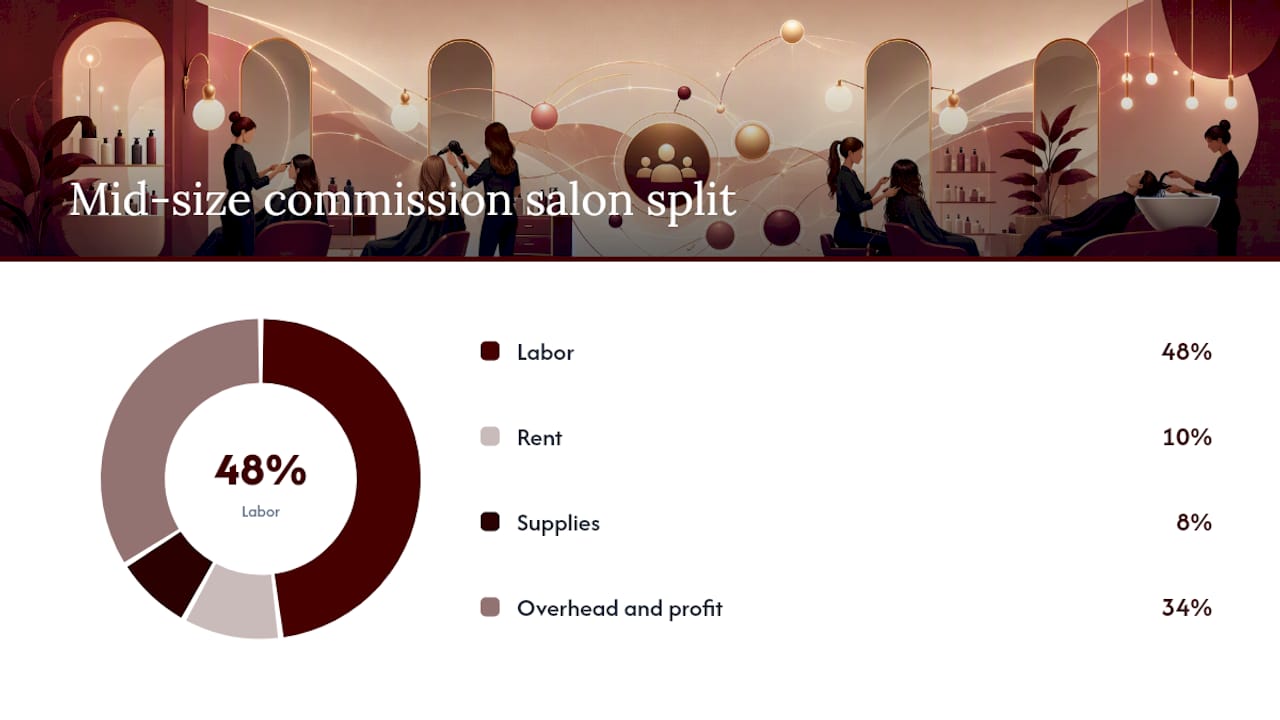
For a mid-size commission salon with four chairs, model labor at 48% of service revenue, rent at 10%, and supplies at 8%, leaving roughly 34% for overhead and owner profit before taxes. A full-service salon with six or more chairs can achieve better rent ratios but carries higher payroll risk.
What does a realistic startup budget look like?
Startup costs break into five categories. The ranges below reflect U.S. market conditions for three common models.
Build-out costs are the most variable and the most commonly underestimated. Ventilation, plumbing for shampoo bowls, and ADA compliance can add $10,000–$30,000 to a storefront build-out that initially looked straightforward. Get contractor bids before you finalize the funding ask.
For tech, Square handles POS and appointment booking for solo operators at low entry cost, while QuickBooks integrates with most booking platforms to automate your P&L and cash-flow tracking. Both are worth budgeting from day one.
Add a contingency line of 10–15% of your total pre-working-capital costs. Then add 3–6 months of fixed operating costs as your working capital reserve. That combined number is your minimum funding ask.
Where do you find downloadable templates and how do you adapt them?
Your appendix should contain the supporting documents that make the plan credible to anyone reading it cold: a copy of your signed lease or letter of intent, a sample employment or booth-rental contract, supplier quotes for FF&E and retail inventory, a market research snapshot (competitor prices, local demographic data), and copies of your licenses and permits once obtained.
For downloadable templates, LivePlan offers free sample plans for hair salons, hair and beauty salons, and barbershops. Each includes a pre-built financial model you can adapt by swapping in your local rent, your service prices, and your staffing model assumptions.
How to adapt a template for a lender packet:
- Replace every placeholder assumption with a locally researched number (actual rent quotes, real competitor prices, your own service menu)
- Add a month-by-month P&L and cash-flow forecast for 12 months
- Include a use-of-funds schedule that ties each dollar of the funding ask to a specific line item
- Attach supporting documents in the appendix in the order a lender would want to review them
Pro Tip: Keep two versions of the plan: a clean PDF for lenders and landlords, and a live spreadsheet for yourself. The spreadsheet is where you update assumptions monthly. The PDF is a snapshot. Never send the spreadsheet to a lender unless they ask for it.
What’s the launch timeline and lender-readiness checklist?
A 90–120 day pre-launch roadmap keeps the plan from staying a document and becoming a business.
- Weeks 1–2: Finalize concept, run the three numbers on the one-page scaffold, identify three target locations
- Weeks 3–4: Tour locations, get rent quotes, pull demographic data for each site, begin competitor mapping
- Weeks 5–6: Negotiate lease terms, get contractor bids for build-out, finalize legal structure and open business bank account
- Weeks 7–8: Sign lease or letter of intent, submit permit applications, order FF&E with lead times in mind
- Weeks 9–10: Finalize staffing model, post job listings or contact booth-rental candidates, set up POS and booking software
- Weeks 11–12: Pre-opening marketing push (Google Business Profile, founding-client offer, social media), staff training
- Weeks 13–16: Soft launch with pre-booked clients, collect reviews, refine operations, open fully
Lender-readiness checklist:
- Complete monthly P&L and cash-flow forecast (12 months)
- Balance sheet at opening
- Itemized startup budget with contractor bids attached
- Signed lease or letter of intent
- Three months of personal bank statements
- Personal financial statement (assets, liabilities, net worth)
- Use-of-funds schedule
- Collateral notes (equipment, personal assets if applicable)
- Business license and entity formation documents
- Key hire commitments or signed booth-rental agreements
The SBA’s small-business resources outline what lenders typically review when evaluating loan requests. A complete, well-organized packet shortens the approval timeline and signals that you run a tight operation before you’ve opened the door.
How do you write the plan faster and keep it useful after opening?
Start with the three numbers. Seriously. Before you write a mission statement or pick a font for your logo, fill in startup cost, break-even clients per week, and year-one owner draw on a single page. If those numbers don’t work, the plan needs revision, not polish.
Once the numbers hold up, expand the one-page scaffold into full sections only as needed. A solo suite renter applying for no outside funding may never need more than four pages. A full-salon operator seeking a $200,000 SBA loan needs the complete lender packet.
To keep the plan alive after opening:
- Monthly: compare actual revenue and expenses to your P&L forecast. Note the variance and adjust the next month’s assumptions.
- Quarterly: run a pricing and promotion test. Raise one service price by $5–10 and track whether bookings hold. Test one new add-on package.
- Every 90 days: review your rebooking rate, retail percentage, and chair utilization against the benchmarks. If any metric is consistently below target, that’s where to focus, not on adding new services.
Pro Tip: Draft the plan in a shared Google Doc or Notion page so you can update it without reformatting a PDF every time. Keep the lender-ready PDF as a separate export. The living document is your operating manual; the PDF is your pitch deck.
What most salon owners get wrong in their business plan
The two mistakes I see most often have nothing to do with formatting or missing sections. The first is underestimating runway. Owners calculate break-even correctly, then fund only to break-even with no buffer. Month three arrives, revenue is 20% below projection (which is normal), and there’s no cash to cover the gap. The fix is mechanical: add three months of fixed costs to your funding ask before you finalize the number. If that makes the ask feel too large, the fixed-cost structure needs to come down, not the runway.
The second mistake is hiring too fast. A new salon owner lands a good first month, feels the pressure of a full appointment book, and hires a second stylist before the first month’s cash has cleared. Now payroll is fixed, but revenue is still variable. The one-page scaffold forces you to model staffing costs explicitly before you commit. If adding one commission employee doesn’t move break-even to a number you can hit in month four, wait until month six when you have the data to justify it.
The “three numbers” approach isn’t a shortcut. It’s a forcing function. Owners who fill those three cells before they sign a lease make better decisions at every step after it, because they’ve already stress-tested the model against reality.
Lumaripro turns your salon plan into a running business
Most salon owners finish the plan and then watch it collect dust. Lumaripro is built for what comes next: the daily reality of running a suite or independent salon without a finance team, an HR department, or a business partner to sanity-check your numbers.

The platform connects to your POS and QuickBooks integration to pull real revenue and expense data into live dashboards, so your P&L is never a spreadsheet you update manually. Business playbooks walk you through pricing strategy, client retention, and retail margins using frameworks built specifically for suite-based operators. Group and 1:1 coaching sessions replace the guesswork of figuring out why your rebooking rate is stuck at 28% or why retail isn’t moving.
For suite renters and independent operators, Lumaripro is the difference between a plan that sits in a folder and one that runs your business week to week. See how it works and start a trial today.
Sources
The sources below back the benchmarks, templates, and lender-readiness guidance throughout this article. Each is worth bookmarking.
- How to Write a Hair Salon or Barber Shop Business Plan + Free Sample Plans | LivePlan
- The Salon Business Plan: Free Template + Complete Guide | TheSalonBrief
- Business Plan for Salon Suites | Build, Launch, Scale | Salon Sequence
- How to Write a Salon Suite Business Plan (Renter’s Guide) | Rockwall Salon and Spa
- Salon Business Plan: Complete Guide with Numbers, Structure, and Real Examples - SocCash
- Avedafi
- Self-Employment Tax (Social Security and Medicare Taxes) | IRS
This article is general information, not a substitute for advice from a qualified financial advisor. Consult a qualified financial professional about your own circumstances before acting on anything here.
Recommended