A salon business playbook is a written set of systems, scripts, and financial rules that runs your business whether or not you’re behind the chair. The highest-leverage module to build first is client ownership and chair economics: moving loyalty from “my stylist” to “my salon,” and making revenue per technician-minute visible. Trade guides consistently find that prioritizing booking and retention fixes first delivers the fastest return. LumariPRO builds this exact sequence into its dashboards.
- Owns client data at the brand level, not the stylist level
- Tracks revenue per technician-minute weekly
- Automates rebooking and deposit collection
Start this week: pull last month’s booking data and calculate your average revenue per chair-hour before you touch pricing.
Key Takeaways
A salon business playbook works when it sequences retention and booking fixes before pricing and compensation projects, and makes chair-level profit visible every day.
| Point | Details |
|---|---|
| Start with retention, not pricing | Fix rebooking and no-show controls before touching your menu or commission structure. |
| Calculate revenue per minute | Divide net service price by actual minutes worked to find which services truly profit. |
| Use a 30/90-day sequence | Automate booking and deposits in 30 days; reprice and retrain by day 90. |
| Document before automating | Write the script, price rule, or complaint procedure before software enforces it. |
| LumariPRO speeds execution | Its dashboards and POS/QuickBooks integrations surface chair economics automatically. |
Table of Contents
- Core Salon Business Playbook Modules to Build First
- Your 30/90-Day Salon Playbook Rollout
- Financial Playbook: Pricing by the Minute, Not the Menu
- Building a Team That Runs the Playbook Without You
- Which Salon Technology Should You Automate First?
- How LumariPRO Executes This Playbook Faster
- How to Handle Client Complaints and Recover Service Failures
- Legal and Compliance Basics Every Salon Playbook Needs
- Sources
Core Salon Business Playbook Modules to Build First
A playbook is only useful if it’s ordered. Build these in sequence, not all at once, and you’ll avoid the chaos of trying to fix pricing, staffing, and marketing simultaneously.
- Pricing and menu engineering. Services often get priced by popularity rather than profit. Action: examine ticket data over several months and identify services with revenue per minute below your shop average.
- Booking and no-show controls. No-shows, even brief ones, can negatively impact revenue significantly. Action: turn on deposit requirements and automated text reminders this week.
- Client retention and rebooking. Walk-outs without a next appointment are the single biggest churn driver. Action: script a rebooking line for every front-desk and stylist interaction.
- Chair-level financials and compensation. Most owners know total revenue, not per-chair profit. Action: build one spreadsheet tab per technician showing revenue minus product cost minus commission.
- Retail attach and bundling. Retail margin often outpaces service margin. Action: set a per-ticket retail suggestion script and track attach rate weekly.
- Operations and standards. Inconsistent service is the top complaint driver in multi-stylist shops. Action: write a one-page standard for your three most-booked services.
- Daily dashboard and KPIs. You can’t fix what you don’t measure daily. Action: pick five numbers (bookings, no-shows, retail attach, rebooking rate, revenue per hour) and check them each morning.
The order matters. Retention and booking fixes pay off in days. Pricing and compensation projects take longer but move the profit needle further, and neither works if the front desk is still losing clients to no-shows.
Your 30/90-Day Salon Playbook Rollout
Turning modules into habits takes a sequence, not a memo. Here’s a timeline that assigns simple owners to each action so nothing stalls waiting on “someday.”
First 30 days:
- Turn on automated rebooking prompts at checkout. Owner: front desk lead. Metric: percentage of clients leaving with a booked next visit.
- Require deposits on new-client and higher-value bookings where appropriate. Owner: you or your manager. Metric: no-show rate.
- Run a timing audit on your five busiest services. Owner: you. Metric: actual minutes per service versus menu time.
- Set a five-number daily dashboard. Owner: you. Metric: consistency of morning check-ins.
Next 60 days (through day 90): 5. Reprice or re-time any service below your revenue-per-minute average. Owner: you. Metric: average ticket after repricing. 6. Adjust compensation structure if a technician’s chair economics don’t cover their cost. Owner: you, with technician input. Metric: net profit per chair. 7. Launch a retail attach script and train staff to use it. Owner: senior stylist or manager. Metric: attach rate. 8. Run a training session on your written service standards. Owner: manager. Metric: repeat-complaint rate.
Pro Tip: Don’t launch all four 30-day actions on the same Monday. Stagger them by a few days so your team can absorb one new habit before the next lands.
Financial Playbook: Pricing by the Minute, Not the Menu
Revenue per technician-minute is the number most salon owners have never calculated, and it’s the one that changes pricing decisions fastest. The formula is simple: take a service’s total price, subtract product cost, then divide by the actual minutes it takes (not the menu time). A $65 color service that actually eats 90 minutes of chair time nets less per minute than a $45 blowout done in 30.

Run this audit on your five busiest services this week. Moonmoot’s operating playbook notes that the busiest services on a menu are often not the most profitable, and re-timing or repricing them can lift margin without adding a single new client.
Three levers to pull once you have the numbers:
- Protect peak hours with deposits and prepay packages so Friday and Saturday slots aren’t lost to no-shows.
- Raise average ticket through service bundles (color plus gloss, cut plus treatment) rather than raising any single line-item price.
- Push retail attach at checkout, where margin frequently beats service margin on a per-minute basis.
Building a Team That Runs the Playbook Without You
Delegation fails when owners hand off tasks but keep the decisions. A leadership mindset means writing down the decision rules, not just the to-do list, so a manager can act without texting you every hour.
Compensation shapes behavior more than any pep talk. If a technician’s commission structure doesn’t leave room for product cost and your target margin, no amount of “hustle” fixes it. Run a quick diagnostic: for each technician, is their monthly revenue minus product cost minus commission still profitable after rent and overhead allocation? If not, the pay structure needs adjusting before performance expectations do.
- Write one-page role docs for front desk, senior stylist, and assistant positions
- Run a 15-minute weekly huddle to review the five-number dashboard
- Hold a monthly one-on-one focused on one skill, not general feedback
Pro Tip: Ask each technician to calculate their own chair economics once. Ownership of the number changes behavior faster than a lecture about it.
Which Salon Technology Should You Automate First?
Document the process before you automate it. A rebooking script, a pricing rule, and a complaint-handling procedure all need to exist on paper before software can enforce them consistently.
Once documented, prioritize these capabilities in order:
- Booking and reminders to cut no-shows automatically
- CRM that lives with the brand, not a single stylist’s personal phone
- A daily dashboard pulling bookings, retail, and rebooking rate into one view
- POS to bookkeeping integration, since manual data entry between systems is where financial clarity dies
Square’s guide to opening a salon recommends an integrated POS precisely because scheduling, staff management, and sales tracking work best tied together rather than bolted on separately. Data ownership matters here too: if client history lives in a stylist’s personal app instead of your system, you don’t own your own client base.
How LumariPRO Executes This Playbook Faster
LumariPRO was built to close the gap between knowing what to do and actually doing it. The platform maps directly onto the modules above:
- Real-time dashboards that surface revenue per technician-minute automatically
- POS and QuickBooks integrations so chair economics don’t require a spreadsheet
- Built-in playbooks and coaching (group and one-on-one) for the 30/90-day rollout
- A peer community for owners implementing the same modules in parallel
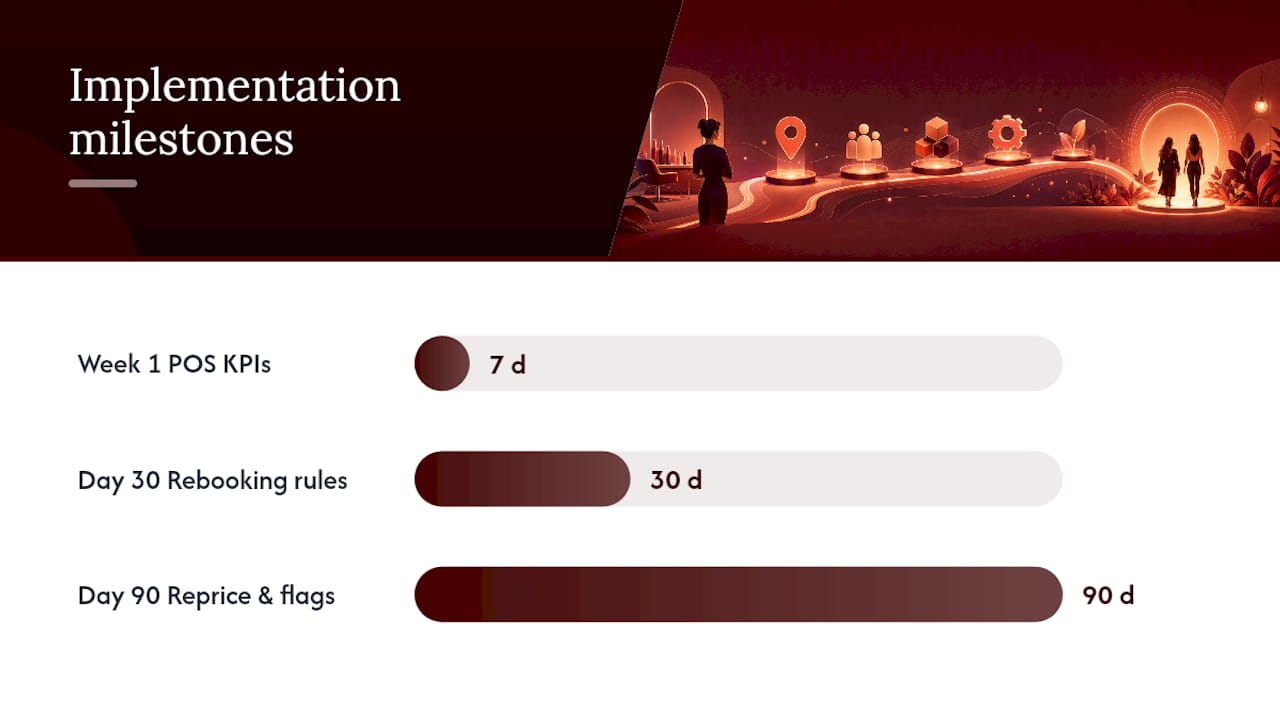
A typical workflow: week one connects your POS and pulls baseline KPIs into the dashboard; by day 30, automated rebooking and deposit rules are live; by day 90, the platform has surfaced which services to reprice and flagged which technician’s chair economics need a compensation conversation.
How to Handle Client Complaints and Recover Service Failures
A complaint handled well often builds more loyalty than a service that never went wrong in the first place, because it’s the moment a client decides whether to trust the brand again. The failure isn’t usually the botched color or the late appointment. It’s what happens in the next ten minutes.
Build a simple recovery sequence into your standards module:
- Acknowledge without defending. “I hear you, and that’s not the experience we want you to have” beats any explanation.
- Fix it same-visit when possible. A redo, a partial refund, or a complimentary add-on resolves most complaints on the spot.
- Document the pattern. One bad haircut is a technician issue. Three complaints about the same service in a month is a training or pricing issue.
- Follow up within 48 hours. A short text checking in on the fix costs nothing and often converts an angry client into a repeat one.
Train every front desk person and stylist on this sequence specifically, not as part of a general “customer service” chat. The script should live in your operations module alongside your service standards, because a complaint is really just your standards being tested in public. Track complaint volume and resolution time as two of your dashboard numbers. If resolution time creeps up, that’s usually a staffing or authority problem: someone at the front desk needs the power to comp a service without calling you first.
Legal and Compliance Basics Every Salon Playbook Needs
Licensing and compliance aren’t glamorous, but they’re the foundation the rest of the playbook sits on. Cosmetology licensing requirements, health and sanitation codes, and business registration vary by state and county, so verify your specific requirements with your state’s cosmetology board rather than assuming your last shop’s rules apply.
Beyond licensing, four areas belong in every salon’s compliance checklist:
- Booth rental agreements, if you lease chairs to independent stylists, need clear written terms on rent, scheduling, and liability.
- Employee versus independent contractor classification, which affects payroll tax obligations and can trigger penalties if misclassified.
- Health and safety codes, covering sanitation, chemical storage, and ventilation, typically enforced through state board inspections.
- Liability insurance, covering both the physical space and service-related claims like allergic reactions or chemical burns.
Shopify’s salon opening checklist organizes concept, licensing, and location decisions into a sequence worth revisiting even if you’ve been open for years, since compliance gaps often creep in as a salon grows and adds staff. Build a simple annual calendar reminder for license renewals, insurance reviews, and any required continuing education hours. None of this replaces a conversation with a licensed attorney or accountant for your specific situation, but a documented compliance checklist means you’re not discovering a gap during an inspection.
An Editor’s Take on Systems Versus Hustle
The salons that scale calmly aren’t the busiest ones. They’re the ones where a manager can answer “what’s our rebooking rate” without checking with the owner. Hustle fills a calendar. Systems build a business you can actually sell or step back from.
Start with one module this week, not all seven.
Getting Started With LumariPRO
LumariPRO turns the modules in this playbook into working dashboards instead of spreadsheets you update once and abandon. Where a generic business tool asks you to build your own tracking from scratch, LumariPRO already connects to your POS and QuickBooks, so revenue per technician-minute, retail attach rate, and rebooking numbers show up automatically instead of requiring a Sunday-night spreadsheet session.

The platform pairs those dashboards with built-in playbooks and coaching, group and one-on-one, so you’re not implementing the 30/90-day rollout alone. If you’re weighing supplier partnerships as part of your retail attach strategy, Crisan’s salon partnership program is worth a look alongside your own retail plan.
Check the LumariPRO plans page to see which tier matches where you are in the playbook, or visit how LumariPRO helps salon owners to see the platform mapped against these exact modules before you commit.
Sources
Recommended