A strong salon cancellation policy protects your booked time, sets clear notice windows, defines fees, and secures client consent before the appointment ever happens. Without those four elements in writing, you have a preference, not a policy.
Here is the short version you can paste into your booking flow today:
“We require notice to cancel or reschedule, typically one to two full days. Cancellations made late may incur a fee commonly around half the service price. No-shows usually incur a charge equal to the full service price. A card on file is required to hold your appointment. By booking, you agree to these terms.”
Every enforceable policy needs exactly four things:
- Notice window: typically one to two full days depending on service type
- Fee structure: clearly defined late cancellation and no-show charges
- Secured payment method: card on file, deposit, or prepayment
- Documented consent: affirmative agreement recorded at booking
The templates section below has copy-ready wording for three levels of strictness.
Key Takeaways
A written salon cancellation policy with card-on-file consent, a tiered fee structure, and automated reminders is the most direct way to recover lost revenue from no-shows and late cancellations.
| Point | Details |
|---|---|
| Notice window by service type | Use 24 hours for quick services; use 48 hours for color, extensions, group, or bridal bookings. |
| Standard fee benchmarks | Charge 50% of the service price for late cancellations and 100% for no-shows. |
| Three documentation elements | Timestamped consent, confirmation/reminder trail, and appointment record make fees defensible in disputes. |
| Reminder cadence that works | Send three automated reminders: 3 days out, 24 hours out, and 2 hours before the appointment. |
| Lumaripro for enforcement | Lumaripro’s platform automates consent capture, card validation, reminders, and no-show tracking for suite owners. |
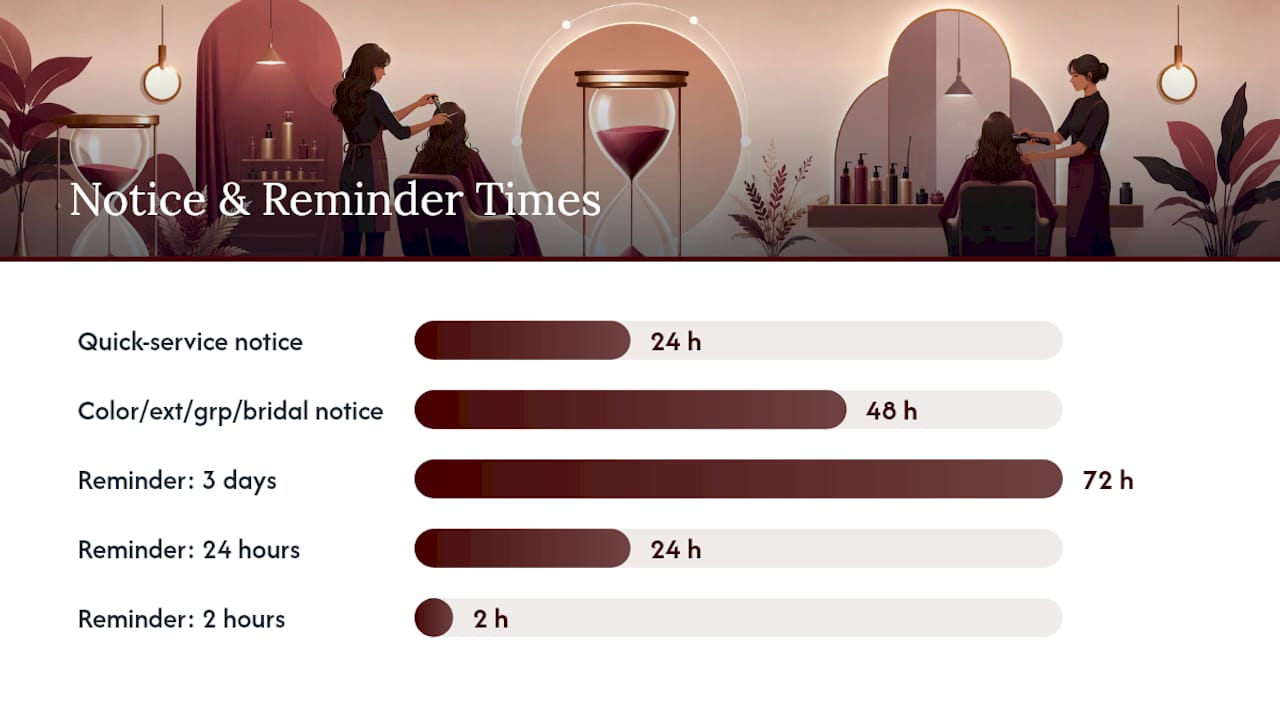
Table of Contents
- Why your salon’s revenue depends on a written cancellation policy
- What every salon cancellation policy must include
- Ready-to-copy cancellation policy templates for common salon scenarios
- How to implement and enforce your policy step by step
- Legal considerations for U.S. salons: what makes a fee defensible
- How to choose the right notice window and fee amount
- How Lumaripro operationalizes your cancellation policy
- The policy change that actually moved the needle
- Lumaripro gives you the tools to stop losing revenue to no-shows
- Sources
Why your salon’s revenue depends on a written cancellation policy
A single no-show on a $200 color service is not just a lost appointment. It is a blocked time slot no other client could fill, a stylist who showed up and earned nothing, and a product cost you already absorbed. Multiply that by even two or three per week and the annual loss becomes significant.

The financial case is straightforward. When a client cancels 30 minutes before a two-hour color appointment, you cannot realistically rebook that slot. The stylist’s time is gone. Your overhead for that hour runs regardless. A written policy with a card on file means that time has a recoverable value.
Beyond revenue, a clear policy protects your staff’s income. Suite renters and commission stylists earn only when they work. A no-show policy salon owners enforce consistently tells the team their time is valued, which matters for retention.
There is also a fairness argument. Clients who book and show up reliably deserve access to your best availability. A policy that creates consequences for chronic no-shows frees those slots for clients who respect them.
Industry best practices recommend a three-part framework: prevention through reminders and card-on-file requirements, clear communication at booking and in confirmations, and tiered enforcement with graduated consequences. That structure reduces recurring no-shows while keeping the client relationship intact.
What every salon cancellation policy must include
A policy that is vague or buried in fine print is nearly impossible to enforce. LegalClarity’s guidance is direct: a fee is defensible when the client gave clear consent before booking and the salon can document that agreement. Here is what that means in practice.
Definitions that prevent disputes
Start by defining your terms. Clients will test the edges.
- Cancellation: client notifies you before the appointment, within or outside the notice window
- Reschedule: client moves the appointment to a new time (decide whether this triggers a fee if done inside the notice window)
- No-show: client does not arrive and does not contact you
- Late arrival: client arrives after a threshold (typically 15 minutes) that prevents the full service
Spell out who decides exceptions. “At the salon’s discretion” is fine, but your staff needs a consistent answer when a client calls with a story.
Required clauses
- Notice window: state the exact hours (24 or 48) and when the clock starts (from appointment time, not from when you open)
- Fee amounts: a specific dollar amount or percentage, not “a fee may apply”
- How charges are processed: card on file, deposit applied, or invoice sent
- Deposit rules: when deposits are required, whether they are refundable, and under what conditions they transfer to a rescheduled appointment
- Exception handling: illness, documented emergencies, and first-offense grace (one-time courtesy waiver)
- Minor clients: who holds the card on file and who signs the consent
24 hours versus 48 hours
Use 24 hours for haircuts, blowouts, and quick services where the slot can realistically be refilled same-day. Use 48 hours for color, extensions, keratin treatments, bridal, or any group booking where preparation time and product cost are significant. Keptbookings’ template guidance recommends 24–48 hours as the standard window, with card on file or deposit required to make the fee enforceable.
Pro Tip: Keep two versions of your policy text: a condensed two-sentence checkbox for the booking screen and a full-length version for your website and confirmation emails. The checkbox captures consent in seconds; the long form gives you documentation depth for disputes.
Ready-to-copy cancellation policy templates for common salon scenarios
These three templates move from gentle to firm. Adapt the bracketed fields to your service menu and ticket size.
Template 1: Gentle (reminder-first, low-ticket services)
“We understand life happens. We ask for [24] hours’ notice if you need to cancel or reschedule so we can offer your spot to another guest. Repeated last-minute cancellations may require a deposit for future bookings. Thank you for respecting our time.”
Use this for quick-service salons with a high client volume and easy rebooking. It sets expectations without requiring a card on file upfront, which works well for walk-in-friendly businesses building a new client base.
Template 2: Standard (24-hour notice with fee structure)
“We require a full day’s notice to cancel or reschedule your appointment. Late cancellations may incur a fee commonly around half of the scheduled service price. No-shows are charged the full service price. A valid credit card is required to hold your booking. By completing your reservation, you agree to this policy.”
This is the right fit for most full-service salons. It is firm enough to recover revenue but not so aggressive that it alienates new clients. Pair it with a first-offense grace period communicated verbally, not in writing, so you retain flexibility without setting a precedent.
Template 3: Firm (card on file + deposits for high-value or group bookings)
“A non-refundable deposit is typically required to secure appointments for higher-value services such as color, extensions, bridal, and group bookings. This deposit applies toward the service and may be forfeited for late cancellations or no-shows. Deposits may be transferable once to a rescheduled appointment if given sufficient notice. By booking, you authorize us to charge the card on file per this policy.”
This template fits high-ticket services where product is pre-ordered and chair time cannot be easily refilled. Reservio’s no-show policy guidance recommends exactly this approach: 48-hour windows and deposits for longer or group services, 24-hour windows for quick appointments.
Booking checkbox wording
For the point-of-booking consent capture, use something this short:
“I agree to the cancellation policy: a notice period is required; late cancellations may incur a charge commonly around half the service price; no-shows are charged the full price.”
Link the bracketed phrase to your full policy page. That link creates a timestamped record of what the client agreed to.
When to require deposits versus card on file: Deposits work best for new clients, group bookings, and high-ticket services. Card on file is lower friction for returning clients with a clean history. For a real-world example of how a service-based beauty business structures these terms, Véloura’s reliability policy shows how an on-demand operator handles cancellation and reliability language in practice.
How to implement and enforce your policy step by step
Writing the policy is the easy part. Getting it into your booking workflow, training your staff, and actually charging fees when needed is where most salons stall.
Technical setup checklist
- Enable policy agreement at booking. In Square, Booksy, or SalonBiz, turn on the policy acknowledgment step so clients must check a box before confirming. This creates a timestamped consent record.
- Require card on file or deposit at booking. Do not make this optional. Square and Booksy both support card-on-file capture during the booking flow; SalonBiz supports deposit collection natively.
- Validate the card. Run a $0 or $1 authorization at booking so you know the card is real before the appointment day.
- Set automated reminders. Three touches work best: 3 days out, 24 hours out, and 2 hours before. Each reminder should restate the cancellation window so clients cannot claim they forgot.
- Enable post-appointment logging. Record no-shows and late cancellations in the client profile immediately. This creates the paper trail you need if a client disputes a charge.
Staff scripts
At phone booking: “I’ll need a card on file to hold this appointment. Our policy is [24/48] hours’ notice to cancel or reschedule. Within that window, we do charge [50%] of the service. Does that work for you?”
Day-of reminder (text or call): “Hi [Name], just a reminder about your [service] tomorrow at [time]. If you need to cancel or reschedule, please let us know by [specific time] to avoid a cancellation fee. We look forward to seeing you!”
After a no-show: “Hi [Name], we had you scheduled for [service] today at [time] and didn’t hear from you. Per our cancellation policy, a [100%/$X] charge has been applied to the card on file. We’d love to rebook you — please reach out when you’re ready.”
Enforcement ladder
TheSalonBusiness’s guidance and industry practice both support a tiered approach that changes behavior without burning relationships.
- First offense: courtesy waiver, verbal reminder of the policy, note in client file
- Second offense: 50% charge applied, written confirmation sent
- Third offense: 100% charge, deposit required for all future bookings
- Repeat pattern: booking restrictions (prepay only or no future bookings)
Metrics to track
Track your no-show rate (no-shows divided by total appointments), late-cancel rate, and recovered revenue from fees charged. If your no-show rate drops after implementing the policy, that is your ROI signal. If it stays flat, your reminder cadence or consent capture needs tightening.
Pro Tip: Before you start charging fees, run a two-week test of your booking flow as if you were a new client. Confirm the policy checkbox appears, the card capture works, and the reminder sequence fires correctly. Fix the gaps before a dispute forces you to.
Legal considerations for U.S. salons: what makes a fee defensible
Cancellation fees are generally lawful in the United States when three conditions are met: the fee is reasonable relative to the service price, the client gave affirmative consent before booking, and the salon has documentation to back up the charge.
“Reasonable” is not defined by statute in most states, but courts and card networks look at whether the fee is proportionate to actual lost revenue. Charging $200 for a no-show on a $200 service is defensible. Charging $200 for a no-show on a $30 haircut is not.
The three documentation elements that matter in a chargeback dispute:
- Signed or checked consent: a timestamped booking confirmation showing the client agreed to the policy
- Confirmation and reminder trail: emails or texts sent before the appointment that restated the cancellation terms
- Appointment record: date, time, service booked, and the no-show or late-cancel notation
LegalClarity’s enforceable policy framework confirms that clear, prominent display of the policy at booking, in confirmation emails, and on-site increases the chance fees hold up in disputes.
Special cases to watch
- Minors: the cardholder must be the parent or guardian, and that person must be the one who agreed to the policy
- Medical emergencies: document the exception in the client file; a one-time waiver with a note is far less risky than a disputed charge
- State-level variations: some states have consumer protection rules that affect how deposits are handled or refunded; consult a local attorney if you are implementing a deposit policy for the first time
Pro Tip: Post your full policy in three places: your booking confirmation email, your website’s booking page, and a printed sign at your front desk or suite door. Three-point visibility is your best defense if a client claims they never saw it.
This article provides general information, not legal advice. Consult a licensed attorney in your state before implementing fees or deposit requirements for the first time.
How to choose the right notice window and fee amount
The right numbers depend on your average ticket, how quickly you can refill a slot, and how much prep work a service requires.
Notice window benchmarks
Use 24 hours when your services run under 90 minutes, your client volume is high enough to fill gaps same-day, and most of your bookings are repeat clients who know the drill. Haircuts, blowouts, and basic color touch-ups fit here.
Use 48 hours when you pre-order product for the appointment, the service runs two hours or more, or the booking is for a group or bridal party. Extensions, full color, and keratin treatments all justify the longer window. Keptbookings and Reservio both cite this service-length logic as the primary driver of notice window choice.
Fee options and when to use each
- Flat fee ($25–$50): low friction, easy to explain, works well for lower-ticket services where a percentage would feel trivial
- Percentage of service (50% late cancel / 100% no-show): scales with your ticket, feels proportionate to clients, and is the most common structure in working templates
- Deposit (25–50% of service price): best for high-ticket or group bookings; collected upfront, applied to the service if the client shows
- Full-service charge for no-shows: appropriate when the slot is genuinely unrecoverable (bridal, extensions, same-day appointments)
A simple revenue-impact calculation
If you have 10 appointments per week at an average of $120 and your no-show rate is 10%, you are losing roughly $1,200 per month in unrecovered revenue. A 50% late-cancel fee on those appointments recovers $600. A card-on-file policy that reduces your no-show rate by half recovers the other $600 by keeping the slot fillable.
Pro Tip: For group and bridal bookings, require a non-refundable deposit equal to at least one service’s cost and set the notice window at 72 hours. Same-day cancellations on a party of five are essentially unrecoverable, so the deposit needs to cover your floor cost, not just your inconvenience.
How Lumaripro operationalizes your cancellation policy
Enforcing a cancellation policy manually, across texts, emails, and a paper sign-in sheet, creates gaps. Lumaripro’s platform is built to close those gaps for suite renters and independent beauty professionals who do not have a front desk team handling it.
The platform connects to your POS and booking tools to support:
- Consent capture at booking: policy agreement is built into the booking flow, creating a timestamped record automatically
- Card-on-file and deposit workflows: clients enter payment details at booking, and the platform handles authorization so you are not chasing cards on appointment day
- Automated reminder sequences: three-touch cadence (3 days, 24 hours, 2 hours) fires without manual follow-up, and each message restates the cancellation window
- No-show and late-cancel tracking: client profiles log every missed appointment, so you can see repeat patterns and apply the enforcement ladder with evidence
- Financial dashboards: recovered revenue from fees and your no-show rate appear in real-time, so you can measure whether the policy is actually working
For a new client booking a color service, the flow looks like this: they book online, agree to the policy, enter a card for the deposit, and receive three automated reminders. If they no-show, the charge processes automatically and the event is logged. No manual follow-up required.
Lumaripro’s platform capabilities are built specifically for the suite and solopreneur model, where you are the owner, the stylist, and the front desk all at once.
The policy change that actually moved the needle
The most common mistake salon owners make is writing a strong policy and then not enforcing it the first time. One courtesy waiver is reasonable. A pattern of courtesy waivers trains clients that the policy is optional.
The quickest win is almost always the booking checkbox combined with a first-offense grace period that is communicated verbally but not written into the policy. You tell the client once, in person or by text: “I waived the fee this time, but going forward the policy applies.” That conversation, logged in the client file, changes behavior faster than any wording change.
Most owners who implement a card-on-file requirement alongside a three-touch reminder sequence see their no-show rate drop within four to six weeks. The reminders alone reduce genuine forgetfulness. The card on file changes the calculus for clients who cancel casually. Together, they address the two most common causes of missed appointments.
A realistic timeline: set up the booking flow and reminders in week one, run the test booking yourself in week two, start enforcing fees in week three. By week six, you will have enough data to know whether your no-show rate has moved.
Lumaripro gives you the tools to stop losing revenue to no-shows
Most salon owners know they need a cancellation policy. The gap is in the setup: getting consent capture, card validation, reminders, and fee tracking working together without spending hours configuring software that was not built for beauty businesses.

Lumaripro is built specifically for suite renters and independent beauty professionals who need those systems to work without a dedicated admin. The platform’s owner-focused tools include policy templates, booking consent workflows, automated reminder sequences, and real-time dashboards that show your no-show rate and recovered revenue in one place. It connects to your POS and QuickBooks so your financial picture is always current.
If you are ready to stop absorbing the cost of missed appointments, explore the Lumaripro platform and see how the policy enforcement tools fit your booking workflow.
Sources
These are the primary references cited throughout this guide, each worth bookmarking for their copy-ready template text.
- Salon Cancellation Policy Template (Free) | Keptbookings
- 6 Salon Cancellation Policy Examples Free Template | TheSalonBusiness
- Salon No-Show Policy: 4 Copy-Paste Templates (2026) | Regulr Blog
- No-Show Policy Wording: Templates for 4 Business Types | Reservio Blog
This article is general information, not a substitute for advice from a qualified lawyer. Consult a qualified legal professional about your own circumstances before acting on anything here.
Recommended