For most salon and spa owners, the right salon coaching programs pair a structured 6- to 12-month curriculum with real business tools, not just motivational calls. That combination drives faster gains in leadership and profit than either piece alone. Your immediate next step: book a discovery call and ask for a sample 90-day action plan, coach credentials, and the KPIs the program actually tracks. If a provider can’t produce those three things on the spot, keep shopping.
Key Takeaways
The most reliable salon coaching programs combine a fixed, KPI-anchored curriculum with tools that let owners verify results in real time rather than waiting on faith.
| Point | Details |
|---|---|
| Match format to role | Solo owners suit certification journeys; established owners suit custom 1:1 coaching. |
| Demand KPI attachment | Every curriculum module should name a specific metric it’s meant to move. |
| Expect 6 to 12 month cycles | Certification and accelerator programs typically run this range, with intensives compressed to 6 to 8 weeks. |
| Verify before you sign | Ask for coach bios, a sample module overview, and a reference call before enrolling. |
| Pair coaching with tools | Lumaripro combines AI coaching, dashboards, and POS/QuickBooks integrations so progress is measurable, not assumed. |
Table of Contents
- What Do Salon Coaching Programs Actually Look Like?
- Which Program Type Fits Your Role?
- What Should the Curriculum Actually Cover?
- How Long Do These Programs Run, and What Do They Cost?
- How Do You Choose the Right Program?
- What Do Credible Coach Bios and Case Studies Look Like?
- Coaching When You’re Already Stretched Thin
- How LumariPRO Pairs Coaching With the Tools to Prove It Works
- Where to Learn More
- Frequently Asked Questions
- Sources
What Do Salon Coaching Programs Actually Look Like?
Salon business coaching splits into five recognizable formats, and knowing which one you’re looking at saves you from mismatched expectations.
- Certification journeys run multi-module tracks over roughly six months, blending virtual coaching with on-site visits, similar to the model Summit Salon Business Center uses for its Certification Journey.
- Accelerators compress the same ground into weeks instead of months, useful when one problem (pricing, staffing) needs fixing fast.
- Custom 1:1 coaching is built around your specific numbers rather than a shared syllabus.
- Membership or group coaching gives you weekly calls and peer accountability at a lower price point.
- Spa and medspa-specific tracks address regulatory and service-mix issues generic salon programs skip entirely.
When a landing page says “weekly calls,” it usually means a 45 to 60 minute group session. “6 to 12 months” almost always means a phased curriculum with milestone check-ins, not a single long course.
Which Program Type Fits Your Role?
Not every owner needs the same salon management programs, and matching format to role is where most people waste money.
- Solo owners and first-time managers benefit most from certification journeys that build leadership skills and pricing discipline from the ground up.
- Multi-location or established owners get more out of custom 1:1 coaching focused on margin growth and delegation.
- Suite renters and independents need lighter-weight, tool-driven coaching that covers client acquisition and retail margins without salon-level overhead.
- Beauty school owners often need a hybrid: staff training content plus the same profitability frameworks their graduates will eventually need.
Realistic outcomes include a measurable bump in average ticket, better staff retention, and fewer hours the owner personally spends on scheduling and payroll.
What Should the Curriculum Actually Cover?
A credible program covers six areas, and each one should tie to a number you can track, not just a feeling of improvement.
- Leadership and team culture — should move staff retention and reduce turnover-related hiring costs.
- Pricing and profit — should lift average ticket and gross margin per service.
- Service flow and productivity — should raise bookings per chair and cut idle time.
- Retail and add-on sales — should increase retail attach rate per ticket.
- Marketing and retention — should improve client rebooking rate and reduce no-shows.
- Operations and bookkeeping — should tighten labor-to-revenue ratio.
Pro Tip: Ask any program for the exact KPI it claims to move in each module, not just the topic it covers. “We teach pricing” is not the same as “we help you raise average ticket by tracking it weekly.”
Structured goal-setting, the kind Forbes reports sharpens focus and follow-through, is exactly why KPI-anchored modules outperform vague “business coaching” pitches. What you get should include playbooks, scripts for team conversations, financial dashboards, and help connecting the program to your POS or accounting software.
How Long Do These Programs Run, and What Do They Cost?
Certification and accelerator programs, like the SoZo Academy’s structured apprenticeship model, typically run 6 to 12 months for the full arc, while focused intensives compress that into 6 to 8 weeks around a single bottleneck. Ongoing membership coaching has no end date. It runs as a subscription for owners who want continuous access.
Cadence shapes how much traction you get relative to your own time:
- Regular group calls keep momentum but require consistent attendance to matter.
- Periodic 1:1 sessions work well for owners juggling floor time with strategy work.
- Periodic on-site visits suit multi-location owners who need hands-on audits more than constant check-ins.
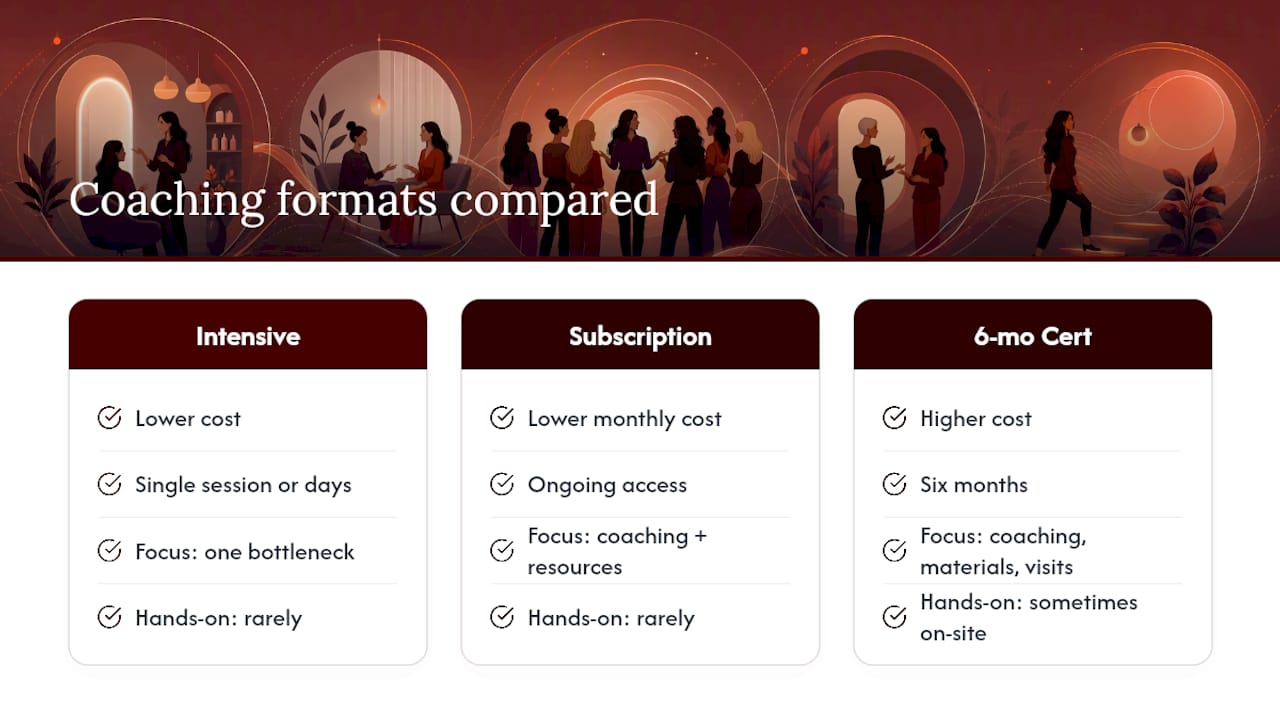
Pricing bands vary widely. Short intensives and 90-day resets sit at the low end and usually include a single deliverable, structural fixes and immediate bottleneck removal, rather than ongoing support. Certification journeys lasting several months cost more but bundle coaching, materials, and sometimes on-site visits into one investment. Subscription-based platforms with built-in coaching tend to land lowest per month since they spread cost across ongoing access rather than a single engagement.
How Do You Choose the Right Program?
Score every program on the same six criteria before you sign anything.
- Fit — does it target your actual role (owner, manager, suite renter) and salon stage?
- Evidence — does it show measurable before-and-after results, not just testimonials?
- Curriculum clarity — can they hand you a syllabus or module overview, similar to the kind of detailed module breakdown SSBC publishes?
- Tools — does it connect to your POS or QuickBooks, or leave you tracking everything by hand?
- Coach credibility — do the coaches have real salon-floor or ownership experience?
- Price versus value — does the investment match what’s actually included?
On the discovery call, ask directly:
- “How is this customized to my salon’s numbers, not just a generic playbook?”
- “What support exists after the program ends?”
- “What KPI targets will we set in the first 90 days?”
- “Does this integrate with my POS or accounting software?”
Red flags are easy to spot once you know what to look for: guarantees with no attached metric, a curriculum described only in adjectives (“transformational,” “empowering”), no listed coach bios, and zero mention of measurable outcomes anywhere on the site. Programs like Kantor & Company’s apprenticeship model show what specificity should look like: named modules, licensing alignment, and a clear salon-floor pipeline.
What Do Credible Coach Bios and Case Studies Look Like?
A trustworthy coach bio names actual salon or ownership experience, not just “years in the industry.” Look for measurable client outcomes (“helped 12 salons raise average ticket by tracking retail attach rate”) and real teaching or certification credentials, similar to how training partners like QAI Hair profile their educators.

A useful case study includes a baseline KPI, the specific interventions made, a timeline, and a measurable result tied to that baseline.
Before enrolling, ask for a reference call or a sample dashboard. If a provider hesitates to share either, that hesitation tells you something the marketing page won’t.
Coaching When You’re Already Stretched Thin
Coaching feels like one more thing until you realize a structured program plus the right tools gets you to a decision faster than guessing alone ever would. The trade isn’t time for more time. It’s scattered hours for focused ones.
My advice: commit to the KPI reviews yourself, but hand implementation to a trusted lead on your team. You don’t need to do everything the coach suggests personally. You need to know whether it’s working.
How LumariPRO Pairs Coaching With the Tools to Prove It Works
Most coaching programs give you a curriculum and leave the tracking to you. Lumaripro closes that gap by pairing AI-powered coaching with business playbooks, real-time dashboards, and direct POS and QuickBooks integrations, so the advice and the numbers live in the same place.
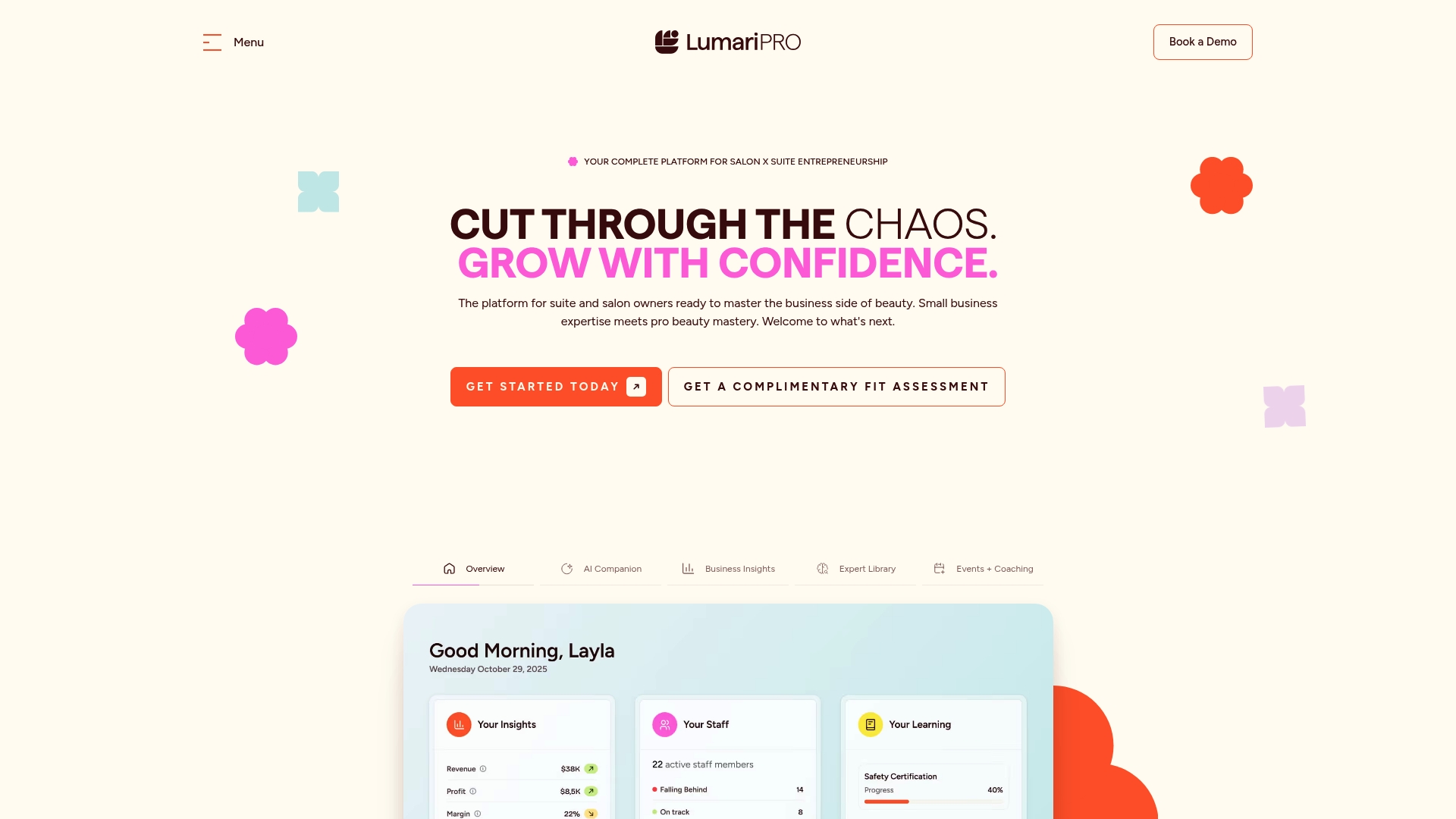
That combination matters because accountability only works when you can see the result of a decision within days, not at the end of a quarter. A pricing change means nothing if you’re still guessing at your margin three months later. Lumaripro’s dashboards turn coaching sessions into a feedback loop instead of a one-way lecture, and the platform’s integration setup means you’re not manually re-entering numbers to check if a change actually moved your average ticket.
If you’re ready to see what this looks like for your business, request a demo and ask specifically for a sample 90-day KPI dashboard, an example first-quarter action plan, and your coach match options. Pricing runs on tiered subscription plans, so ask which tier includes the coaching cadence you actually need before you commit. Start that conversation through Lumaripro’s coaching and platform overview.
Where to Learn More
For curriculum examples, review Summit Salon’s Certification Journey, SoZo Academy’s 12-week apprenticeship model, and Sassoon Academy’s technique-focused courses. When you contact a provider, request their sample curriculum, KPI examples, and at least one client reference before enrolling.
Frequently Asked Questions
How much do salon coaching programs typically cost? Investment ranges widely based on format. Short intensives cost less but cover a single bottleneck, while six-month certification journeys bundle coaching, materials, and sometimes on-site visits into one higher-priced package. Subscription platforms with built-in coaching often cost less per month since expenses spread across ongoing access.
Can online salon coaching replace in-person training? Online salon coaching handles leadership, pricing, and marketing strategy effectively since those areas depend on discussion and accountability, not physical demonstration. Technique-heavy skills like cutting or color still benefit from hands-on formats.
What’s the difference between salon business coaching and general business coaching? Salon-specific coaching accounts for booth rental economics, retail margins, and service-based pricing that generic business coaches often miss entirely. That specificity is why beauty industry coaching outperforms borrowed advice from unrelated industries.
How do I know if a coaching program will actually improve profitability? Ask for the specific KPIs the program tracks and request to see a before-and-after case study with real numbers attached, not just a testimonial. Programs that integrate with your POS or QuickBooks make this far easier to verify on your own.
Sources
- SoZo Hair, Spa & Wigs — Academy program and 12-week apprenticeship
- Forbes — 5 reasons why goal-setting will improve your focus
Recommended