A salon marketing plan is a rolling 12-month system built around three moves: get found, convert fast, and retain the client so they never think about booking elsewhere. It is not a single campaign or a flyer drop before Mother’s Day. It’s infrastructure.
If you do nothing else this week, do these three things. First, audit your Google Business Profile (GBP) and fix anything stale (hours, photos, service list). Second, turn on an automated rebooking sequence so clients get nudged back before they drift to a competitor. Third, start the 30-day checklist later in this article instead of waiting for a “better time” to plan your marketing.
Consistent GBP activity, including fresh photos and prompt review replies, correlates with more discovery traffic and inbound bookings for local service businesses. That single channel, kept active, often outperforms whatever paid campaign you were about to launch instead.
- Fix your GBP listing this week: hours, categories, keyword-rich service descriptions, real photos.
- Turn on automated rebooking texts or emails triggered at checkout.
- Work through the 30-day checklist below instead of a scattered to-do list.
A platform like LumariPRO exists specifically to run these systems in the background so you’re not rebuilding them from scratch every month.
Key Takeaways
A salon marketing plan works when it treats growth as a repeatable operational system, foundation first, growth second, retention always, rather than a series of disconnected campaigns.
| Point | Details |
|---|---|
| Fix GBP first | Update photos weekly, list keyword-rich services, and reply to every review within 48 hours. |
| Sequence, don’t scatter | Build foundation in months 1 to 3 before spending on paid ads or heavy content pushes. |
| Automate retention | Set rebooking reminders at 8 to 12 weeks and win-back sequences at 90 days of silence. |
| Plan seasonal offers 6 to 8 weeks out | Rushed campaigns compete poorly against businesses that started earlier. |
| Track six core metrics monthly | GBP views, lead response time, conversion rate, rebooking rate, revenue per visit, no-show rate. |
| Let LumariPRO run the systems | LumariPRO automates rebooking, KPI dashboards, and playbook execution so the plan runs without manual upkeep. |
Table of Contents
- What Is a Salon Marketing Plan, and Why Does a 12-Month Framework Work Better?
- Which Channels Actually Move the Needle for Salons?
- How Much Should a Salon Spend on Marketing?
- How Do You Turn Discovery Into a Booked Appointment?
- When Should You Start Planning Seasonal Campaigns?
- What Should You Track Every Month?
- What Should You Do in the First 30 Days?
- How LumariPRO Helps You Run This Plan Without Losing Your Weekends
- Sources
What Is a Salon Marketing Plan, and Why Does a 12-Month Framework Work Better?
Most salon owners write a marketing plan once a year, glance at it in January, and never open it again. A better approach treats the calendar as a living document, sequenced month by month, so early groundwork feeds later growth instead of competing with it. That sequencing matters more than any individual tactic.
The engine behind this is what’s often called the Salon Growth Loop: get found, convert fast, retain. Get found means people searching “hair salon near me” or scrolling Instagram actually see you. Convert fast means the gap between discovery and booked appointment stays short, because every hour of delay costs you leads. Retain means the client who just sat in your chair comes back on a schedule, without you chasing them down. Skip any one of the three and the other two waste effort. A gorgeous GBP profile that funnels into a booking form nobody finishes is pointless. A packed calendar with no retention system means Every year starts your client list at zero.
Sequencing also protects your ad budget. Resolving foundational SEO and booking friction before you scale paid ads prevents wasted ad spend on high-intent clicks that bounce off a clunky booking page. Paying for traffic that lands on a broken funnel is one of the most common ways salons burn cash without knowing why.
Months 1 to 3: Foundation. Clean up your GBP listing completely, streamline your online booking flow so it takes under a minute, and turn on your first automated review request and rebooking sequence. This phase is unglamorous and non-negotiable.
Months 4 to 9: Growth. With the foundation stable, layer in a consistent content cadence (Reels, posts, email newsletters), test a small paid search or social budget, push a referral campaign, and run a mid-year seasonal promotion timed to your slow season.
Months 10 to 12: Retention and gifting. Close the year with holiday gift card pushes, voucher visibility campaigns, and win-back sequences targeting anyone who hasn’t booked in 90 days.
| Month | Primary Focus | Key Action |
|---|---|---|
| 1 | GBP and booking foundation | Fully optimize Google Business Profile listing |
| 2 | Automation setup | Launch automated rebooking and review request sequences |
| 3 | Content baseline | Establish weekly photo and Reel posting rhythm |
| 4 to 6 | Growth testing | Run a small paid local search test |
| 7 to 9 | Referral and mid-year push | Launch referral rewards and a seasonal offer |
| 10 to 11 | Holiday gifting | Promote gift cards and prepaid packages |
| 12 | Win-back and review | Send win-back sequence, audit the full year’s KPIs |
A structured 12-month rolling framework like this compounds. Every month builds on the last instead of starting from a blank page.
- Lock down the foundation before spending a dollar on ads.
- Add growth tactics only once booking friction is gone.
- Close the year with retention, not another acquisition push.
Which Channels Actually Move the Needle for Salons?
Not every channel deserves equal attention, especially with a small team or a solo book. Prioritize the ones with the highest return for the lowest lift, then add complexity as bandwidth allows.
Google Business Profile is still the single highest-leverage free channel most salons underuse. A working GBP checklist looks like this:
- List every service with the actual keyword clients search (not internal jargon like “balayage refresh,” but “blonde highlights near me”).
- Upload new photos weekly, not once a quarter.
- Post GBP updates the same way you’d post to Instagram, promos, new services, staff spotlights.
- Keep your booking link visible and current.
- Reply to every review, good or bad, within 48 hours.
Instagram and TikTok reward transformation content over polished branding. Short, platform-specific clips showing the before-and-after in the first two seconds consistently outperform static images for local discovery. Post three to five times a week, geo-tag every post, and write captions that pair the service with your neighborhood (“balayage in [your city]” beats “loving this color”).
Email and SMS carry the retention weight that social media can’t. A basic lifecycle looks like: a rebooking reminder at 8 to 12 weeks depending on service type, a win-back message at 90 days of silence, and an automated birthday offer. Segment your list by service category so a lash client isn’t getting color promotions.

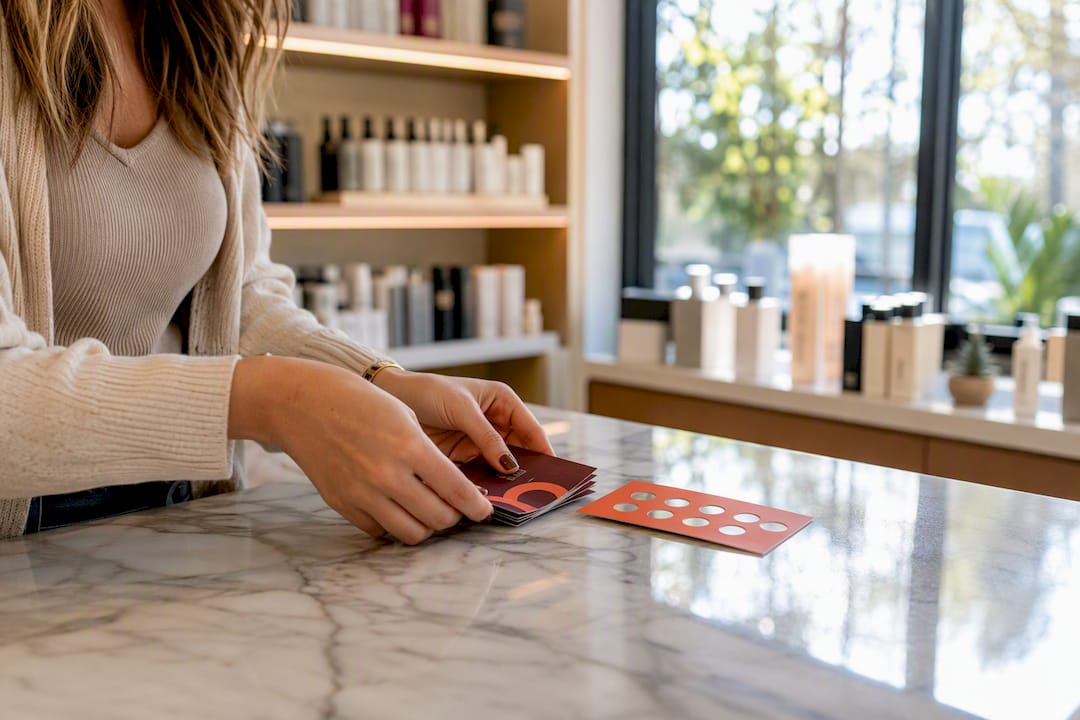
Referral and loyalty programs work best when both sides get rewarded, not just the referring client. Physical referral cards handed at checkout still convert better than a link buried in an email. Tiered loyalty programs (bronze/silver/gold, or simply “5 visits unlocks a free add-on”) give clients a reason to stay loyal instead of price-shopping.
Paid ads come last, and small. A modest local search campaign with call and booking extensions, tested at a fixed budget for 30 days with a target cost-per-booked-appointment, tells you more than a broad awareness campaign ever will. Recent salon marketing guidance recommends starting with free channels like GBP, social, and referrals before scaling into paid.
Pro Tip: Batch your Reel filming into one session per week. Shoot five transformations back to back on your slowest day, then schedule the posts across the week. This alone solves the “I don’t have time for social” excuse most owners give up on.
How Much Should a Salon Spend on Marketing?
Budget guidance from the Small Business Administration recommends tying marketing spend directly to specific business goals rather than a vague percentage pulled from a blog post.
Set SMART goals for each 90-day cycle instead of one vague annual target, focusing on acquiring new clients, improving rebooking, and increasing revenue per visit without specific numeric targets.
Track these monthly, not quarterly:
- GBP profile views: rising month over month signals your listing is working.
- Lead response time: under 5 minutes dramatically improves booking conversion.
- Rebooking rate: aim for 60% or higher as a healthy benchmark.
- New reviews per month: consistent flow (aim for 8 to 10) beats a burst of 20 followed by silence.
The SBA’s guidance on marketing budgets emphasizes measuring returns consistently rather than spending reactively, which is exactly where most solo salon owners fall short.
How Do You Turn Discovery Into a Booked Appointment?
Every unfilled chair traces back to friction somewhere in the funnel, and most of it happens in places owners never check.
- Audit your booking flow end to end. If it takes more than three taps to book on mobile, you’re losing clients. The most common leak: a booking page that requires an account creation before showing availability.
- Set a deposit policy. A $20 to $30 deposit, or 20% of service cost for higher-ticket appointments like extensions or color corrections, cuts no-shows significantly without scaring off serious clients.
- Script the rebooking conversation. Something as simple as “Let’s get you back in 8 weeks so this color stays fresh, want me to book that now?” at checkout converts far better than a generic reminder text sent later.
- Automate the follow-up. Set rebooking reminders at 8 to 12 weeks depending on service (color needs tighter cycles than a haircut).
- Ask for reviews in two steps. First, a QR code at the front desk or on the receipt sends clients to a quick feedback form immediately after their appointment. Second, route happy responses straight to your Google review link while catching unhappy ones privately before they go public.
Pro Tip: Print your review QR code on a small card and hand it over physically instead of relying on a text link. Clients are far more likely to scan something in their hand than tap a link buried in a text they’ll read later, if at all.
When Should You Start Planning Seasonal Campaigns?
Seasonal campaigns need a 6 to 8 week runway to actually convert, not the 10 days most owners give them. Waiting until two weeks before Mother’s Day means you’re competing for attention against every other business making the same rushed push, a timing principle that 2026 salon marketing guides consistently emphasize.
For Mother’s Day, start six weeks out: an email announcing gift packages, GBP posts featuring mother-daughter service bundles, Reels showing gift-worthy transformations, and SMS reminders in the final week.
For holiday gifting, start eight weeks before December: gift card promotion via email, voucher visibility on your GBP and website, prepaid package offers, and a final SMS push the week before Christmas.
Favor offers that protect your margin over blanket discounts:
- Prepaid packages (buy 3 sessions, get one partial discount) beat straight percentage-off deals.
- Gift vouchers with a slight bonus (spend $100, get a $10 add-on) drive volume without devaluing your base pricing.
- Reserve deep discounts for genuinely slow periods, not peak-demand holidays where you don’t need them.
What Should You Track Every Month?
A minimum viable dashboard has six numbers: GBP views, lead response time, conversion rate (leads to booked appointments), rebooking rate, revenue per visit, and no-show rate. If you’re only tracking revenue, you’re flying blind on everything upstream of it.
Calculating cost-per-acquisition for a small campaign is simple: total spend divided by new clients acquired. A $200 local ad test that brings in 8 new clients puts your CPA at $25, compare that against average client lifetime value to know if it’s worth scaling.
| Metric | Healthy Benchmark | What Moves It |
|---|---|---|
| GBP profile views | Trending upward monthly | Fresh photos, weekly posts, keyword-rich services |
| Lead response time | Under 5 minutes | Automated confirmations, staff notifications |
| Rebooking rate | 60% or higher | Chairside scripts, automated reminders |
| No-show rate | Under 10% | Deposit policy, confirmation texts |
Run a monthly review: if a channel’s CPA is climbing while conversion is flat, pause it. If rebooking rate ticks up after a script change, keep it and expand it.
What Should You Do in the First 30 Days?
Stop planning and start executing. Here’s the sequence that gets you from zero to a functioning system in one month.
- Days 1 to 7: Audit and rebuild your GBP profile, confirm your booking link works on mobile, add keywords to every service description, and schedule a photo shoot for fresh visuals.
- Days 8 to 21: Publish three transformation Reels, train your team on the chairside rebooking script, and set up your first automated review request sequence.
- Days 22 to 30: Launch a small local paid search test with a fixed budget, start your referral card program, and build your first monthly KPI dashboard.
Why operational execution beats another strategy document
Most salon marketing advice stops at strategy. The gap that actually costs owners money is execution, the rebooking text that never gets set up, the GBP profile nobody updates past week one. What separates salons that grow from ones that stall isn’t better ideas, it’s whether anyone follows through on the boring, repeated tasks. Tools that automate the recurring pieces, so the plan runs even on your busiest week, close that gap better than any new tactic could.
— Oliver
How LumariPRO Helps You Run This Plan Without Losing Your Weekends
Everything above works on paper. The hard part is running rebooking sequences, review requests, and monthly KPI tracking on top of an already full appointment book. LumariPRO exists to run that machinery for you instead of leaving it as another task on your list.
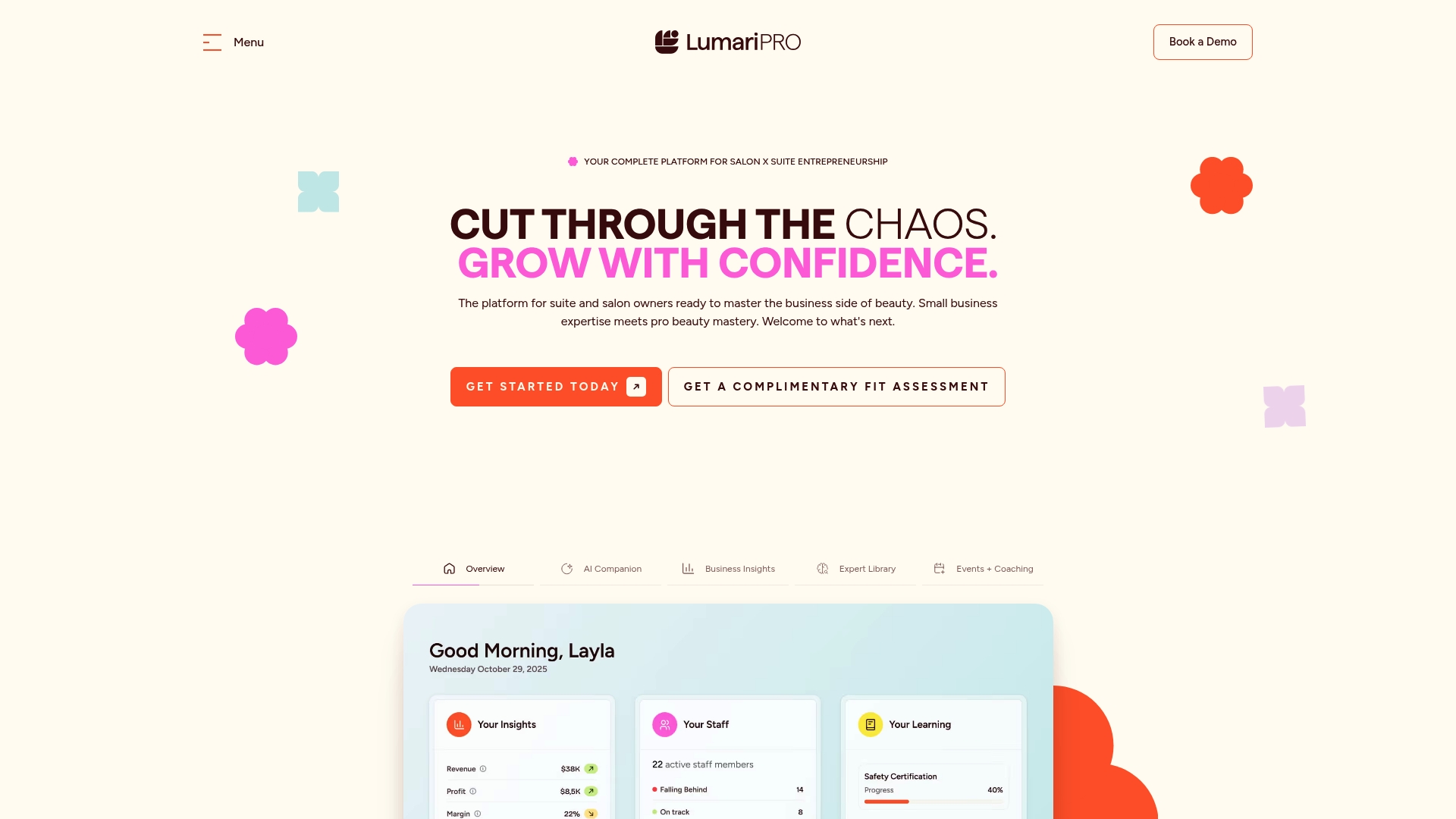
The platform connects directly to your POS and QuickBooks, so your revenue per visit, rebooking rate, and no-show numbers show up in a real dashboard instead of a spreadsheet you update once and forget. It also carries built-in business playbooks for the exact systems covered here, chairside rebooking scripts, review automation sequences, and seasonal campaign timing, so you’re not building the wheel from scratch. If you’d rather have someone walk you through execution instead of guessing, the hands-on coaching and support built into the platform covers that too.
If your booking page itself is the leak, a partner like Exclusively builds dedicated, booking-optimized websites for salons and barbershops, worth a look if your current site is the friction point.
Check the pricing page to see which plan fits a solo suite renter versus a multi-chair salon, and get your dashboard and rebooking automation running this week instead of next quarter.
Sources
Recommended