A salon membership program charges clients a recurring fee for a fixed bundle of services, credits, or discounts, and it works by trading a lower per-visit price for a guaranteed, repeatable booking. The primary payoff is predictable recurring revenue and a measurable jump in visit frequency. Most well-run programs land with a notable portion of active clients enrolled within the first year, and this guide gives you the templates and math to get there.
TL;DR:
- Subscription models work best for high-frequency, low-ticket services like blowouts, while credit and tiered systems suit irregular or higher-cost services.
- Pricing should be based on actual costs, aiming for at least a 27-dollar margin per four-visit bundle, and tested with initial discounted memberships to validate demand.
- Clear, detailed policies on rollover, cancellations, and unused credits reduce complaints and improve member satisfaction, especially when explained plainly.
- Integrating membership software with POS and accounting systems streamlines tracking, reduces errors, and can drive up to 21% revenue growth.
- Tracking key metrics like churn, visits per member, and revenue per member monthly helps identify early signs of program issues, allowing timely adjustments.
Table of Contents
- What Types of Salon Membership Programs Work Best?
- Real Salon Membership Examples You Can Copy This Month
- How Do You Price a Membership Without Losing Money?
- How Do You Launch a Membership Program Step by Step?
- What Software Do You Need to Run Memberships?
- What Marketing and Retention Tactics Actually Grow Memberships?
- How Do You Know If Your Membership Program Is Working?
- How LumariPRO Supports Launching and Managing Memberships
- When Should Memberships Be Your Growth Focus?
- Build Your Membership Program Without the Guesswork
- Sources
What Types of Salon Membership Programs Work Best?
Not every membership model fits every service. A blowout bar and a color-heavy salon need different mechanics entirely.
Subscription or service-frequency models work best for high-frequency, lower-ticket services like blowouts, waxing, or basic manicures, where clients naturally return every two to four weeks. Points and tiered systems suit product-heavy or multi-service businesses, since they reward total spend across retail and services rather than locking clients into one category. Punch-card or credit-bank models reduce friction for services with irregular cadence, letting a client bank six waxing visits and use them whenever needed instead of committing to a monthly date. Referral and social-engagement rewards are non-transactional retention plays: they cost you little and turn happy clients into unpaid marketers, an approach loyalty consultants specifically recommend over discount-only rewards because it builds actual advocates instead of bargain hunters.
Match the model to two variables: how often the service repeats, and how price-sensitive the client is. High-frequency, low-ticket services favor flat subscriptions. High-ticket, irregular services favor banked credits or tiered points. Shopify’s breakdown of loyalty program types confirms that punch cards, points, referral, tiered, and paid membership formats can all run through the same POS-integrated app, so you’re not locked into one structure forever.
Real Salon Membership Examples You Can Copy This Month
You don’t need to invent a model from scratch. National chains and independent operators have already tested the mechanics that work.
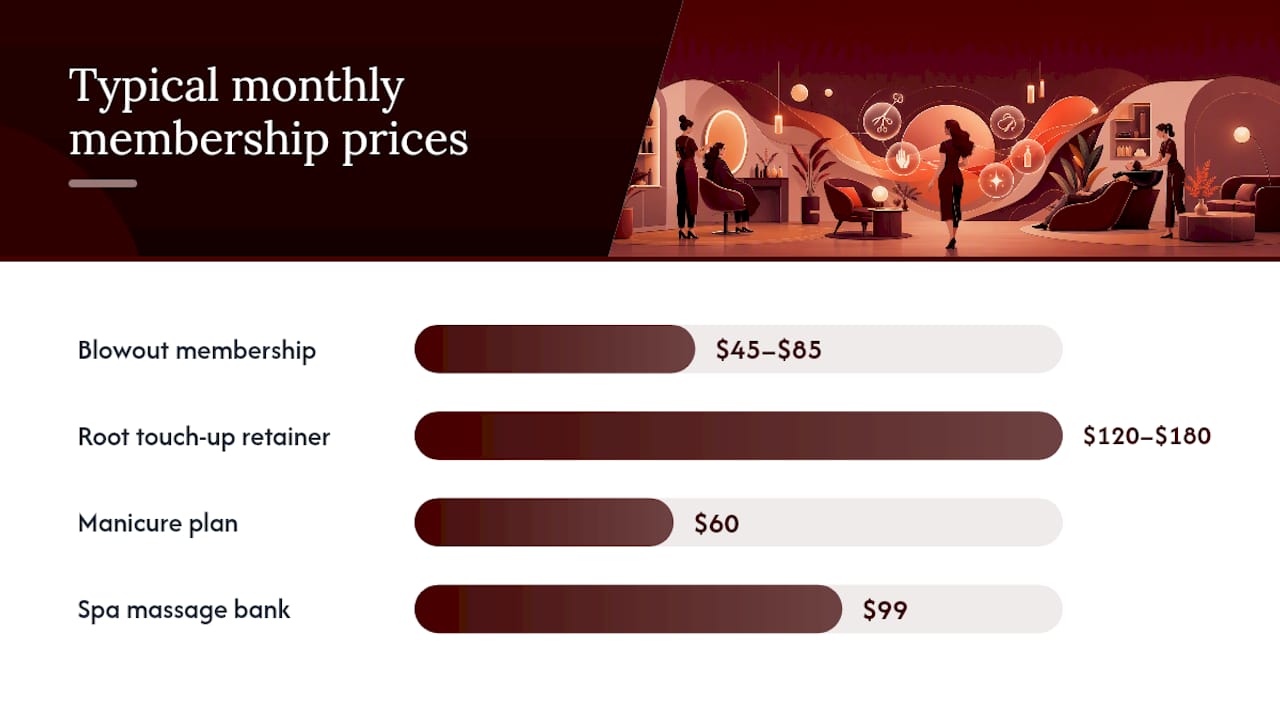
- Blowout membership: $45 to $85 monthly for four visits, unused visits roll over for 30 days, birthday month includes a free deep-conditioning add-on.
- Root touch-up retainer: $120 to $180 monthly covering one color service plus a 10% retail discount on take-home color care.
- Manicure plan: $60 monthly for two visits, third visit each quarter free as a loyalty bump.
- Waxing bank: Pre-paid 6-visit credit pack at a 15% discount versus drop-in pricing, no expiration for 12 months.
- Product club: Annual membership fee unlocking member-only pricing on retail, modeled on the mechanics Beauty Pie uses for its retail membership, adapted for salons with a strong retail wall.
- Spa massage bank: $99 monthly for one 60-minute massage, add-on services at member rate.
Blo Blow Dry Bar’s “Mane Squeeze” membership is a good reference point: it prices around this range and uses rollover windows to keep unused visits from feeling wasted, a detail that shows up across several chain-level membership case studies.
Pro Tip: Put your terms in plain language on the sign-up page. State the rollover window, the cancellation notice period, and what happens to unused credits if someone leaves. Vague terms are the number one source of membership complaints.
How Do You Price a Membership Without Losing Money?
Start with your cost-per-service, not your gut. Add product cost, labor time at your stylist’s hourly rate, and a share of fixed overhead (rent, utilities) per appointment slot. That number is your floor.
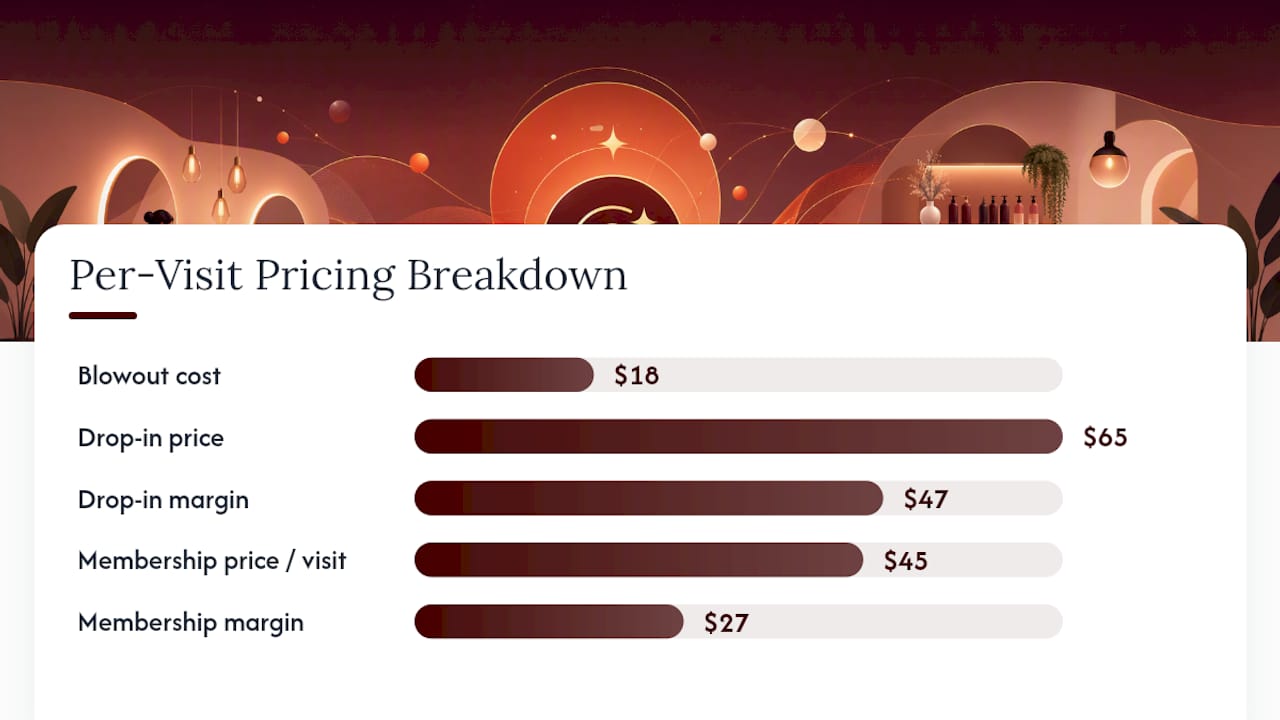
A blowout that costs you $18 in product and labor time, sold at $65 drop-in, gives you a $47 contribution margin per visit. If your membership bundles four visits for $180 monthly, that’s $45 per visit, still a healthy $27 margin, and you’ve traded $2 per visit for a guaranteed four bookings instead of a maybe.
| Pricing model | Best for | Typical structure |
|---|---|---|
| Flat monthly subscription | High-frequency single service | Fixed visits per month, rollover limited |
| Credit pack (punch/bank) | Irregular-cadence services | Pre-paid block, discount vs drop-in rate |
| Hybrid (subscription + retail) | Salons with strong product sales | Service credits plus member retail pricing |
Run the math before you launch:
- Multiply your target member count by monthly fee to project baseline monthly recurring revenue (MRR).
- Calculate break-even by dividing fixed program costs (software, admin time) by your per-member contribution margin.
- Test with founder pricing: offer your first 20 to 30 members a locked-in discounted rate for a 90-day trial window before raising to full price.
Members historically spend more per visit than one-off clients, with loyalty studies showing repeat members spending 2 to 3 times more than non-members over time, which is the number that should anchor your break-even target.
How Do You Launch a Membership Program Step by Step?
Treat the launch like an operational project, not a marketing announcement. Skipping steps here is where most programs quietly fail within six months.
- Define the member promise. Pick one or two services, set eligibility (new clients only, or existing clients too), and write the exact deliverable in plain terms.
- Document policies before you sell a single membership. Cancellation notice period, rollover rules, what happens on a missed appointment, and refund policy for early cancellation all need to be in writing.
- Set up recurring billing and a failed-payment rule. Decide in advance: do you pause services after one failed charge, or give a three-day grace window?
- Train your staff on the sales script and commission changes. Front desk and stylists need a consistent 30-second pitch, and stylists need to know how membership visits affect their commission versus drop-in pricing.
- Build a welcome flow. A confirmation email, a first-visit reminder, and a quick explainer on how credits work reduce the confused-client calls that eat up your receptionist’s day.
- Pilot before you roll out salon-wide. Cap enrollment to your comfortable servicing capacity, brief your staff on launch day expectations, and set a review date.
Pro Tip: Run the pilot for 90 days with a hard cap on enrollment and check conversion at the 30, 60, and 90-day marks. If staff referrals alone fill the cap, you’ve validated demand before spending a dollar on marketing.
What Software Do You Need to Run Memberships?
The right software eliminates the manual tracking that quietly kills membership programs. At minimum, you need recurring billing that handles failed payments automatically, support for multiple member product types (subscriptions and credit banks in the same system), automated appointment and renewal reminders, and a client-facing portal where members can see their balance.
Prioritize integrations over standalone features:
- POS integration so membership credits deduct automatically at checkout instead of requiring manual tracking.
- QuickBooks or bookkeeping sync to reconcile recurring revenue without re-entering numbers by hand.
- Email and SMS for renewal reminders and failed-payment alerts.
- Website sign-up widgets so new members can enroll without a phone call.
Before choosing a vendor, check their reporting depth, PCI compliance for stored payment data, how easy the admin dashboard is for non-technical staff, and whether solo operators get a lighter-weight tier than multi-chair salons. POS-integrated systems specifically cut down on the manual accounting errors that eat into membership margins over time, and vendor-reported data from integrated platforms shows measurable upside: Phorest cites up to 21% revenue growth from loyalty customers and roughly 30% higher average spend among loyal clients when digital tools layer onto the membership structure.
What Marketing and Retention Tactics Actually Grow Memberships?
Getting your first 20 members is a different problem than keeping 200 engaged past month six.
- Brief your staff before launch. Front desk teams that understand the pitch convert far more walk-ins than a poster on the wall.
- Use early-bird or founder pricing to reward your first cohort and create urgency without a permanent discount.
- Offer a referral bonus tied to a completed membership sign-up, not just a first visit.
- Run member-only events (a seasonal color trend night, a retail preview) that reward loyalty without cutting into service margin.
- Track trial-to-paid conversion, member acquisition cost, and referral effectiveness monthly so you know which channel is actually working.
Pro Tip: Reward the behaviors you want to see more of, not just the transactions. A client who tags your salon on social media or refers a friend is doing marketing for you. Treat that action like a paid one.
How Do You Know If Your Membership Program Is Working?
Track six numbers monthly: total member count, monthly recurring revenue (MRR), churn rate, lifetime value (LTV), visits per member, and revenue per member.
A quick benchmark to watch: if churn climbs two months in a row while visits per member decline, that’s your earliest warning sign, well before your revenue numbers show the damage.
Rising churn usually traces back to unclear terms or a billing failure that went unresolved. Declining visit frequency often means the service bundle no longer matches what the client actually wants, which is a pricing or eligibility fix, not a marketing one.
How LumariPRO Supports Launching and Managing Memberships
Most of the operational friction described above (recurring billing, POS reconciliation, staff scripts, pricing math) is exactly what eats up an independent operator’s week. Some platforms are built specifically for suite-based professionals and salon owners handling this without a back office.
- Real-time financial dashboards sync with your POS and QuickBooks, so membership revenue and churn show up without manual spreadsheet work.
- Business playbooks and coaching walk you through structuring your first pilot, including pricing tests before you commit to a full rollout.
- Templates and scripts cover staff training and client-facing sign-up language, so you’re not writing terms and conditions from scratch.
Model your own numbers before you launch anything using the ROI Calculator, and pair that pricing test with the onboarding playbook to run a 90-day pilot the way operators who’ve done this before recommend.
When Should Memberships Be Your Growth Focus?
Memberships pay off fastest for high-frequency services with predictable repeat cycles, blowouts, waxing, root touch-ups. If your business is mostly one-off bridal work or seasonal treatments, points or simple loyalty rewards will outperform a subscription. The most common blocker isn’t pricing, it’s unclear cancellation policy, and it’s fixable in an afternoon. Small operators should pilot with one service before expanding; growing salons with multiple chairs can run two or three models in parallel once billing is automated.
— Oliver
Build Your Membership Program Without the Guesswork
Every template and pricing formula above still leaves one question unanswered: what happens when a payment fails, a client asks about rollover, or you need to know your real churn number without pulling three reports together by hand. LumariPRO exists to close that gap for suite renters and independent salon owners who don’t have a back-office team to run the numbers for them.
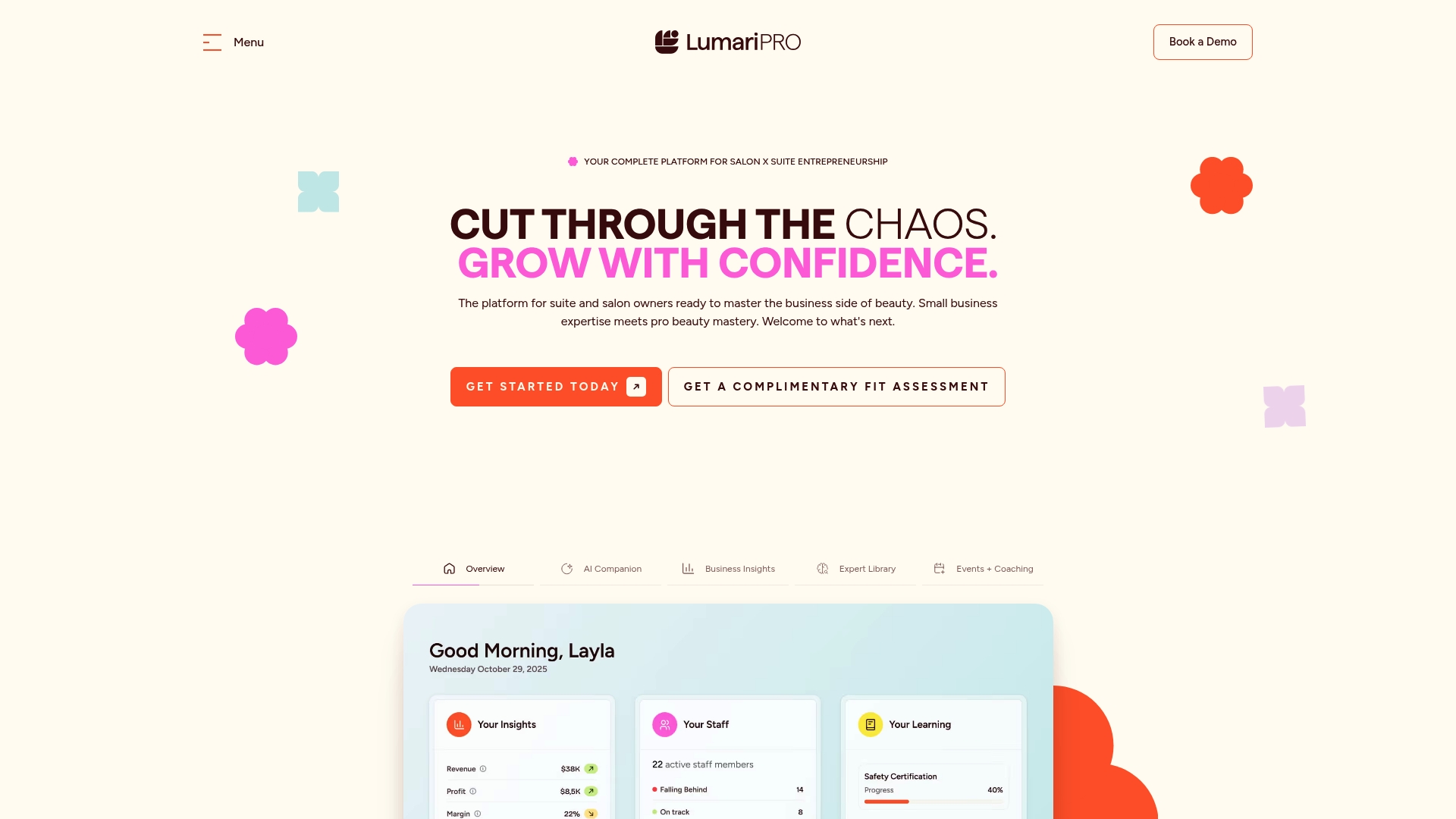
The platform connects directly to your POS and QuickBooks, so membership revenue, churn, and visits per member show up on one dashboard instead of three spreadsheets. Business playbooks walk you through pricing tests and pilot design, and coaching is available when you want a second set of eyes on your launch plan before you commit. Start by modeling your own membership pricing on the platform overview to see exactly how the numbers in this guide apply to your service mix and client base.
Sources
For pricing snippets and templates, see Mangomint’s membership examples. For vendor features and integration options, see Shopify’s loyalty program guide and Phorest’s loyalty software page. For staff training resources, see MUD Studio Italia’s stylist portfolio course.