The essential salon policies every owner needs are a cancellation and no-show rule, a late-arrival rule, deposit and payment terms, a refund or redo guarantee, a privacy and photo-consent statement, and a right-to-refuse-service policy grounded in health and safety. Every one of those can be copied, edited, and published today.
You can put these policies in three places: your booking page or intake form, your appointment confirmation email or text, and your staff handbook so your team enforces them the same way every time.
- Booking flow or website footer
- Confirmation email/SMS sent after every appointment
- Printed signage at the front desk and in your staff manual
Pro Tip: Don’t bury your cancellation policy in a PDF nobody opens. Put the fee amount in the confirmation text message. That single line prevents more disputes than any legal clause you could write.
Jump to the copy-paste templates below for strict, moderate, and flexible wording on every policy type, with exact dollar amounts and notice windows you can drop straight into your booking software.
| Policy | Where to Publish It |
|---|---|
| Cancellation & no-show | Booking page, confirmation text |
| Deposits & card-on-file | Booking flow, intake form |
| Right to refuse service | Staff handbook, in-salon signage |
Key Takeaways
Written salon policies with specific fee amounts and notice windows reduce no-shows, protect revenue, and remove the daily burden of enforcing rules on the spot.
| Point | Details |
|---|---|
| Publish everywhere clients interact | Post cancellation and deposit terms on the booking page, confirmation text, and intake form. |
| Match notice windows to service cost | Use 24–48 hours for standard services and 48–72 hours or more for color and event bookings. |
| Require a card or deposit upfront | Card-on-file authorization at booking makes automated enforcement possible without awkward calls. |
| Review refusal-of-service wording | Keep health and safety language nondiscriminatory and aligned with consumer protection law. |
| Automate enforcement with LumariPRO | Use LumariPRO’s template library and POS integrations to publish policies and track enforcement automatically. |
Table of Contents
- Why clear salon policies matter for revenue, scheduling, and staff safety
- The essential salon client policies and what each should cover
- How to write clear, enforceable policy language
- Copy-paste templates: strict, moderate, and flexible variants
- How to implement and enforce policies across booking platforms, staff, and in-salon
- Common notice windows, deposit rates, and sample wording
- Handling policy updates and communicating changes to existing clients
- Managing policy exceptions and dispute resolution procedures
- Where LumariPRO fits once your policies are written
- Sources
Why clear salon policies matter for revenue, scheduling, and staff safety
A written policy does something a verbal reminder never does: it gives your front desk (or you, if you’re a solo suite renter) something to point to instead of negotiating in the moment. That alone cuts the emotional labor out of enforcing a no-show fee.

The math is straightforward. If your average service runs $85 and you lose two appointments a week to same-day cancellations, that results in significant lost revenue annually in unbooked chair time, before you even count the lost retail add-on sales that typically ride along with a completed visit. A deposit or a card-on-file requirement doesn’t eliminate no-shows, but it changes the incentive enough that most owners see the gap close within a month or two of enforcement.
There’s a legal dimension too. Any policy touching who you’ll serve, especially a right-to-refuse clause, has to stay nondiscriminatory and avoid targeting protected characteristics.
- Fewer no-shows means predictable weekly revenue you can actually plan payroll around.
- Written fee structures remove the awkward on-the-spot negotiation with a client.
- Consistent enforcement protects staff morale. Nobody wants to be the one improvising the rules.
- Clear refund and redo language shortens disputes from days to minutes.
The essential salon client policies and what each should cover
Most salon owners don’t need forty pages of legal language. They need nine short, specific policies that a client can read in under a minute and a staff member can enforce without guessing.
The core client-facing policies:
- Cancellation & no-show — notice window (24, 48, or 72 hours), fee amount or percentage, and what counts as a no-show versus a late cancellation.
- Late arrival — grace period length, what happens after it (shortened service, reschedule, or forfeited deposit).
- Deposits and card-on-file — when a deposit is required, how much, and whether it’s refundable or applied to the final bill.
- Payment & tipping — accepted payment methods, whether tips can go on card, and any service charge for large parties or bridal bookings.
- Refunds and redo guarantees — the window for reporting dissatisfaction (typically 3 to 7 days) and what qualifies for a free correction versus a discount.
- Privacy & photo consent — whether you post before/after photos, and how clients opt in or out.
- Right to refuse service & health disclosures — communicable conditions, allergy patch tests, and behavior standards, applied the same way to every client.
- Age, pet, and child policies — minimum age for chemical services, whether children are allowed to wait unsupervised, pet restrictions.
- Employee conduct/expectations — dress code, punctuality, and client-interaction standards for your team.
A complete policies and procedures manual typically organizes these into booking rules, payment and refund terms, confidentiality, and health and safety sections, which is a useful skeleton even if you’re a solo operator with no staff to manage yet.
- Draft each policy in one sentence, then add the fee or timeframe.
- Decide where each one lives: booking page for cancellation and deposit rules, staff handbook for conduct, signage for age and pet rules.
- Test the wording out loud with a colleague before you publish it.
Pro Tip: If you rent a suite and don’t have a front desk to enforce anything, your booking software’s confirmation message is your enforcement mechanism. Write the policy assuming no human will explain it in person.
How to write clear, enforceable policy language
Enforceable policy wording follows a pattern: state the rule, explain the scope in one clause, then say exactly what happens next. Vague language is what creates disputes, not strict rules.
- Lead with the rule. “Appointments canceled with less than 24 hours’ notice are charged 50% of the service price.” No preamble.
- Add the scope. Specify which services it applies to. Color and extension appointments often need a longer window than a basic haircut.
- State the consequence. Say whether the card on file is charged automatically or whether the client is invoiced.
- Place it everywhere a client interacts with your booking. Booking page, confirmation email, intake form, in-salon signage, and a short verbal script your stylist repeats at the first consultation.
- Collect consent deliberately. A checkbox at booking, card-on-file authorization language, and a verbal acknowledgment during consultation all create a paper trail. Log the date and method.
A short staff handout with one paragraph per policy, stored somewhere your team actually checks, gets you far more consistent enforcement than a policy that only lives on your website.
Pro Tip: Keep your tone neutral and identical for every client. “This policy applies to all appointments” reads as fair. “We’ve had a lot of people flake lately, so” reads as personal, and personal is where disputes start.
Copy-paste templates: strict, moderate, and flexible variants
Pick the tone that matches your business model. A high-volume blowout bar can run stricter than a solo colorist building a loyal client base from scratch. Here’s cancellation and no-show wording in three versions, plus deposit and refund variants below.
Cancellation & no-show policy
Strict: "Cancellations require 48 hours’ notice.
Moderate: “We ask for 24 hours’ notice to cancel or reschedule. Late cancellations are charged 50%, and no-shows are charged the full service price.”
Flexible: “Please give us as much notice as you can. Repeated late cancellations or no-shows within 24 hours may result in a $25 booking fee for future appointments.”
Choose strict if deposits already secure most of your bookings and no-shows still cost you real chair time. Choose flexible if you’re building a new client base and would rather absorb an occasional loss than risk a bad review over a $25 fee.
Late-arrival policy
Strict: “Arrivals more than 10 minutes late will have their appointment rescheduled and forfeit any deposit.”
Moderate: “We hold a 15-minute grace period. After that, your service may be shortened to fit the remaining time.”
Flexible: “Running late? Text us. We’ll do our best to accommodate you, though your service time may be adjusted.”
Deposits and card-on-file
Moderate: “A $25–$50 deposit secures appointments over $150 and is applied to your final total.”
Flexible: “A card on file is required to book but is only charged in the case of a same-day cancellation or no-show.”
| Variant | Best for | Typical enforcement |
|---|---|---|
| Strict | High-demand, fully booked calendars | Automated card-on-file charge, no exceptions |
| Moderate | Established salons with mixed clientele | Deposit applied to total, fee for late cancellations |
| Flexible | New businesses building a client base | Card on file, charged only for no-shows |
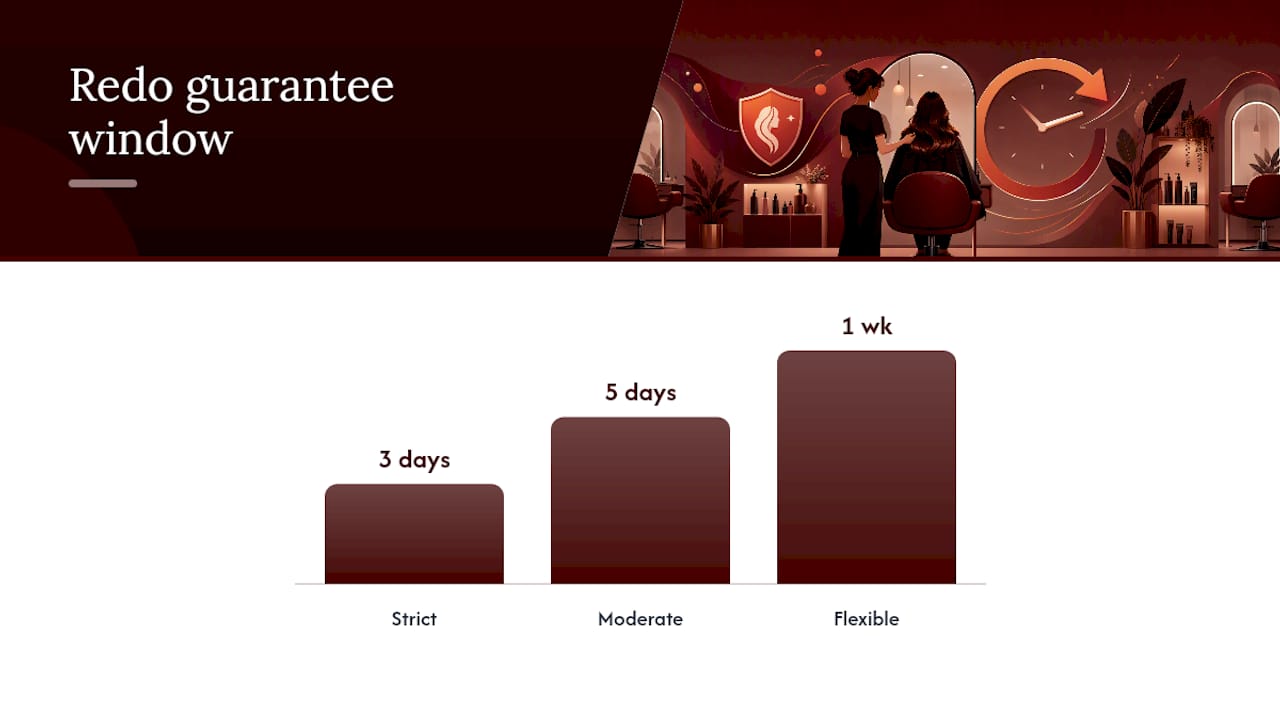
Refund and redo guarantee
Strict: “Redos are offered within 3 days for services performed by our team, at no charge. No cash refunds are issued.”
Moderate: “If you’re not satisfied, contact us within 5 days for a complimentary adjustment.”
Flexible: “Your happiness matters to us. Reach out within a week and we’ll make it right, whether that’s an adjustment or a partial refund.”
- Paste the cancellation and deposit wording into your booking software’s policy field.
- Paste the refund guarantee into your intake form and website FAQ.
- Paste the late-arrival policy into your confirmation text template.
Pro Tip: Run all three variants past a client-facing employee before choosing one. If they wince reading it out loud, it’s too strict for how your business actually operates.
How to implement and enforce policies across booking platforms, staff, and in-salon
Publishing a policy is only half the job. Enforcement is what makes it real, and that comes down to five steps done in order.
- Update your booking page’s policy section with the exact wording you chose above.
- Add a shortened version to every confirmation SMS and email.
- Require a card on file or deposit at the point of booking, not after.
- Train staff on a short script: “Just so you know, we do require 24 hours’ notice for cancellations.”
- Log every enforcement action, including exceptions, in a shared note or spreadsheet.
Most booking platforms now let you embed cancellation and deposit terms directly into the scheduling flow, and card-on-file tools handle the automated charge so nobody on your team has to call a client and ask for money. Whether you’re on Vagaro, Booksy, or Square, the setup path is similar: policy text lives in your business settings, the deposit or no-show fee attaches to the service listing, and the charge triggers automatically based on the rules you set.
- Keep a dispute log separate from your booking notes.
- Save timestamped screenshots of consent checkboxes for chargebacks.
- Review your no-show log monthly to see if your fee is actually working.
Pro Tip: If a platform update resets your policy text, check it quarterly. Owners lose more enforcement leverage to a silently reverted setting than to any client pushback.
Common notice windows, deposit rates, and sample wording
Most salons land in a predictable range once they’ve tested a few options, and starting near the industry norm saves you the trial-and-error most new owners go through in year one.
| Service type | Typical notice window | Typical deposit or fee |
|---|---|---|
| Standard haircut/style | 24–48 hours | $25 flat fee |
| Color or multi-tech service | a typical notice window of two to three days | a moderate deposit percentage |
| Wedding or event booking | a longer notice window of several days | a significant deposit amount |
These ranges track closely with common industry benchmarks for cancellation windows, and they scale sensibly: the more time and product a service consumes, the more notice and deposit it justifies.
For late arrivals, a 10 to 15 minute grace period followed by a shortened service or reschedule is the most common structure. A sample booking-form line: “A valid card is required to hold your appointment. No charge unless canceled within 24 hours.”
Before you publish a right-to-refuse policy, check it against nondiscrimination law. A rule can address health, safety, or behavior, but it cannot single out a protected characteristic, and state civil rights guidance is the place to verify wording before it goes live.
Handling policy updates and communicating changes to existing clients
A policy change lands very differently on a brand-new client than on someone who’s been in your chair every six weeks for three years. Give existing clients notice before the new rule takes effect, not on the day you start charging for it.
The cleanest approach: send an email or text 30 days ahead announcing the change, explain the reason in one sentence (“to keep our schedule fair for everyone waiting for appointments”), and give the effective date. Update the booking page and confirmation template on that same date, not before, so nobody gets charged under a rule they never saw.
Keep a simple version log, even if it’s just a note in your phone: date changed, what changed, why. That log becomes useful the one time a client disputes a charge and asks why the fee is different from what they remember agreeing to.
For loyal clients who push back on a new deposit requirement, a short grace period, like waiving the deposit for their next one or two bookings, tends to smooth the transition better than a blanket exemption that undercuts the policy for everyone else. Staff should hear about any policy change before clients do. Nothing erodes trust faster than a stylist getting caught off guard by a rule their own business just changed.
Managing policy exceptions and dispute resolution procedures
Every policy will eventually meet an exception: a genuine emergency, a client with a decade of loyalty, a billing error on your end. The question isn’t whether to make exceptions. It’s how to make them without quietly dissolving the policy.
Set a simple rule for yourself or your front desk: exceptions require a reason logged in writing, and the same category of exception (medical emergency, weather, salon error) gets treated the same way every time. That consistency is what keeps a policy enforceable rather than a suggestion.
For disputes, a three-step path works for most small salons: first, the staff member handles it directly using the documented policy language. Second, if the client disagrees, the owner reviews the booking record, consent timestamp, and any prior exceptions granted to that client. Third, the owner makes a final call and documents it, whether that’s a fee waiver, a partial refund, or holding firm.
Chargebacks deserve special attention. A card-on-file charge disputed with the bank needs your timestamped consent record and policy screenshot ready to submit, which is exactly why the recordkeeping habit from your implementation checklist earns its keep the first time a client fights a charge.
A stylist’s take on holding the line
I once had a client show up 40 minutes late for a color appointment, expecting the full service anyway. Because the late-arrival policy was already posted and she’d agreed to it at booking, I could shorten the service without an argument. No guilt, no negotiation, just the policy doing its job. Review your policies once a year, and get any staff you have to weigh in before you change them. Buy-in is what makes enforcement stick.
Where LumariPRO fits once your policies are written
LumariPRO is the difference between writing a policy once and actually enforcing it every week without becoming the bad guy at your own front desk. The platform’s template library gives you cancellation, deposit, and refund wording you can publish directly into your booking flow, while its integrations with your POS and QuickBooks turn card-on-file charges and refund logs into real numbers on a dashboard instead of a mental tally you’re keeping in your head.

Beyond templates, you get expert-led coaching built specifically for suite renters and solopreneurs, people who’ve actually worked behind the chair and know why a generic small-business template never quite fits a beauty practice. If you’re ready to stop rewriting your cancellation policy from scratch every time a client pushes back, explore how LumariPRO’s platform and coaching can get your policies published, enforced, and reflected in your real financial picture this week.
Sources
- Refusal of service and discrimination — Indiana Civil Rights Commission
- Salon policies: 8 essential rules every salon needs — Suplery
- POLICIES & PROCEDURES MANUAL (EXAMPLE ONLY) SALON — Pretty Perfect Beauty (PDF)
This article is general information, not a substitute for advice from a qualified lawyer. Consult a qualified legal professional about your own circumstances before acting on anything here.
Recommended