Tell clients in person first, confirm the change in writing with the exact effective date and old-to-new pricing, and give at least six weeks’ notice. That sequence, done confidently, keeps client retention high after a well-communicated increase. Here is a short template you can use in the chair or as an email opener right now:
Keep it factual, keep it warm, and skip the apology. Clients respect confidence far more than hedging.

Table of Contents
- Why do salons raise prices, and how should you frame it?
- How much should you raise your prices?
- When should you announce a price increase?
- How to write and deliver your price increase notice
- What does every price increase letter need to include?
- Ready-to-use salon price increase letter templates
- How to handle client pushback
- Operational checklist: updating your systems
- How Lumaripro supports your price increase process
- What good and bad price increase letters actually look like
- Key Takeaways
- The part most guides get wrong about price increases
- Lumaripro makes the numbers and the messaging easier
- Useful sources and further reading
Why do salons raise prices, and how should you frame it?
Prices go up for real, concrete reasons: product costs climb, rent increases, continuing education costs money, and the skill behind the chair grows over time. Clients understand all of this. What they do not respond well to is vague language or an owner who sounds embarrassed about the change.
Common valid reasons and how to state each one in a single sentence:
- Rising product costs: “The professional color and treatment lines we use have increased in cost, and our pricing reflects that.”
- Rent or overhead increases: “Our suite costs have gone up this year, and our rates now reflect the full cost of running the space.”
- Staff training and education: “We’ve invested in advanced training to bring you better results, and our pricing reflects that expertise.”
- Correcting underpricing: “Our rates haven’t changed in [X] years, and this update brings them in line with the actual cost of the service.”
The psychological framing that works is reinvestment, not complaint. You are not raising prices because things are hard. You are raising prices because you are committed to delivering at a high level and your business needs to be sustainable to do that. One sentence is enough. Clients do not need a full explanation; they need to feel respected.
Pro Tip: An unapologetic, grateful tone outperforms an apologetic one every time. “Thank you for being part of this community” lands better than “We’re so sorry for any inconvenience.” Own the decision.
How much should you raise your prices?
Two approaches exist: calculated increases based on actual cost-per-service math or simple percentage or flat-dollar increases. Both work, but they serve different situations.
Calculated increases require you to know your real cost per service: chair rent per hour, product consumption per appointment, and time spent. Many stylists discover they are undercharging by $8–$20 per service once they run the numbers. A data-driven increase is easier to communicate confidently because you know exactly why you landed on the number.

Percentage or flat increases are faster to implement and easier for clients to understand. A 5%–10% annual adjustment is a common industry range for salons that review pricing regularly.
| Scenario | Current Price | Increase | New Price | Annual Revenue Impact (25 clients/week) |
|---|---|---|---|---|
| — | — | — | — | +$15,600/year |
| 8% increase | — | — | — | +$8,320/year |
| 10% increase | — | $10 | — | +$13,000/year |
If the gap between what you charge and what you should charge is more than $25, a staged increase is smarter than one large jump. Split it: half now, half in six months. Clients absorb gradual changes far better than a sudden correction, and you protect the relationship while closing the gap.
When should you announce a price increase?
Timing shapes client reaction almost as much as the message itself. Give at least six weeks’ notice; four weeks is the floor, and eight or more is ideal for larger increases or long-standing client relationships.
The best months to announce are March/April or August/September. Avoid December and January. Clients are financially stretched during the holidays and into the new year, and your staff is already managing peak booking pressure with less bandwidth to handle questions.
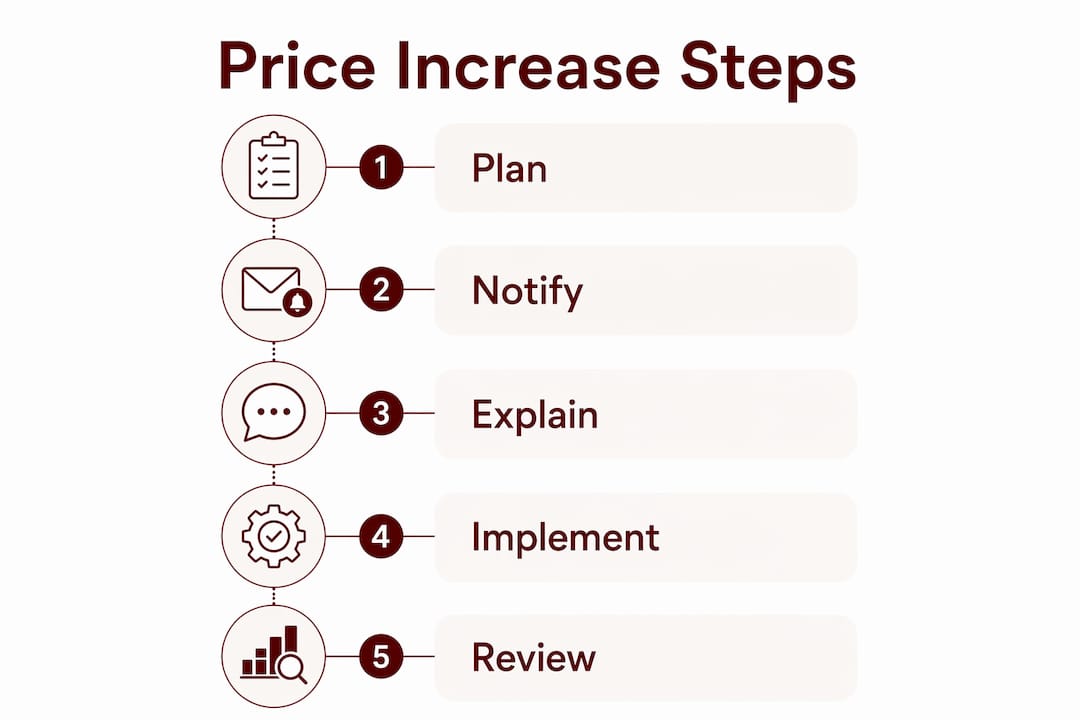
Here is the announcement sequence to follow:
- In-chair conversation (6–8 weeks before the effective date): Tell each client personally at their next appointment. Keep it brief and confident.
- Written follow-up (same week or within a few days): Send an email or text confirming what you said in person, with the exact date and pricing.
- Reminder notice (one week before the effective date): A short message reminding clients the change takes effect soon, with a final chance to book at the current rate.
Pro Tip: Announcing during a quieter scheduling month gives your front desk and stylists room to answer questions without it becoming a crisis. A busy December announcement means staff fielding objections during your most stressful weeks.
How to write and deliver your price increase notice
Start by gathering the exact data before you write a single word: the old price per service, the new price, the effective date, and whether any currently booked appointments will be honored at the old rate (grandfathering). Decide that last point before you communicate anything, because clients will ask.
Delivery by channel:
- In-chair: Use the short script from the BLUF above. Speak first, then confirm in writing. This is the highest-impact step.
- Email: Lead with the new price and effective date in the first paragraph. Do not bury the number.
- SMS: Keep it under 160 characters. State the service, old price, new price, and date. Nothing else.
- Front desk: Train staff to say it plainly: “Just so you know, our pricing is changing on [date]. Your [service] will be $[Y] going forward.”
- Social media: A neutral post works. Do not make it a big announcement or a public apology. A simple “Heads up — our pricing is updating on [date]. Reach out with any questions” is enough.
Staff briefing checklist:
- Share the new price list with every team member before the first client conversation
- Confirm the effective date and grandfathering policy in writing to staff
- Role-play the in-chair script at least once before the announcement period begins
- Clarify who handles escalations (owner or manager)
Technical updates to complete before the effective date:
- Update POS system pricing
- Revise online booking menu and service descriptions
- Adjust package pricing and any bundled services
- Update commission calculations if staff pay is percentage-based
- Replace printed service menus and signage
What does every price increase letter need to include?
A strong client notification letter covers six things. Miss any of them and you will field more questions than necessary.
Required elements:
- Effective date: State it clearly in the first paragraph. “Starting [Month Day, Year]” is enough.
- Old vs. new pricing: List the specific services and both prices, or state the percentage increase. Do not make clients calculate it themselves.
- Brief reason: One sentence. Tie it to costs, training, or service quality.
- Contact information: Give clients a way to ask questions. An email address or phone number is fine.
- Grandfathering policy: State whether appointments already booked will be honored at the old rate.
- Closing appreciation: Thank them. Keep it genuine and short.
Optional but effective:
- A loyalty gesture: “Book your next appointment before [date] to lock in the current rate.”
- A short list of recent improvements: new equipment, advanced training, extended hours.
Sample lines for each part:
- Opening: “We’re reaching out to let you know about an upcoming change to our service pricing.”
- Reason: “Our costs for professional products and salon operations have increased, and this update reflects that.”
- Call to action: “Book before [date] to secure today’s pricing for your next visit.”
- Closing: “Thank you for trusting us with your hair. We’re grateful for your continued support.”
Ready-to-use salon price increase letter templates
Professional email (new or newer clients)
Subject: Update to our service pricing
Hi [Name],
We’re writing to let you know about an upcoming change to our pricing. Starting [Date], our rates will be updated to reflect increased costs for professional products and salon operations.
Your new price for [Service] will be $[New Price], up from $[Old Price].
If you have any questions, reply to this email or call us at [Phone]. We appreciate your business.
[Salon Name]
Warm email for long-term clients
Subject: A personal note about our pricing
Hi [Name],
You’ve been coming to see us for [X years/months], and I wanted to reach out personally before you heard about our pricing update any other way.
Starting [Date], [Service] will move from $[Old Price] to $[New Price]. This reflects the rising cost of the products we use and the continued investment we make in training and education.
As a thank-you for your loyalty, you’re welcome to book your next appointment before [Date] and lock in today’s rate.
Thank you for being part of our community.
[Your Name], [Salon Name]
SMS announcement
Hi [Name], [Salon Name] here. Our pricing updates on [Date]. [Service] moves from $[X] to $[Y]. Book before [Date] to lock in today’s rate. Questions? Call [Phone].
Front-desk script
“Just a heads-up before you go — our pricing is changing on [Date]. Your [service] will be $[New Price] going forward. If you’d like to book your next appointment today, we can lock in the current rate for you.”
Social media post (neutral)
“Heads up: our service pricing is updating on [Date]. We’ve kept our rates steady for [X years], and this change reflects the real costs of running a professional salon. Reach out with any questions — we’re happy to talk through it.”
One-week reminder email
Subject: Reminder: pricing update takes effect [Date]
Hi [Name],
Just a quick reminder that our updated pricing takes effect on [Date]. If you’d like to book at today’s rate, now is the time. We appreciate your continued trust and look forward to seeing you soon.
[Salon Name]
How to handle client pushback
Most clients accept a well-communicated increase without complaint. The ones who push back usually fall into three categories: sticker shock, genuine budget concern, or a test to see if you’ll back down. Here is how to handle each.
Common objections and responses:
- “That’s a big jump.” “I understand it feels that way. Our rates haven’t changed in [X years], so this brings us in line with where we should be. The quality of your service stays exactly the same.”
- “I can’t afford that.” “I completely understand. If you’d like, I can suggest some options that might work better for your budget, or we can talk about adjusting your service frequency.”
- “I might have to go somewhere else.” “That’s totally fair, and I appreciate your honesty. If you decide to try somewhere else, I hope you’ll come back if it’s not the right fit. The door is always open.”
Three escalation levels:
- Front desk: Acknowledge, state the effective date and new price, offer to book before the deadline.
- Stylist in-chair: Personalize the response, reference the relationship, offer the loyalty booking window.
- Manager or owner follow-up: For clients who are genuinely upset, a direct call or personal email from the owner goes a long way. Keep it brief and warm.
Short FAQ for clients who want more detail:
- When does the new pricing start? [Date].
- Will my already-booked appointment be at the old price? [Yes/No — state your policy].
- Why is the price going up? Our costs for professional products and salon operations have increased.
- Can I lock in the old price? Book before [Date] and we’ll honor today’s rate.
Operational checklist: updating your systems
A price increase announcement that does not get reflected in your systems creates billing errors and client confusion. Assign each task to a specific person and set a deadline relative to the effective date.
| Task | Owner | Deadline |
|---|---|---|
| Update POS pricing for all services | Manager/Owner | 1 week before effective date |
| Revise online booking menu | Front desk or booker | 1 week before effective date |
| Update website service menu | Owner or web manager | 1 week before effective date |
| Adjust package and bundle pricing | Manager | 1 week before effective date |
| Recalculate staff commissions | Owner | Before effective date |
| Replace printed menus and signage | Front desk | Day before effective date |
| Update loyalty reward redemption values | Manager | Before effective date |
| Send reminder to all active clients | Front desk | 1 week before effective date |
Metrics to track after the increase:
- Rebooking rate: Your primary signal. If rebooking drops more than 10%, revisit your messaging or add a value-building gesture.
- Appointment cancellations: Track the two weeks following the effective date.
- Revenue per service: Compare the 30 days before and after the change.
Schedule a 30-day and 60-day check-in to review these numbers. Most salons find the revenue gain outweighs any attrition when the increase was well-communicated.
How Lumaripro supports your price increase process
Lumaripro is built specifically for salon and suite owners navigating exactly this kind of business decision. The platform’s financial tools let you model the revenue impact of any price change before you announce it, so you walk into client conversations knowing the numbers cold.
Key features that directly support a price increase:
- Revenue modeling: Run scenarios (flat increase vs. percentage, per-service vs. across the board) and see the annual impact before you commit.
- Template library: Access ready-to-use price increase letters, SMS scripts, and staff briefing guides built for the beauty industry.
- Appointment reminder automation: Schedule follow-up notices and pre-deadline booking reminders without manual effort.
- Staff coaching modules: Train your team on objection handling and in-chair scripts through structured, beauty-specific content.
- POS and QuickBooks integrations: Once you set the new pricing, Lumaripro connects to your existing systems so updates flow through without double entry.
The coaching and playbook resources are built by people who have worked behind the chair, which means the guidance reflects how salon businesses actually operate, not generic small-business advice borrowed from another industry.
What good and bad price increase letters actually look like
Successful example — what works:
Subject: Update to our service pricing
Hi Sarah, starting April 1, your balayage service moves from $180 to $195. Our color product costs have increased significantly over the past year, and this update reflects that. Your appointment on March 15 will still be at today’s rate. Book your April visit before March 31 to lock in the current price. Thank you for being a loyal client. — [Stylist Name]
Why it works: specific date, specific old and new price, one-sentence reason, grandfathering policy stated, loyalty gesture included, personal sign-off. The client knows exactly what is happening and what to do next.
Unsuccessful example — what to avoid:
Subject: Important announcement
Dear valued client, due to various factors beyond our control, we regret to inform you that we will be making some adjustments to our pricing structure in the coming weeks. We apologize for any inconvenience this may cause and hope you will continue to support our small business.
Why it fails: no specific date, no prices listed, vague reason, apologetic tone, no call to action. A client reading this has no idea what is changing, when it changes, or what to do. The apology signals uncertainty, which invites pushback. Clients who receive this kind of notice are more likely to call in confused or simply not rebook.
The difference between the two is not length. It is specificity and confidence.
Key Takeaways
A well-timed, specific, and confident price increase notice keeps client retention between 85% and 95% and grows annual revenue without damaging relationships.
| Point | Details |
|---|---|
| Tell clients in person first | In-chair disclosure before written notice is the single highest-impact step for reducing churn. |
| Give at least six weeks’ notice | Four weeks is the minimum; six to eight weeks is the standard that keeps client loss under 5% in practice. |
| State exact prices and dates | List old price, new price, and effective date in the first paragraph — never make clients calculate the change. |
| Track rebooking rate post-increase | If rebooking drops more than 10% after the change, revisit your messaging or add a loyalty gesture. |
| Lumaripro for modeling and templates | Lumaripro’s revenue modeling, template library, and staff coaching modules are built specifically for this process. |
The part most guides get wrong about price increases
The conventional wisdom says the hardest part of raising prices is deciding how much. It is not. The hardest part is the 48 hours after you send the notice, when a handful of clients respond with concern and your instinct is to walk it back.
Every time an owner apologizes for a price increase or offers an unsolicited discount to a client who did not even ask for one, they undercut the entire communication. Clients read hesitation as a signal that the increase was not justified. A confident, warm, specific notice almost never generates the volume of pushback owners expect. The fear is almost always larger than the reality.
The other thing most guides underestimate is the cost of waiting. Salons that have not raised prices in two or three years often face a gap of $20 or more per service. Closing that gap in one move is jarring for clients. The owners who handle increases best are the ones who raise prices annually by a modest amount, so no single increase ever feels like a shock.
Run the numbers, brief your staff, tell your clients in person, and send the written notice the same week. That is the whole process.
Lumaripro makes the numbers and the messaging easier
Price increases are one of the highest-leverage decisions a salon owner makes, and most owners do it without any financial modeling at all. Lumaripro changes that. The platform’s real-time financial dashboards let you calculate the exact revenue impact of any pricing scenario before you commit, so you walk into client conversations with data, not guesses.
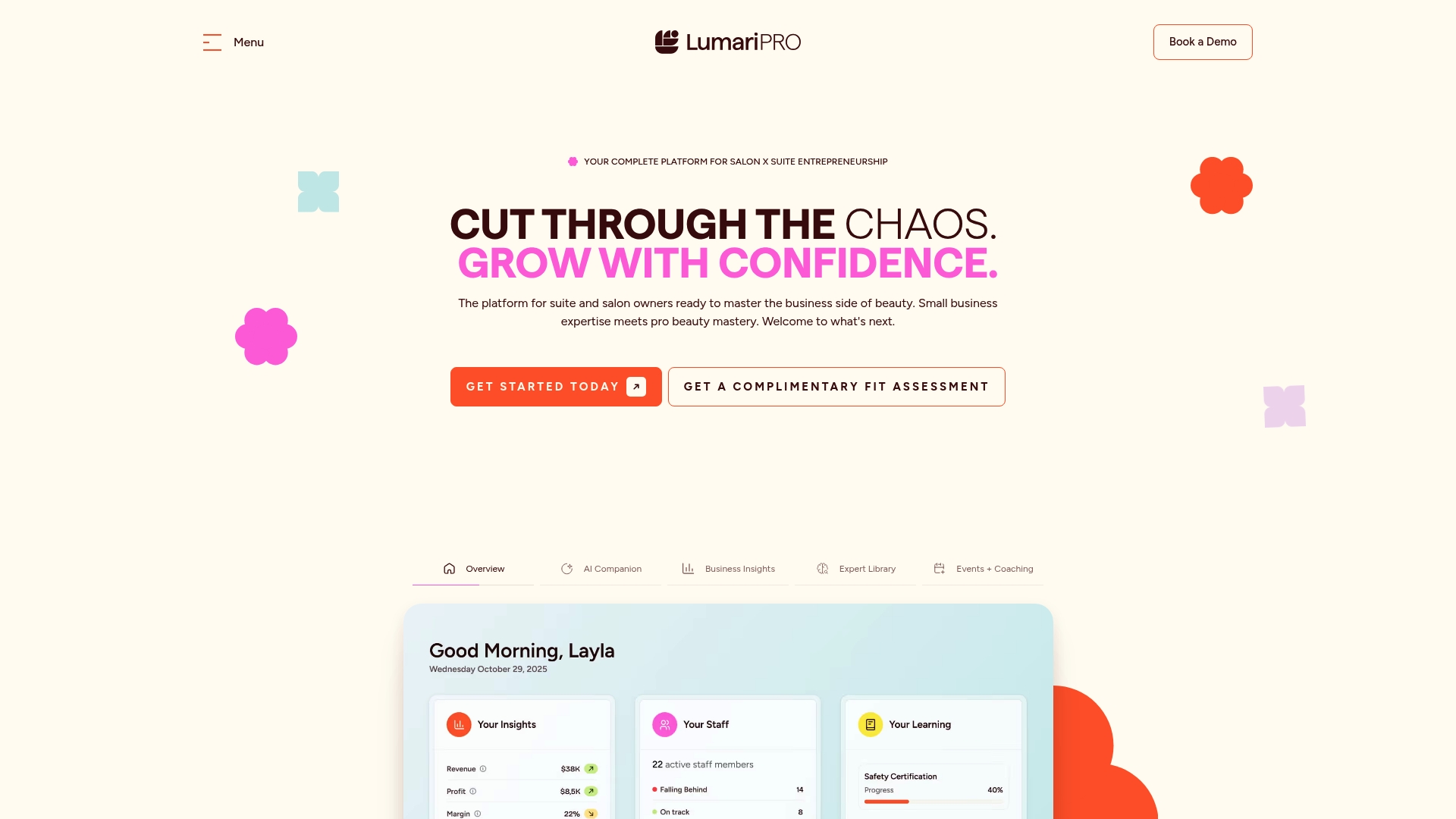
Beyond the numbers, Lumaripro’s template library includes ready-to-use price increase letters, SMS scripts, and staff briefing guides built specifically for the beauty industry. The staff coaching modules train your team on objection handling so your front desk is not improvising when a client pushes back. And because Lumaripro connects to your POS and QuickBooks, updating your pricing flows through your systems without manual double entry.
If you want to model your next increase, access done-for-you templates, and get coaching from people who understand salon economics, explore what Lumaripro offers and see how it fits your business.
Useful sources and further reading
“Every service business has to raise prices eventually. As your costs go up and your expertise grows, your rates need to reflect the value you’re actually delivering.” — How to Write a Price Increase Letter, HouseCall Pro
- Salon Price Increase Letter: 3 Free Templates — The most practical salon-specific resource in this guide. Covers timing, in-chair disclosure, and three copy-ready templates with guidance on when to use each.
- How To Raise Your Prices as a Hairstylist — Detailed walkthrough of cost-per-service calculation, staged increases, and the revenue math behind a modest price change.
- How to Write a Price Increase Letter — Shopify’s general-business guide covers the seven strategies (notice, justification, directness, specifics, appreciation, contact, selective deals) that reduce client churn across service businesses.
- Notice of Price Increase Template — Useful for owners who need contract-compliant formal notice language, including checkboxes for required client actions.
- How To Write a Rate Increase Letter — Indeed’s career resource covers the business rationale and provides two example letters useful for adapting to a salon context.
- Lumaripro Platform — For owners who want software support: revenue modeling, template access, and POS integrations built for the beauty industry.
Recommended