Price every service from a floor price built on your real labor, product, and overhead costs, then layer on a target margin of 20% by default. Do that math for three services this week: your top color service, your most-booked haircut, and one add-on. Everything below explains the formula, how to structure your menu around it, and exactly when to raise prices without spooking clients.
TL;DR:
- Calculating a salon’s floor price requires accurate estimates of labor, product, overhead, and billable minutes, not simply copying competitor prices.
- Target margins should be 18-25% for owner-stylist solo models and 10-15% for salons with staff, and prices must be rounded up to the nearest dollar or five.
- Keeping your menu simple with 15 to 25 core services, clear categories, and visible, high-margin add-ons improves client understanding and boosts profits.
- Price increases should be based on specific signals like high chair utilization, growing waitlists, or rising supplier costs, with regular annual reviews.
- Using real-time dashboards and data tracking tools helps maintain profitable pricing by preventing services from drifting below their calculated floor prices.
Table of Contents
- What Is the Right Salon Pricing Strategy for Profit?
- How Do You Calculate a Salon Service’s Floor Price?
- How Should You Structure Your Salon Service Menu?
- How Does Tiered Pricing by Stylist Level Work?
- When Should You Raise Salon Prices and How?
- What Pricing Mistakes Are Costing Salons the Most Money?
- What Should You Do This Week to Fix Your Pricing?
- How LumariPRO Turns Pricing Formulas Into a Daily Habit
- Should You Charge Different Prices for Peak and Off-Peak Hours?
- Do Bundles and Package Pricing Actually Increase Profit?
- How Do Loyalty Programs Affect Your Pricing Strategy?
- How Do You Analyze Competitor Pricing Without Just Copying It?
- Should New Clients Pay the Same Price as Repeat Clients?
- What the Formula Gets Right (and What Most Advice Skips)
- Let LumariPRO Handle the Pricing Math for You
- Sources
What Is the Right Salon Pricing Strategy for Profit?
A defensible salon pricing strategy starts with a cost floor, not a glance at the salon down the street. The floor price is the minimum you can charge and still hit your target margin after covering labor, product, and overhead. Everything else, your “starting from” pricing, your tiers, your seasonal offers, gets built on top of that number.
Most owners do this backward. They check three competitor menus, average the numbers, and call it a strategy. That approach copies someone else’s cost structure, someone else’s rent, someone else’s product waste, and someone else’s staffing model. It tells you nothing about whether your own service pricing model actually makes money.
The formula-first method fixes that. You calculate cost per billable minute, add product cost per service, allocate a slice of overhead, then divide by (1 minus your target margin) to land on a floor price. Zenoti’s pricing guide lays out this exact structure, and it holds up whether you’re a solo suite renter or running a five-chair payroll salon. Once you know your floor, you can price confidently above it based on skill, demand, and market position, instead of guessing and hoping the math works out at tax time.
How Do You Calculate a Salon Service’s Floor Price?
Four numbers drive every floor price calculation: labor cost, product cost, overhead, and billable minutes. Get these wrong and every price on your menu is wrong too.
Labor cost is what that hour actually costs the business, either the stylist’s real wage plus taxes and benefits, or, if you’re the one behind the chair, the hourly income you need to pay yourself to make this worth doing. Product cost (COGS) is the actual product used per service, not a rough guess. Overhead is rent, utilities, software, insurance, and supplies, allocated per billable minute across your total working hours. Billable minutes are the minutes you can actually bill in a week, after subtracting breaks, cleaning, and no shows.
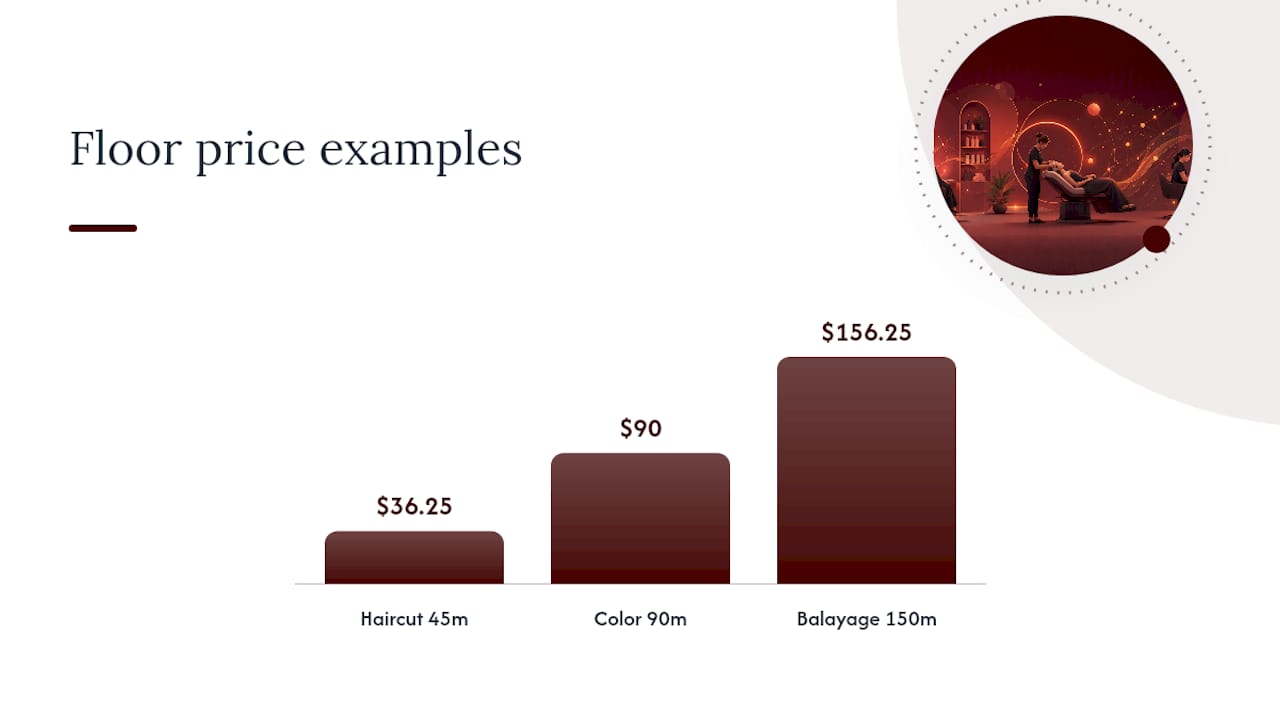
The formula, drawn from Nouz’s pricing breakdown, looks like this:
Price = (cost per minute × service duration + product cost) ÷ (1 − target margin)
Here’s the math in action:
- Haircut, 45 minutes: Labor and overhead run $0.60 per minute ($27 for the visit), product cost is $2. At a 20% target margin: ($27 + $2) ÷ 0.80 = $36.25, round to $35 or $38.
- Single-process color, 90 minutes: Cost per minute is still $0.60 ($54 labor and overhead), product cost is $18 for color and developer. ($54 + $18) ÷ 0.80 = $90, round to $90.
- Balayage, 150 minutes: $0.60 per minute ($90), product cost $35 for lightener, toner, and bond builder. ($90 + $35) ÷ 0.80 = $156.25, round to $155 or $160.
Round to clean numbers your front desk can quote without a calculator, but round up, never down. A $2 discount on paper turns into real money lost across hundreds of appointments a year.
The mistake that quietly wrecks margins: confusing markup with margin. If your cost is $30 and you mark it up 20%, you charge $36. But $6 of profit on a $36 sale is a 16.7% margin, not 20%. You have to divide by (1 − margin), not multiply cost by (1 + markup), or you’ll underprice every single service on your menu without realizing it.
Statistic Callout: Target margins vary by business model. Owner-stylists working solo should aim for 18 to 25% net margin, while payroll-model salons with staff and greater overhead typically run 10 to 15%, according to Kevonia’s pricing guide. If your actual margin sits well below that range, your floor prices are too low, your overhead allocation is off, or both.
How Should You Structure Your Salon Service Menu?
A menu with 60 line items doesn’t look thorough, it looks confusing, and confused clients default to the cheapest option or ask the front desk for help that eats staff time. Keep your core list to 15 to 25 services, grouped into short categories like Cuts, Color, Treatments, and Extensions, following the curation approach outlined by The Salon Brief.
For services where time and product vary wildly by client, hair length, density, or condition, use “starting from” pricing rather than a single fixed number. A balayage on shoulder length fine hair and one on waist length thick hair are not the same job, and pricing them identically means you eat the difference on every long haired client. “Starting from” pricing, paired with a quick consultation quote, protects your floor price on the jobs that actually cost more to deliver.
Add-ons are where menu structure turns into real margin. A bond treatment, scalp massage, or gloss layered onto an existing appointment adds ten to fifteen minutes but carries almost no incremental labor cost beyond the product itself. Effective add-ons typically run $15 to $50 and convert at high margin because you’re not paying for a new appointment slot, you’re monetizing time you already have someone in the chair.
- Round retail-facing prices to clean $5 increments ($85, not $83.40).
- List what’s included in multi-step services (wash, cut, style) so clients see the value, not just a number.
- Use tier labels like “Signature” or “Master” sparingly, overusing them dilutes the meaning and confuses new clients.
- Keep add-ons visible on the menu itself, not buried as a verbal upsell only the front desk remembers to mention.
Pro Tip: Put your highest-margin add-on directly under your most-booked service on the printed or digital menu. Clients scan top to bottom, and proximity sells better than a script ever will.
How Does Tiered Pricing by Stylist Level Work?
Tiered pricing lets you charge more for the same service based on who’s holding the shears, and it’s one of the fastest ways to reward senior talent without renegotiating every line on the menu. A clean tier system also gives newer clients a logical reason to “graduate” to a pricier stylist as their loyalty and trust grow.
- Junior or associate tier: Base floor price, typically for stylists building a book or working under supervision.
- Senior tier: Add 10 to 25% over base for stylists with a proven track record, strong rebooking rates, or a consistent waitlist.
- Master or artistic director tier: Add 30 to 50% over base for stylists with advanced training, editorial or platform work, or client demand that regularly exceeds their available hours.
The criteria matter more than the label. Don’t hand out a master tier because someone’s been there five years, tie it to training completed, portfolio strength, and actual booking demand. A stylist with a two week waitlist has earned pricing power that tenure alone doesn’t justify.
On a $90 color service, that structure looks like $90 for junior, roughly $100 to $112 for senior, and $117 to $135 for master. Communicate this plainly on your menu and in booking software so clients see it as a stylist choice, not a hidden surcharge, and staff see it as a growth path worth working toward.
When Should You Raise Salon Prices and How?
Four signals tell you it’s time to raise prices, and waiting past all four is the more common mistake than raising too soon. Watch for chair utilization sitting at 85% or higher for weeks running, a waitlist that keeps growing instead of shrinking, supplier cost increases above 5%, or simply the calendar, if it’s been more than 12 months since your last adjustment, according to Nouz’s trigger framework.
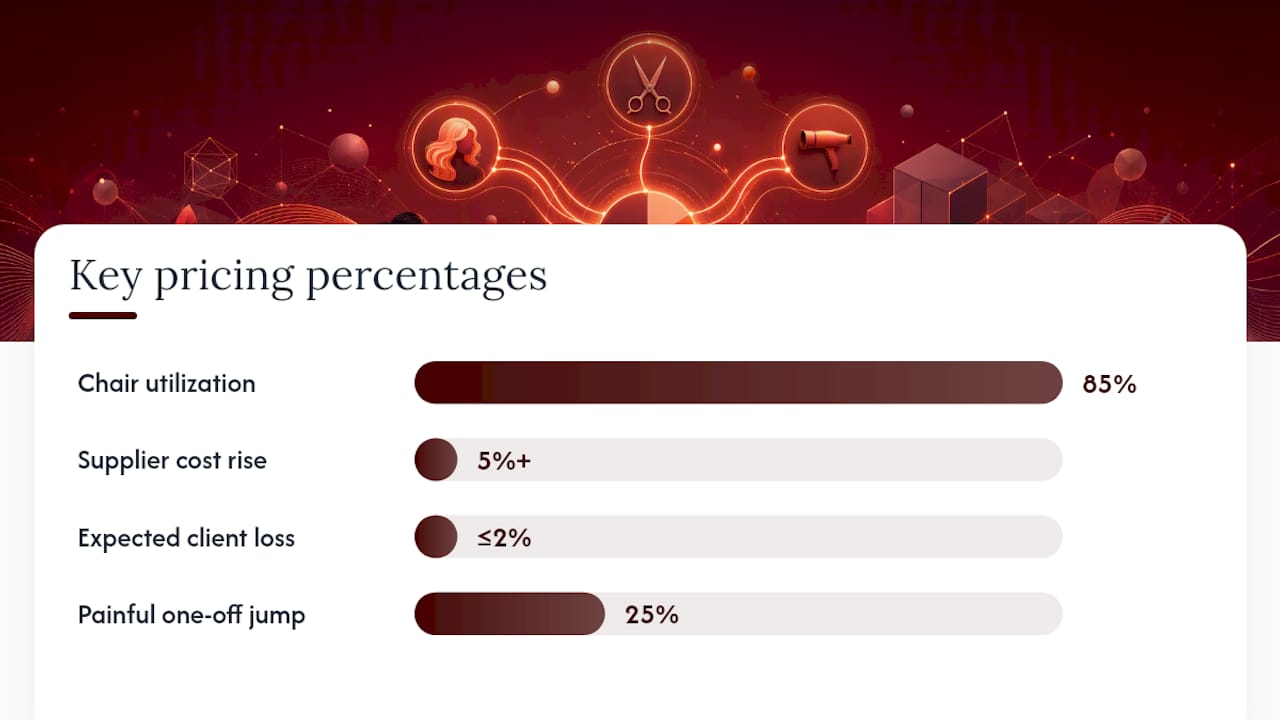
The baseline cadence is an annual review with a 5 to 10% increase, plus quarterly checks on any service line with volatile product costs, a rhythm recommended by The Salon Brief. Small, regular increases beat a rare, painful 25% jump that clients notice and resent.
You have options beyond a blanket increase. Raise only the specific lines under pressure, introduce a new top tier and let it anchor your existing prices as the “reasonable” middle option, or announce the change with 30 days notice so loyal clients can pre-book at the old rate before it shifts.
- Send a short email or text: “Starting [date], our pricing is adjusting to reflect [rising product costs / increased demand]. Loyal clients like you can lock in current pricing by booking before then.”
- Train front desk staff to answer pushback with one line, not an apology.
- Expect client loss to stay under 2% after a 5 to 10% increase, based on The Salon Brief’s data on client response to moderate raises.
Pro Tip: Never apologize for a price increase in writing. State it plainly, give a reason in one phrase, and move on, over-explaining reads as insecurity and invites more questions than it answers.
What Pricing Mistakes Are Costing Salons the Most Money?
Copying competitor prices without knowing your own cost structure is the single most expensive habit in this industry. Two salons three blocks apart can have wildly different rent, staffing, and product costs, so a price that’s profitable for one can be a loss leader for the other.
Undercounting service time is a close second. If a color service actually takes 105 minutes with foil placement and processing but you’ve priced it as if it takes 90, you’re underpricing every single booking by that gap, multiplied across a year.
Discounting to fill empty chairs feels productive but usually isn’t. Broad discounts typically cut profit on the affected appointments roughly in half, according to Appointible’s analysis of salon pricing mistakes, and they train regular clients to wait for the next sale instead of booking at full price. A targeted demand-shifting offer, like a modest discount only on Tuesday mornings, moves the needle without devaluing your entire book.
- Add 10 to 15 minutes of prep and cleanup time to every service calculation, it’s real labor you’re currently giving away for free.
- Audit your top five booked services this month for hidden losses, then recalculate each against your actual floor price formula.
- Replace blanket discounts with narrow, time-boxed offers tied to specific slow periods.
- Recheck product cost per service quarterly, formulas and pricing change more often than owners update their menus.
What Should You Do This Week to Fix Your Pricing?
- Calculate your hourly chair cost, then run the floor price formula on your top three booked services.
- Compare each result to your current menu price and flag anything priced below floor for immediate correction, whether that’s a price change, a new add-on, or a consultation-based quote.
- Pick a firm date for your next price update, then draft the client notification email now so you’re not writing it under pressure later.
- Turn on basic tracking for product usage and billable minutes per service, or plug that data into a tool that models the revenue impact of the changes before you commit to them.
How LumariPRO Turns Pricing Formulas Into a Daily Habit
Running these formulas by hand once is useful. Running them every month, across every service, every stylist tier, and every supplier price change, is where most owners quietly stop. That’s the gap real-time dashboards close.
Some platforms connect to POS systems and QuickBooks to pull actual labor, product, and overhead numbers instead of estimates, then surface which services are sitting below floor price before that gap compounds across a full quarter of bookings. Tracking expenses accurately in the first place, using a method like structured expense tracking for service businesses, makes those dashboard numbers worth trusting.
- Real-time dashboards that flag underpriced services automatically, not at year-end.
- Built-in playbooks for menu structure, tiering, and price-increase timing.
- AI-powered coaching and 1:1 sessions for owners working through their first formal pricing overhaul.
- A peer community of suite renters and salon owners comparing real numbers, not competitor guesses.
Should You Charge Different Prices for Peak and Off-Peak Hours?
Dynamic pricing in a salon setting means charging a premium during your highest-demand hours, typically weekday evenings and all-day Saturday, while offering modest incentives during predictably slow windows like Tuesday mornings or the first two weeks of January.
This works because chair time is a perishable inventory. An empty 10 a.m. slot on a Wednesday is gone forever once the clock passes it, so a small, targeted incentive that fills that slot beats leaving it empty. The mistake is treating peak and off-peak pricing as symmetrical. Raising Saturday prices by 10% is easy and rarely costs you bookings, since demand already outstrips supply in that window.
A simpler version that avoids the discount trap: keep your standard menu price as the baseline everywhere, then add a small peak-hour surcharge for evening and weekend slots rather than discounting slow ones. Clients tend to accept a premium for convenience more readily than they notice the absence of a discount, and it protects your floor price instead of eroding it.
Do Bundles and Package Pricing Actually Increase Profit?
Bundling works when it increases total spend per visit, not when it just repackages services at a lower combined price to look generous. A cut, color, and treatment bundled at a modest discount off the sum of individual prices can lift average ticket, because clients who’d normally skip the treatment add it in when it’s framed as part of a package deal.
The math still has to clear your floor price on every component.
Package pricing works especially well for prepaid multi-visit deals, like four maintenance color visits sold as a package with a small built-in discount. You get cash up front, a client committed to returning, and a scheduling advantage, since prepaid clients rebook more reliably than pay-per-visit clients.
How Do Loyalty Programs Affect Your Pricing Strategy?
A loyalty program only helps your pricing strategy if the rewards come from margin you’ve already built in, not from an extra discount layered on top of already-thin pricing. Points-based or visit-based rewards work best when they’re funded by the add-on and retail margin discussed earlier, rather than by shaving points off your core service floor price.
Structure loyalty rewards around behavior that actually helps your business: consistent rebooking, referrals, or retail purchases, rather than simply rewarding total dollars spent. A client who rebooks every six weeks on schedule is more valuable to your calendar utilization than one who spends more per visit but books unpredictably, and your loyalty structure should reflect that.
Integrate loyalty tracking with the same system you use for price and cost tracking, so you can see the true cost of every reward against the margin it’s drawn from.
How Do You Analyze Competitor Pricing Without Just Copying It?
Competitor menus tell you what the market will tolerate, they don’t tell you what your business needs to charge to stay profitable. Useful competitive analysis looks at positioning and service depth, not just the number on the page.
Look at what’s included in a competitor’s price, does their color service include a gloss and blowout, or is that an extra line item? A $95 color that includes styling isn’t more expensive than your $75 color that charges styling separately, it’s priced almost identically once you account for what’s bundled in. Note how competitors structure their tiers, whether they use “starting from” pricing on the same variable services you do, and how often their prices seem to change based on reviews or social mentions of a recent increase.
The number that actually matters is your own floor price, checked against the market range as a sanity check, not as the source of the number itself. If your floor price sits meaningfully above every competitor in your area, that’s useful information too, it might mean your overhead is too high, or it might mean you’re positioned to market yourself as the premium option and should lean into that instead of racing to match a lower price you can’t actually afford to charge.
Should New Clients Pay the Same Price as Repeat Clients?
Charging new clients less than repeat clients to win them in the door is a common instinct, and it’s usually the wrong one for core services. A new-client discount on your floor-priced color service means you’re losing money on exactly the visit where you’re trying to prove your value and earn a rebooking, which is backward.
Where a new-client incentive makes sense is on the consultation or the add-on layer, not the core service price. A complimentary consultation, a small retail sample, or a free deep-conditioning add-on on a first visit costs you far less than discounting the entire service, and it still signals generosity without touching your floor price.
Repeat clients, by contrast, are the ones who’ve earned pricing consideration through loyalty program value or prepaid packages, precisely because their rebooking pattern reduces your acquisition cost over time. Reserve real discounts for retention and referral behavior you can measure, not for the first visit where you have the least information about whether that client will actually come back.
What the Formula Gets Right (and What Most Advice Skips)
The floor price formula is correct, but it’s incomplete on its own, and most articles stop right where the real work starts. Knowing your number is easy. Building the discipline to recalculate it every time a supplier raises prices, a lease renews, or a stylist earns a tier promotion, that’s the part owners actually struggle with.
Conventional pricing advice leans hard on competitor comparison because it’s fast and requires no math. It’s also how most salons end up underpriced for years without noticing, because a competitor’s price tells you nothing about their labor cost or their rent. The owners who get pricing right treat it as a recurring calculation tied to real numbers, not a one-time decision made during a slow afternoon.
If there’s one place to start, it’s not the menu redesign or the tier structure, it’s the floor price on your three most-booked services. Everything downstream, add-ons, bundles, loyalty rewards, only protects margin if the base number underneath it is already correct. Get that right first, and the rest of the strategy has something solid to stand on.
— Oliver
Let LumariPRO Handle the Pricing Math for You
Running floor-price formulas by hand every quarter, across every service and every stylist tier, is exactly the kind of task that quietly slips once a busy season hits. LumariPRO replaces that spreadsheet juggling with live dashboards pulled from your actual POS and QuickBooks data, so you see which services have drifted below floor before it costs you a full quarter of underpriced bookings.
Some platforms pair those dashboards with playbooks for small business owners, plus coaching from experienced professionals, not generic small-business advice borrowed from an unrelated industry. If you want a clear read on where your current pricing stands, book a complimentary fit assessment and get a direct look at what’s underpriced and what to fix first.
Sources