Run a two-sided give/get referral, not a one-sided coupon. Offer $25 for the referring client and $25 (or equivalent salon credit) for the new one, tied to a unique referral link with automated tracking. Your first move this week: set that reward and turn on one-tap SMS sharing for your top ten repeat clients.
TL;DR:
- A two-sided referral reward of $25 for both the referrer and new client is most effective, especially when tied to a unique, trackable link via SMS.
- Referral programs should aim to generate 30 to 50 percent of new bookings and be simple, automated, and integrated with your booking platform.
- Calculating your cost per acquisition and setting clear rules ensures rewards are sustainable and incentives motivate genuine sharing.
- Tracking tools built into booking or CRM systems help automate referral attribution, reducing manual errors and increasing program transparency.
- Regular monitoring and small-scale experiments on timing, messaging, and rewards can optimize referral growth before scaling up.
Table of Contents
- Why a Salon Referral Program Works (And What to Expect)
- What Referral Rewards Actually Get Clients to Share?
- How Do You Set Up a Salon Referral Program?
- What Tools Handle Referral Tracking Without Extra Work?
- How Do You Know If Your Referral Program Is Working?
- Three Experiments Worth Running Before You Touch Anything Else
- Let LumariPRO Handle the Referral Tracking You Don’t Have Time For
- Sources
Why a Salon Referral Program Works (And What to Expect)
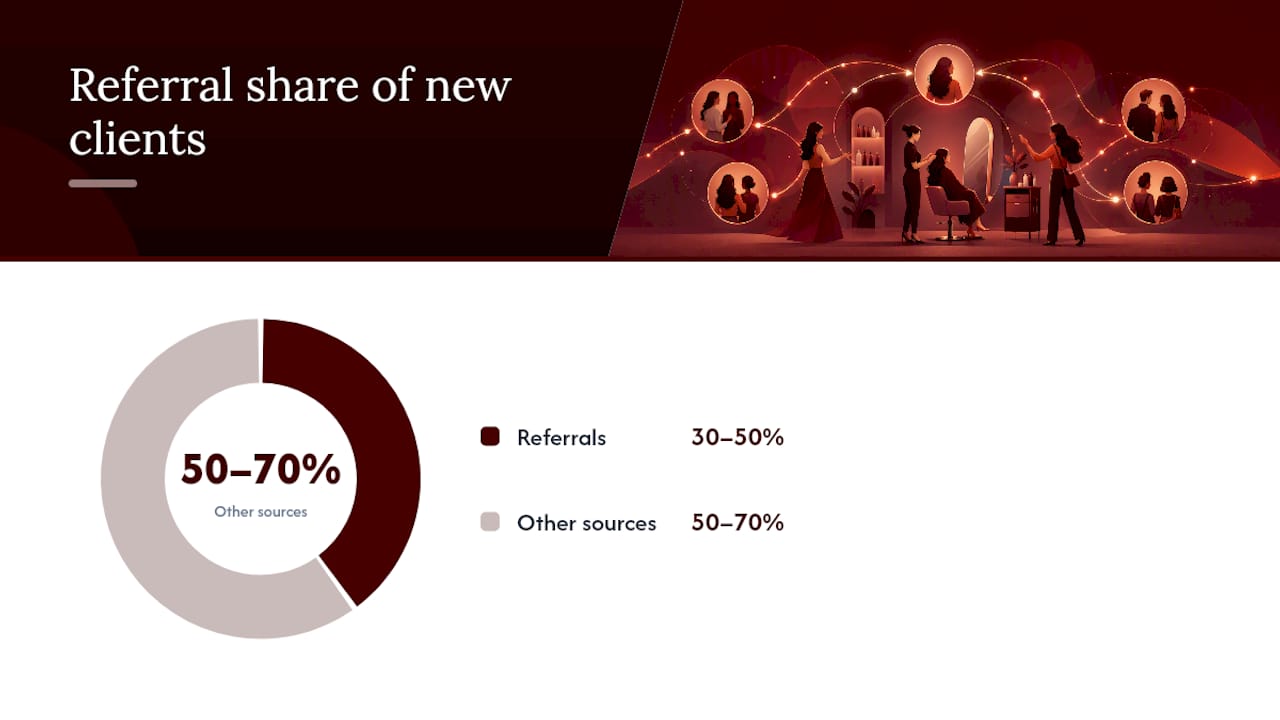
Referred clients trust you before they ever sit in the chair. A friend’s recommendation carries more weight than a five-star review from a stranger, and that trust shows up in the numbers. In healthy, mature programs, referrals account for roughly 30 to 50 percent of new clients, which makes referral marketing one of the few growth channels that gets cheaper as it scales instead of more expensive.
Compare that to paid social or search ads, where cost per booked client tends to climb every quarter as competition for the same audience increases. A referral costs you a reward, maybe $20 to $30 in credit, but that client usually sticks around longer and spends more per visit than someone who found you through an ad. Referral clients also tend to book at the same cadence as the person who referred them, since they’re often already primed by a friend’s opinion on frequency and pricing.
A working referral program does three things for your business at once:
- Lowers your blended client acquisition cost over time, since word-of-mouth doesn’t scale with ad spend
- Builds a loyalty loop where your best clients feel invested in your success, not just their own appointments
- Reduces how dependent you are on ad platforms and seasonal booking dips
The catch: a referral program only works if it’s easy to use and the reward actually motivates action. A flyer at the front desk that says “refer a friend” without a tracking mechanism isn’t a program. It’s a suggestion nobody follows up on.
What Referral Rewards Actually Get Clients to Share?
Not every incentive performs the same way, and some ideas that sound generous on paper fall flat in practice. Here’s a rough priority order based on what tends to move the needle for salons and beauty businesses, from strongest to weakest.
- Two-sided dollar credit. A $25 give / $25 get structure (or a percentage-based equivalent, like 20% off for both) is the format used in more than 90% of referral programs across industries, and salons are no exception. Credit toward a future service, rather than cash, tends to outperform cash payouts because it locks the referrer into a return visit instead of paying out money that leaves your business entirely.
- Free add-ons over discounts. A complimentary deep-conditioning treatment, a scalp massage, or a brow tint feels like a gift, not a transaction, and it costs you far less than the retail price implies. Clients remember the experience of being upgraded more than they remember a dollar figure.
- Tiered rewards for repeat referrers. Your top referrers, the clients who bring in three or more people, deserve something better than the standard credit. A free service, early access to new stylists, or a small retail bundle at referral number three or five turns your best advocates into an informal ambassador group.
- Gamified milestones. A simple point system, where every successful referral earns points redeemable for services or products, works well for salons with a younger or more social-media-active clientele. It doesn’t need software beyond what your booking platform already tracks.
- Staff-driven bonuses. Give stylists and estheticians a small bonus, $5 to $10, for every referral that books and completes an appointment because of their direct mention. Staff who have a stake in the outcome bring up the program more often during natural conversation, which is where most referrals actually start.
- Review-triggered referral asks. Pair your review request with a referral invitation. A client who just left a five-star review is in exactly the right headspace to share your name with a friend.
Pro Tip: Cap your reward at a dollar amount you’d happily pay for a new client through any channel. If you’d spend $30 on a Facebook ad to get one new booking, a $25 give / $25 get referral is a bargain by comparison, and it comes with a built-in trust signal an ad never will.
The mistake most salons make with rewards is trying to get clever before they’ve proven the basics work. Start with the simple two-sided credit. Layer in tiers and staff bonuses only after you’ve confirmed clients are actually sharing links, not just hearing about the program and forgetting it exists.
How Do You Set Up a Salon Referral Program?
Setting one up correctly takes an afternoon of planning and a week of staff training. Skip either step and the program quietly dies within a month.
1. Set your goals and KPIs before you set your reward. Decide what success looks like: a target referral share of new clients (aim for 20% in your first quarter, working toward the 30 to 50 percent range mature programs hit), a target number of active referrers, or a specific revenue goal. Without a number to hit, you won’t know if the program is working or just running.
2. Do the reward math. Calculate your average client lifetime value and your current cost per acquisition from paid channels. Set your give/get reward well below what you’d pay an ad platform for the same result. Decide on a cap, maybe five rewarded referrals per client per year, so a handful of hyper-networked clients don’t drain your margin.
3. Write rules that leave no ambiguity. Define exactly:
- Which services qualify (all services, or just first-time bookings above a minimum price)
- When the reward triggers (on completed and paid appointment, never on booking alone, to protect against no-shows)
- How long the referral link stays valid before it expires
- Who counts as the referrer if a client shares with multiple friends
- Whether reward credit expires if unused after a set window
4. Build the frictionless sharing mechanism. This is the step most salons skip, and it’s the one that makes or breaks adoption. Every client needs a unique referral link they can send with one tap, ideally through SMS since text-based sharing converts far better than email or printed cards. Draft pre-written share text for clients so they don’t have to think of what to say. Something like: “I get my hair done here and they’re amazing. Here’s $25 off your first visit: [link].” Removing that awkward blank-page moment is often the single biggest lever you have.
5. Train your staff with real scripts. Front desk and stylists need a natural way to bring up the program, not a script that sounds like a script. Suggest something like: “By the way, if you know anyone who’d love this, you both get $25 when they book.” The best timing is right after checkout or immediately following a great appointment, when satisfaction is highest.
6. Promote across every touchpoint you already have. Mention it at checkout, include it in your post-appointment SMS, feature it in your email newsletter, add it to your Instagram bio link, and post about it after collecting a strong review. A post-review referral ask converts three to five times better than a generic newsletter mention, so don’t bury the invitation in a monthly email nobody opens.
7. Review performance monthly for the first quarter, then quarterly after that. Look at referral share of new clients, how many links get shared versus redeemed, and whether your top referrers are staying engaged. Adjust the reward or messaging only after you’ve ruled out friction as the problem.
What Tools Handle Referral Tracking Without Extra Work?
Manual tracking is where most salon referral programs quietly fall apart. If your front desk has to remember who referred whom and apply a discount by hand, you’ll lose referrals to human error within the first month, and you’ll never get a clean read on whether the program is working.
Unique referral links solve this at the root. Each client gets a personal link tied to their profile, so when a new client books and completes a paid appointment through that link, the system attributes it automatically. That “completed and paid” trigger matters more than it sounds: crediting a reward the moment someone books, rather than after they actually show up and pay, opens the door to no-show abuse and phantom referrals.
What to expect from a modern booking or CRM platform with referral features built in:
- Automatic issuance of a unique link per client, no manual code generation
- Auto-applied credit or discount at checkout for both parties once the qualifying visit is complete
- A dashboard showing referral volume, redemption rate, and top referrers without spreadsheet work
- Integration with your point-of-sale and payment processor, so the reward reflects in the client’s account balance without a staff member touching it
Booking platforms with referral tools baked in tend to produce the highest adoption simply because there’s less for staff to manage manually. If your current system doesn’t support this, a workable manual fallback exists: keep a shared spreadsheet logging referrer name, referred client name, date of qualifying appointment, and reward status, and assign one staff member to update it weekly. It’s not elegant, but it beats running the program on memory and good intentions.
How Do You Know If Your Referral Program Is Working?
A healthy salon referral program should generate 30 to 50% of new client bookings once it matures, according to industry benchmarks.
Track four numbers monthly: activation rate (percentage of clients who actually share their link), referral conversion rate (shares that turn into booked appointments), referral client lifetime value versus paid-channel lifetime value, and your list of top referrers. On that last metric, referral-acquired clients should outperform paid-channel clients by roughly 15% or more in first-year value. If they don’t, the issue usually traces back to who you’re targeting for referrals or how their first visit is handled, not the program structure.
Pro Tip: If activation is low but the clients who do share convert well, don’t touch the reward. Fix the ask instead: retrain staff on timing, add the referral link to your automated post-appointment text, and revisit before you assume the incentive is too small.
The optimization order matters. Fix friction first (link visibility, SMS delivery, redemption clarity), then adjust the reward amount, and only increase promotion volume once you know the mechanics convert. Pairing your referral program with your existing loyalty structure also helps, since loyalty data often reveals your best referral candidates before you even launch — the clients who rebook most often are usually your strongest advocates too.

Three Experiments Worth Running Before You Touch Anything Else
Most owners overthink the launch and underthink the follow-through. Here’s where to spend your first month: text your top 20 clients a $25/$25 link with pre-written share copy, add a small stylist bonus for referrals that book and complete, and send an automated referral ask 24 hours after every five-star review.
Skip the common traps. A share process that takes more than one tap kills adoption before it starts. Changing the reward amount inside the first eight weeks makes it impossible to tell what actually caused a shift in behavior. And manual payout errors, crediting the wrong client or missing a redemption entirely, erode trust faster than a program that pays out too generously ever would.
Getting the financial side visible matters more than most salons realize; a clear read on what each referral actually costs and returns is often the difference between a program that grows and one that quietly fades.
— Oliver
Let LumariPRO Handle the Referral Tracking You Don’t Have Time For
Building this by hand with spreadsheets and sticky notes works for a while, until it doesn’t. LumariPRO’s platform is built specifically for suite renters and independent beauty pros who need the automation of a big salon system without the overhead of running one.
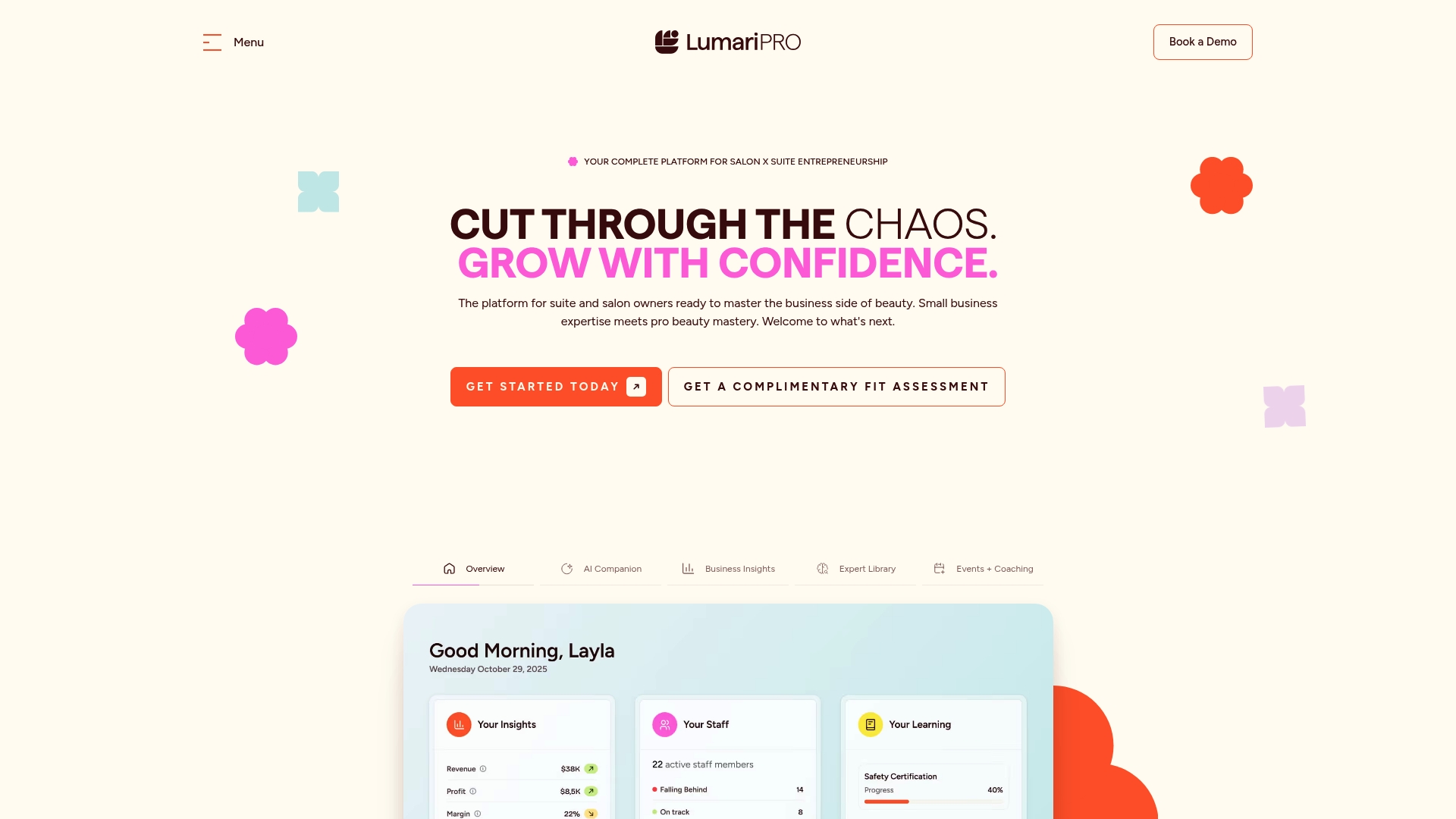
Instead of manually tracking who referred whom, some platforms connect to your point-of-sale and accounting software to provide real-time dashboards on referral activity alongside the rest of your business financials, so you can see referral share of new clients and client lifetime value in the same place you check your booking revenue. Such platforms often pair that tracking with proven business playbooks and coaching designed around the actual economics of independent beauty work, service pricing, retail margins, and booth rental costs, rather than generic small-business advice borrowed from another industry. If you want to see what a working referral program could add to your bottom line before you build anything, run the numbers through the ROI calculator and see where your current client acquisition cost stands against what referrals could save you.
Sources
- How to Set Up a Referral Program for Your Salon (That Actually Drives Bookings) | Deelo Blog
- How to build a customer referral program in 2026 | Zendesk
- How to Set Up a Salon Referral Scheme That Brings in New Clients | Fresha
Recommended