Gross margins on professional retail products typically run 42% to 55% at MAP pricing, and after commissions, shrinkage, and carrying cost, net retail margin usually settles around 30% to 35%. That’s roughly double what most service revenue nets after labor. If you’re not tracking retail as its own profit center, you’re leaving real money on the shelf. Start by pulling your attach rate this week and running the math below.
TL;DR:
- Retail margins at MAP generally range from 42% to 55%, with net margins after costs around 30% to 35%, doubling typical service profit margins.
- Increasing attach rates from 8% to 15% can significantly boost retail revenue, generating an extra $42,000 or more annually on $600,000 service revenue.
- Properly calculating retail profit involves subtracting commission, shrinkage, and carrying costs from gross margin, resulting in a net contribution of 30% to 35%.
- Enforcing MAP pricing, curating product lines, and linking retail recommendations to consultations are effective strategies to lift retail margins and attach rates.
- Using digital tools to connect POS and accounting data enables accurate, real-time tracking of retail margins and profit contribution, guiding better merchandising decisions.
Table of Contents
- Salon Retail Margins: Benchmarks You Can Check Against Your Own Books
- Why Retail Is a Different Kind of Profit
- How to Calculate Markup, Margin, and Net Retail Contribution
- Which Levers Actually Raise Retail Margins
- What Hidden Costs Do to Your Retail Margin
- KPIs and Target Ranges Worth Tracking Monthly
- Your 30/60/90-Day Retail Margin Checklist
- How Retail Margins Differ by Salon Type
- How Seasonal Swings Move Retail Numbers
- What Actually Drives a Client to Buy at the Chair
- Choosing the Right Products and Assortment
- Training Your Team to Sell Retail Without It Feeling Like Selling
- Tracking Retail Margins With Better Tools
- An Editorial Take on Retail as the Real Growth Lever
- Put These Numbers on a Dashboard, Not a Sticky Note
- Sources
Salon Retail Margins: Benchmarks You Can Check Against Your Own Books
Most salon owners underestimate how far retail margins outrun service margins, mostly because service revenue feels like the “real” business and retail feels like an afterthought. The numbers say otherwise.
Salon net profit margins, across the industry, commonly land somewhere between 8% and 15%, weighed down by labor, rent, and product cost tied to services. Retail carries none of that same labor drag. A bottle of shampoo sold at the front desk doesn’t require forty-five minutes of a stylist’s chair time, so its margin structure looks completely different.
- Gross retail margin (pro-only brands at MAP): 42% to 55%
- Net retail margin (after commission, shrinkage, carrying cost): roughly 30% to 35%
- Salon-wide net profit margin: 8% to 15%
- Retail attach rate, industry median: 8% to 12% of service revenue
- Above-average operators: 12% to 18% attach
- Premium/boutique salons: 18% to 25%+ attach
Quick math: a salon doing $600,000 in annual service revenue at an 8% attach rate generates $48,000 in retail sales. Push attach to 15% and retail revenue jumps to $90,000, an extra $42,000 in sales running at roughly double the net margin of the service side. That’s not a rounding error. That’s a second income stream hiding inside a business that already thinks of itself as fully built out.
Why Retail Is a Different Kind of Profit
Service revenue and retail revenue don’t behave the same way on your profit and loss statement, and treating them identically is where most owners lose ground. A haircut carries commission, product cost, and roughly 45 to 60 minutes of paid labor against it. A retail sale carries none of that time cost, just a unit cost, a commission slice, and shelf space.
That’s why profit share and revenue share diverge so sharply. A salon where retail is only 12% of revenue can still generate close to 26% of total profit from that same 12%. Push retail to 20% of revenue, and its profit contribution can climb toward 42% of the total.
- Service net margin after labor and commission: often single digits to low teens
- Retail net margin after all loads: 30% to 35%
- Profit density per square foot of retail display frequently outperforms an equivalent square foot of chair space
Think in profit share, not revenue share. A dollar of retail sales is worth more to your bottom line than a dollar of service sales, and your merchandising decisions should reflect that.
How to Calculate Markup, Margin, and Net Retail Contribution
Markup and margin get confused constantly, and the mix-up costs owners real money when negotiating with distributors or setting shelf price. Markup is profit divided by cost. Margin is profit divided by retail price. A product that costs you $10 and sells for $20 has a 100% markup, but only a 50% margin, because $10 of profit divided by $20 in sales equals 50%.
- Calculate gross margin: (Retail price minus wholesale cost) divided by retail price.
- Subtract commission: typically a 10% to 15% load on the sale.
- Subtract shrinkage reserve: commonly 3% to 5% for breakage, testers, and theft.
- Subtract annualized carrying cost: often 18% to 25% of average inventory value.
- What’s left is your net retail contribution on that SKU.
Worked example: a $28 shampoo with a $13 wholesale cost has a gross margin around 54%. After a 12% commission, a 4% shrinkage reserve, and carrying cost, net contribution typically lands closer to 30% to 35%, or roughly $8.40 to $9.80 of real profit per bottle sold.
Which Levers Actually Raise Retail Margins
Not every fix carries equal weight. Some moves protect margin structurally; others just chip at the edges.
Enforce MAP pricing and stick to pro-only brands. Minimum advertised price rules and professional-exclusive lines keep your shelf price from getting undercut online, which preserves both your price anchor and your stylist’s confidence when recommending product.
Build consultation-to-prescription language into every service. Trade reporting consistently points to integrating retail recommendations into the actual service consultation rather than treating it as a separate upsell conversation, with ongoing training to reinforce it as standard practice, not a hard sell.
Curate the portfolio. Fewer, better SKUs outperform a crowded shelf. Set par levels so popular items never go dark, and cut anything that hasn’t moved in 90 days.
Rework commission incentives. Test a tiered commission that rewards attach rate growth, not just total dollars, over a 60 day window.
Consider e-commerce or a retail partner platform once your in-salon attach rate stabilizes above 12%, since that’s typically the point where an online storefront adds incremental sales rather than just cannibalizing walk-in purchases.
Case studies and boutique operator playbooks show SKU curation paired with MAP enforcement and consultation discipline can lift attach rates from single digits into the teens within six to twelve months.
Pro Tip: Run a 30 day test where every stylist names one specific product during checkout, tied to something said in the service. Track attach rate before and after. The script matters less than the consistency.
What Hidden Costs Do to Your Retail Margin
Carrying inventory isn’t free, and most owners never see the full cost because it doesn’t show up as a single line item. A realistic net margin model subtracts a commission load, inbound freight, a shrinkage reserve, and an annualized carrying cost of 18% to 25% from gross margin before you get to real contribution.
Slow movers are the quiet killer here. Product sitting on a shelf for six months ties up cash and often ends up written down or given away, which can quietly erase several points of net margin if nobody’s watching.
- Set par levels by SKU and reorder against actual sell-through, not gut feel
- Use FIFO rotation so older stock sells before it expires or fades on the shelf
- Limit promotions to slow movers only, never your top sellers
- Review slow-moving inventory monthly and cut anything stalled for 90+ days
KPIs and Target Ranges Worth Tracking Monthly
You can’t manage what you don’t measure, and retail is the part of the business most salons measure loosest.
- Attach rate: below 8% is underperforming, 8% to 12% is median, 12% to 18% is above average, 18%+ is premium territory
- Retail margin per unit: target 30% to 35% net after all loads
- Average retail dollars per visit: compare against your own six month rolling average, not an industry number
- Retail share of total profit: often disproportionate to retail’s share of revenue, so calculate it separately
- Reporting cadence: pull attach rate weekly, review margin per SKU monthly, reassess the full retail program quarterly
Profit per square foot is worth calculating separately for your retail display area versus your chair area. It clarifies whether that extra shelf unit is worth more than an added service hour, a comparison trade press has long recommended owners run before expanding either.
Your 30/60/90-Day Retail Margin Checklist
- Days 1 to 30: Pull your current attach rate, average retail dollars per visit, and net margin per top-selling SKU. Set one target, usually a 2 to 3 point attach rate increase.
- Days 31 to 60: Run a training sprint on consultation-to-prescription language. Cut any SKU that hasn’t sold in 90 days and tighten par levels on the rest.
- Days 61 to 90: Test a revised commission structure on a subset of stylists. If attach rate holds above 12%, pilot a small e-commerce or partner platform addition.
- Ongoing: Reassess attach rate and margin per unit monthly. Adjust the SKU list and commission structure quarterly, not annually.
How Retail Margins Differ by Salon Type
A high-end salon and a budget chain aren’t playing the same retail game, even though both sell shampoo. Premium and boutique salons tend to run attach rates in the 18% to 25%+ range, driven by higher price points, curated single-brand assortments, and clients who already trust the stylist’s word over a big-box aisle.
The salons that outperform their tier almost always share two traits: a narrow, well-chosen product line and a consistent consultation habit baked into every service, regardless of price point.
Suite renters and solo beauty professionals face a different structural challenge. Lower foot traffic means fewer chances to sell, so per-visit retail dollars and per-client relationship depth matter more than raw attach-rate percentage. A solo operator who prescribes deliberately to a smaller client base can still hit premium-tier margins even without premium-tier volume.
The lesson across every tier: attach rate correlates more with program discipline than with price point or square footage.
How Seasonal Swings Move Retail Numbers
Retail sales don’t move in a straight line through the year, and treating every month the same in your forecasting hides real opportunity. Holiday season, roughly November through late December, typically brings a spike in gift-set purchases and stocking-stuffer add-ons, often the single strongest retail window of the year for salons that stock accordingly.
Late winter and early spring often show a lull as clients work through what they bought over the holidays, so pushing new-arrival displays or a light spring promotion can help bridge the gap. Summer brings its own shift toward sun-protection and color-care products, particularly for salons with a strong color clientele dealing with fade and UV damage.
Back-to-school season, typically August into September, tends to favor styling tools and haircare basics over premium treatment lines, as household budgets tighten elsewhere. Building your par levels and promotional calendar around these shifts, rather than ordering the same mix year round, keeps shelf space working instead of sitting stagnant during predictable slow months.
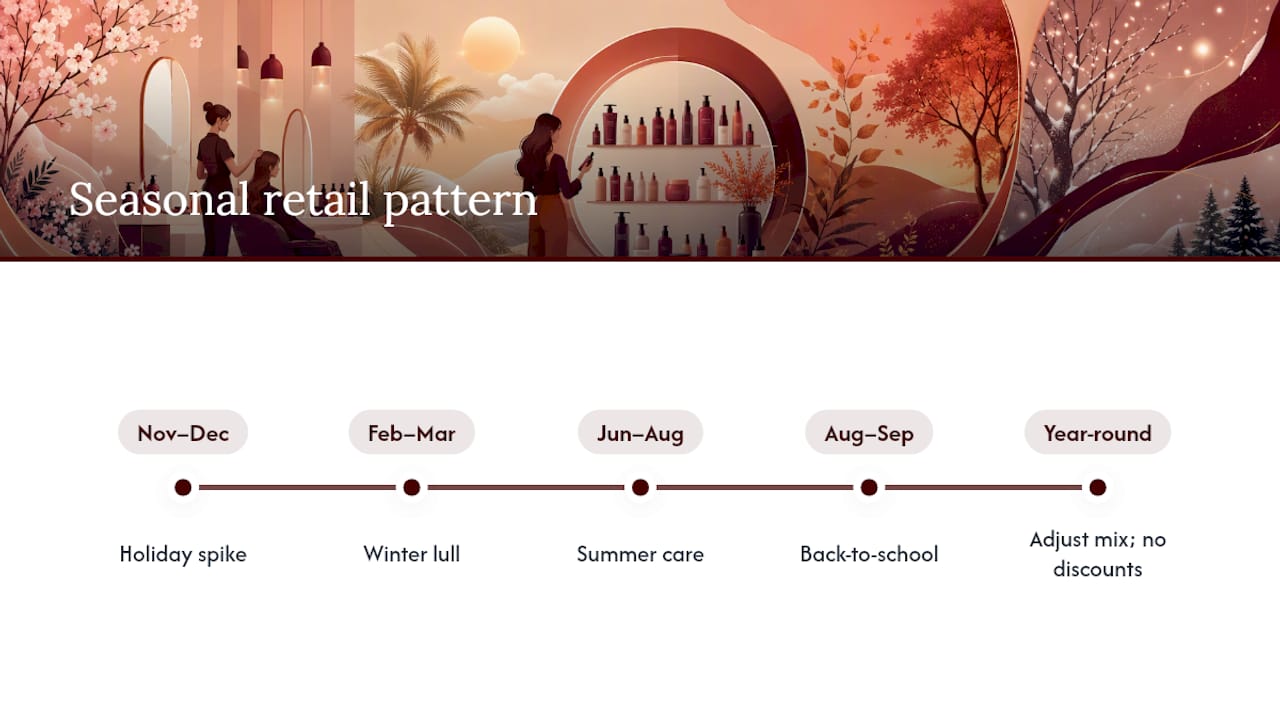
The mistake most owners make is discounting during a slow season to move volume, which erodes the very margin retail is supposed to protect. A better move is shifting the mix toward what clients actually want that month, keeping full price intact.
What Actually Drives a Client to Buy at the Chair
Clients rarely walk in planning to buy retail. They buy because something happened during the service that made the product feel necessary, not optional. That’s the core behavioral truth behind every successful retail program: purchase decisions form in the chair, not at checkout.
Trust is the biggest lever. A client who sees a visible result from a product used during the service, a shine, a curl pattern holding, color looking richer, is far more likely to buy than one who’s simply handed a bottle at the register with a generic pitch. This is why trade reporting keeps pointing back to consultation-integrated selling rather than end-of-visit upsells.
Price anchoring matters too. Clients calibrate what feels reasonable to pay based on what they just paid for the service itself. A $45 color client rarely balks at a $28 shampoo; a $150 color client barely notices it. Bundling reinforces this: pairing a shampoo and conditioner as a “system” tends to outsell either item alone, because it feels like a complete solution rather than an isolated purchase.
Convenience closes the sale. If the product isn’t visibly stocked, easy to grab, and simple to check out with, the moment passes and the client leaves empty-handed, even after saying yes verbally.
Choosing the Right Products and Assortment
The instinct to stock every line a distributor offers is exactly backward. A narrower, more deliberate assortment almost always outperforms a crowded shelf, because it’s easier for stylists to know cold and easier for clients to navigate without decision fatigue.
Start assortment decisions with your actual service mix, not with what’s trending industry wide. A salon built around color services needs a deep bench of color-care retail; a salon built around texture and cuts needs styling and finishing products front and center. Match the shelf to what you’re actually doing in the chair.
Limit each category to two or three price tiers at most. One entry-level option, one mid-tier workhorse, and one premium hero product per category gives stylists a clean recommendation ladder without overwhelming the display. Cut anything that duplicates another SKU’s job.

Reassess quarterly using actual sell-through data, not vendor relationships or personal preference. If a line hasn’t moved in 90 days, it’s occupying shelf space and tying up cash that a better performer could use instead.
Training Your Team to Sell Retail Without It Feeling Like Selling
Most stylists don’t dislike selling retail, they dislike selling it badly, and most salons never actually teach them how to do it well. The fix isn’t a script memorized word for word. It’s a habit built into the service itself.
The strongest training model ties every retail mention to something the stylist is already doing or saying. If they’re explaining why a color looks the way it does, that’s the moment to mention the product protecting it. If they’re demonstrating a styling technique, that’s the moment to hand over the tool or product that made it possible. This consultation-to-prescription approach, rather than a separate sales pitch, is consistently what trade press points to as the difference-maker between salons with strong attach rates and salons without.
Run short, frequent training sessions, fifteen minutes weekly beats ninety minutes quarterly. Role play actual client scenarios, not abstract sales theory. Track individual stylist attach rates, not just salon-wide numbers, so you can identify who needs coaching and who’s already excelling and can mentor others.
Recognition matters more than most owners assume. A simple monthly callout for the highest attach-rate improvement, not just highest total dollars, rewards the behavior you actually want repeated.
Tracking Retail Margins With Better Tools
Spreadsheets work until they don’t. Most salons track retail sales through their point-of-sale system but rarely connect that data to actual margin per SKU, commission load, or carrying cost, which means the number on the sales report and the number that actually hits profit are two different things.
A platform that pulls POS data alongside accounting software like QuickBooks closes that gap, turning raw sales totals into real net-margin tracking without a manual spreadsheet rebuild every month. LumariPRO’s platform is built specifically for this kind of real-time financial visibility for suite renters and independent salon owners.
Beyond dashboards, digital tools help with the merchandising and marketing side of retail too. If you’re testing an e-commerce add-on or want more local visibility to drive retail-ready foot traffic, a partner like Baby Love Growth’s salon SEO service can help more of the right clients find you in the first place, which matters just as much as what happens once they’re in the chair.
The goal isn’t more software for its own sake. It’s replacing guesswork about which SKUs actually make money with a number you can check every week.
An Editorial Take on Retail as the Real Growth Lever
Most salons treat retail like a nice-to-have bonus on top of the “real” business. That’s backward. Retail is the highest-margin asset most owners already own and chronically undersell, and the data on profit share versus revenue share makes the case louder than any pep talk could. Test the checklist for one quarter, measure the attach rate shift, and let the numbers argue for themselves.
— Oliver
Put These Numbers on a Dashboard, Not a Sticky Note
Running the retail math by hand once is useful. Running it every month, automatically, against your actual POS and QuickBooks data, is what actually changes behavior. Some platforms connect those systems into one dashboard so you can see attach rate, margin per SKU, and retail’s real share of profit without rebuilding a spreadsheet every time you want an answer.

The platform overview walks through exactly how the financial dashboards and KPI tracking work for suite renters and independent owners managing retail alongside services. If you want to see what raising your attach rate by even a few points would do to your bottom line before you commit to any changes, run the numbers through the ROI calculator first. And if you’d rather talk it through, book a complimentary fit assessment to see whether LumariPRO matches how your business actually runs.
Sources
- The financials of retail — Salon Today
- Why modern salons are rethinking retail haircare — Dall’Italia
Recommended