Salon SOPs are written procedures that spell out exactly how a task gets done, every time, no matter who’s doing it. The minimum set every salon needs covers six areas: opening, closing, sanitation, consultation, booking and no-shows, and end-of-day reconciliation. Get those six documented and you cut down on wasted product, missed deposits, and the kind of inconsistency that makes clients nervous about rebooking.
TL;DR:
- Writing and consistently updating core SOPs like sanitation, reconciliation, and booking policies can significantly reduce errors and improve revenue stability.
- Prioritize creating detailed, task-specific procedures with clear steps, responsible owners, and review schedules to ensure staff adherence.
- Storing SOPs in easily accessible formats such as shared digital folders or laminated cards enhances daily compliance and quick reference.
- Implementing a gradual, structured rollout and regular staff training helps embed SOPs into routine operations and maintains standards over time.
- Automating SOP enforcement with tools that connect to your POS and inventory systems can save time and increase accuracy across daily tasks.
Table of Contents
- What Are Salon SOPs and Which Ones Should You Write First?
- How Do You Actually Write an SOP That People Will Follow?
- What Should Your Core Salon SOPs Actually Cover?
- How Do You Roll SOPs Out Without Losing Your Staff’s Buy-In?
- What’s the Best Way to Store and Format Your Salon SOPs?
- Why the SOPs That Sound Boring Are the Ones That Save Your Salon
- A Faster Way to Turn SOPs Into Daily Habits
- Where to Go for More on Salon SOPs and Compliance
- Sources
What Are Salon SOPs and Which Ones Should You Write First?
A standard operating procedure is a step-by-step document explaining how one specific task gets performed the same way every time, regardless of who’s on shift. In a salon, that means the opening checklist, closing checklist, sanitation protocol, client consultation script, booking and cancellation policy, and daily reconciliation process all live somewhere your team can actually find them.
Most salons that get real traction start with a compact set rather than trying to document everything at once. Prioritizing six core procedures covering opening, closing, booking, no-shows, reconciliation, and complaint handling tends to produce the fastest payoff, because those are the processes where a missed step directly costs you money.
Here’s a build order that gets you moving without stalling on perfectionism:
- Opening checklist — owner or shift lead, 30 minutes to write, use daily.
- Closing checklist — shift lead, 30 minutes to write, use daily.
- Booking and no-show policy — owner, 1 hour to write, enforce every booking.
- Sanitation protocol — owner with input from senior stylist, 2 hours to write, apply between every client.
- Consultation script — senior stylist, 1 hour to write, use on every new client.
- End-of-day reconciliation — owner or manager, 45 minutes to write, run nightly.
- Inventory reorder triggers — owner, 1 hour to write, review weekly.
- Complaint handling / service recovery — owner, 45 minutes to write, keep at reception.
Knock out the first four this week and you’ve covered the processes with the most revenue risk attached.
How Do You Actually Write an SOP That People Will Follow?
A usable SOP template needs seven fields, and skipping any of them is usually why an SOP ends up ignored in a drawer. Here’s what belongs in each one:
- Title — name the exact task, not the department (“Opening Checklist” beats “Morning Procedures”).
- Purpose — one sentence on why this matters (fewer wait times, safer chemical handling, protected deposits).
- Scope — who this applies to and when (all front desk staff, every shift).
- Steps — numbered, sequential, written so a new hire could follow them without asking questions.
- Owner — the person accountable for keeping it current, by name or role.
- Training checklist — a short sign-off list confirming a staff member has been walked through it.
- Version history — date, what changed, who approved it.
A filled micro-example for opening might read: Purpose: Ensure the salon is client-ready by 9:00 AM. Scope: Opening shift lead. Steps: 1) Unlock and disarm alarm. 2) Turn on lights, music, and styling stations. 3) Confirm sanitation stations are stocked. 4) Check first three appointments and pull client notes. 5) Log opening time in the shift book. Owner: Front desk manager. Version: 1.0, reviewed quarterly.
Store SOPs somewhere staff check daily. A shared folder in Google Docs or Notion works for most single-location salons; laminated cards at the station work best for quick-reference sanitation steps.
Pro Tip: Write your SOPs while your best stylist is still on your team. The strongest procedures come from top performers documenting their own technique before they leave, not from someone reconstructing it afterward.
What Should Your Core Salon SOPs Actually Cover?
Each of these procedures needs specific, measurable steps, not vague instructions like “clean thoroughly.”
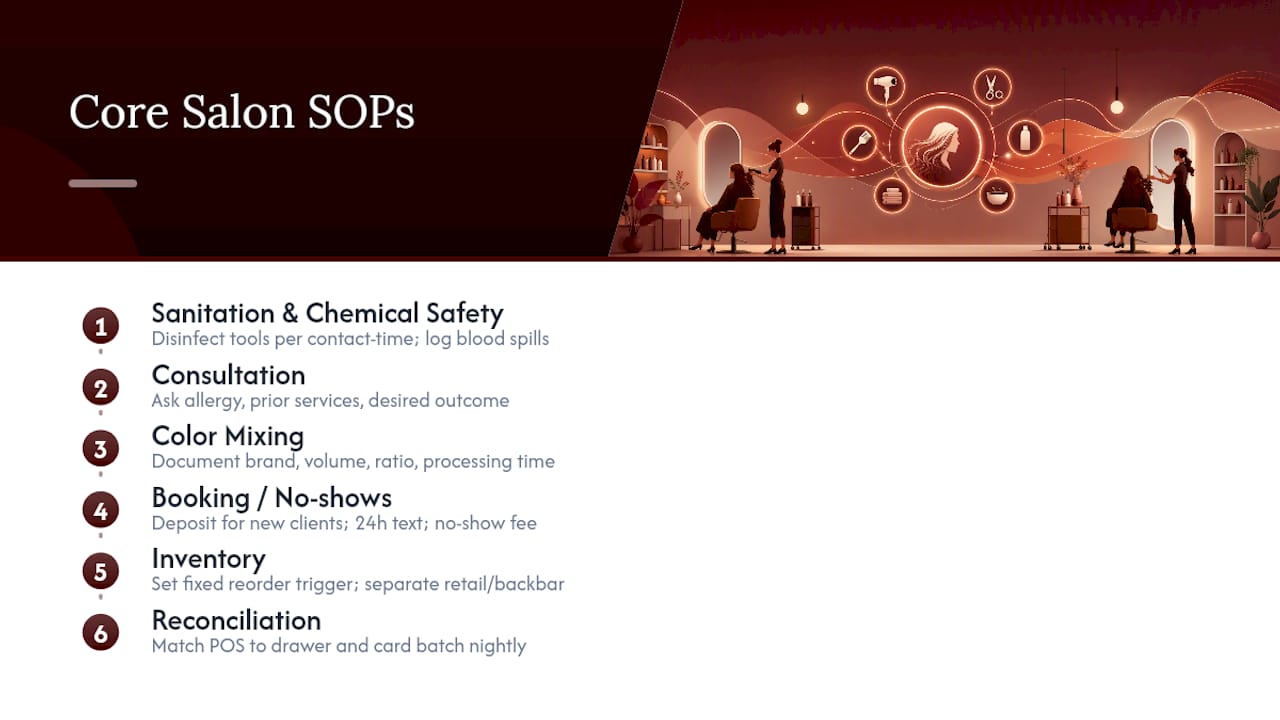
Sanitation and chemical safety. Between every client, tools get disinfected per your state board’s contact-time requirements, capes and towels get swapped, and stations get wiped down. Chemical service SOPs need PPE requirements, patch-testing steps, and manufacturer-specified processing times written in, along with a clear blood-spill protocol: gloves on, affected area isolated, EPA-registered disinfectant applied, incident logged. Design these to meet or exceed your board’s baseline so an inspection never catches you guessing.
Consultation. Every new client answers the same core questions: allergy history, previous chemical services, desired outcome, and maintenance expectations. Photos and written formula notes go into the client file immediately, not from memory later.
Color mixing. Every formula gets documented with brand, volume, ratio, and processing time, tied to the client’s record. This is what keeps color consistent when a client’s regular stylist is out sick.
Booking and no-shows. A deposit on first-time bookings, an automated confirmation text 24 hours out, and a documented no-show fee are the backbone here. Fresha’s guidance on documenting cancellation and pay policies in a staff handbook and enforcing them through the booking system directly reduces disputes.
Inventory. Set a reorder trigger at a fixed stock level (not “when we run low”) and store retail and backbar product separately with rotation dates visible.
Reconciliation. Every night, POS totals get matched against the cash drawer and card batch before close, with discrepancies logged the same day, not “figured out later.”
How Do You Roll SOPs Out Without Losing Your Staff’s Buy-In?
A two-week rollout works better than trying to launch everything at once.
- Week one, days 1 to 3: Introduce one SOP per day, starting with sanitation, at a five-minute huddle.
- Week one, days 4 to 5: Pilot the booking and no-show policy on new bookings only.
- Week two: Roll consultation, color documentation, and reconciliation into daily use, with sign-off sheets for each.
- End of week two: Run a spot audit and fix whatever staff flagged as unclear.
Weekly education is what makes SOPs stick rather than fade after a month. A structured weekly session split between a theory block (a policy review or client scenario) and a technical block (a color or cutting refresher) is the single highest-leverage habit for keeping standards from slipping. Sign-off logs and posted checklists at point-of-use make audits fast rather than a monthly scramble.
Pro Tip: Review each SOP every quarter, and immediately after any incident, staff turnover, or state board rule change. An SOP nobody has touched in a year is usually already out of date.
What’s the Best Way to Store and Format Your Salon SOPs?
Format depends on how the SOP gets used, not personal preference.
- Google Docs or Notion work well for anything staff read once and reference occasionally, like reconciliation steps.
- Laminated cards at the station or front desk work better for procedures used constantly, because short, task-specific checklists get followed more often when stylists can complete them between clients.
- Single-location salons can usually run everything from one shared folder with owner-level edit access and staff-level view access.
- Multi-location operations need a version-controlled master copy with location managers as designated editors, so a change in one location doesn’t silently drift from the others.
Why the SOPs That Sound Boring Are the Ones That Save Your Salon
The SOPs owners skip are almost always the boring ones: reconciliation, inventory triggers, sign-off logs. Those are also the ones with the clearest dollar figure attached when they’re missing. A salon running weekly education alongside a documented no-show policy tends to see fewer last-minute cancellations and fewer hours lost to the owner personally chasing down what went wrong that day.
Two things matter more than the rest: write SOPs with the person doing the job, not for them, and revisit every procedure the moment something breaks. An SOP that only gets reviewed on a schedule misses the real signal, which is the day it actually failed.
— Oliver
A Faster Way to Turn SOPs Into Daily Habits
Writing the SOP is the easy part. Getting a team to actually follow it, week after week, without you standing over their shoulder, is where most salon owners get stuck. LumariPRO was built for exactly that gap, with ready-made business playbooks and templates that turn the checklists in this article into something your team opens and uses instead of a document that sits untouched in a shared drive.

The platform’s dashboards connect to your POS and QuickBooks, so reconciliation and inventory triggers stop living in a separate spreadsheet and start showing up automatically next to your real numbers. Pair that with expert-led coaching on rollout and enforcement, and you get a system built specifically for suite renters and independent beauty professionals, not a generic business tool retrofitted for salons. If you’re ready to see what that looks like for your own operation, check out LumariPRO’s plans and start with the SOPs costing you the most right now.
Where to Go for More on Salon SOPs and Compliance
For sanitation rules specific to your state, check your state cosmetology board’s guidance directly, since requirements vary by jurisdiction. For booking and cancellation policy language, Fresha’s breakdown of salon policies is a solid starting point, and for tool hygiene specifics, this guide on beauty tool cleaning covers the disinfection basics your sanitation SOP should reference.
Sources