The salon suite business model works like this: an owner leases private, lockable rooms to licensed beauty professionals who run their own independent businesses inside them, keeping 100% of their service revenue. Viability comes down to one number: occupancy. Most owners need suites filled to break even, and a six-month operating reserve is the difference between a rough patch and a closed location.
TL;DR:
- Occupancy rates above 85 percent are critical, as buildings at 60 percent occupancy may still operate at a loss after expenses.
- Startup costs for a 15-suite building typically range from 50,000 to 250,000 dollars, with monthly overhead between 880 and 2,950 dollars per suite.
- Successful tenants usually have a built-in client base, business experience, and clear understanding of their pricing to reliably cover rent.
- Owners should monitor occupancy, tenant churn, average rent, and tenant lifetime value monthly to maintain profitability and plan for growth.
- Exit value depends heavily on occupancy history and tenant retention, with higher occupancy buildings commanding better sale prices.
Table of Contents
- What Does the Salon Suite Business Model Look Like?
- How Does the Money Actually Flow Between Owner and Tenant?
- What Do Startup Costs and Monthly Overhead Really Look Like?
- What Legal Steps and Insurance Does a Suite Owner Need?
- How Do You Write a Salon Suite Business Plan and Financial Forecast?
- How Do You Recruit and Retain Good Suite Tenants?
- Franchise or Independent: Which Ownership Path Fits You?
- What Do Lease Agreements Between Owners and Tenants Actually Include?
- What Operational Problems Come Up, and How Do You Handle Them?
- Salon Suites vs. Traditional Salons: Which Model Actually Wins?
- Who Makes a Good Salon Suite Tenant?
- What Are the Exit Options for a Salon Suite Owner?
- What Practitioners Get Wrong About Running a Salon Suite Business
- Ready to Model Your Own Suite Economics?
- Sources
What Does the Salon Suite Business Model Look Like?
Three roles make the model run. The owner/operator buys or leases the building, builds out the suites, and collects rent. The suite renter is a licensed cosmetologist, esthetician, nail tech, or barber who signs a lease and operates as their own business. Larger locations often add a manager who handles tours, maintenance calls, and tenant relations so the owner isn’t on call 24/7.
Lease structures vary by market and building age:
- Flat weekly rent, billed regardless of how many clients the tenant serves
- Tiered rent based on suite size, window placement, or plumbing access
- Security deposit plus first and last week, common for new tenants without a rental history
Independent buildings and franchise systems solve the same problem differently. Phenix Salon Suites, MY SALON Suite, and Sola Salons hand new owners a proven build-out template, marketing playbook, and lead-generation system, usually for a franchise fee plus ongoing royalties. Independent buildings skip those fees but put the entire design, leasing, and branding burden on the owner.
How Does the Money Actually Flow Between Owner and Tenant?
Owner revenue is simple math: rent per suite multiplied by number of suites multiplied by occupancy rate. A 15-suite building charging roughly $300 a week per suite grosses close to $234,000 annually when every suite is leased and paid.
Occupancy is the entire game. A building at 60% occupancy can still lose money after debt service and utilities, while the same building at 85% often clears a healthy margin on the exact same overhead.
Tenant economics run separately. A suite renter’s take-home is service revenue minus product costs, minus booking software or card-processing fees, minus suite rent. One useful comparison: a stylist earning $8,000 a month on a commission split at a traditional salon often takes home less than a suite renter billing similar revenue and paying flat rent, because commission splits eat a percentage no matter how busy the chair gets.
Owners should track four numbers monthly:
- Occupancy rate (suites leased ÷ total suites)
- Tenant churn (how many leases don’t renew)
- Average rent collected per suite
- Tenant lifetime value (average tenure × monthly rent)
What Do Startup Costs and Monthly Overhead Really Look Like?
Build-out costs split into three tiers. A bare-bones single suite for a stylist opening their own space runs $2,000 to $4,700, covering deposit, a basic chair, a shampoo bowl, and starter inventory. A full multi-suite building is a different animal entirely: owners should plan for $50,000 to $250,000 in build-out costs depending on suite count and finish level, plus $75,000 to $100,000 in working capital for a typical 15-suite location.
Monthly overhead for a single suite tenant commonly runs $880 to $2,950, depending on market rent, product costs, and booking software. For owners, monthly line items include:
- Utilities and internet across common areas
- Cleaning and trash service
- Property and liability insurance
- Marketing and lead generation for open suites
- Manager payroll, if the building has one
- Ongoing maintenance and repairs
Pro Tip: Calculate your minimum viable revenue before you sign a lease on the building itself. That’s the rent floor below which you’re subsidizing tenants instead of running a business.
Most new owners reach profitability within 6 to 12 months if they open mostly leased. Budget six months of operating expenses as a cash buffer before you open the doors.
What Legal Steps and Insurance Does a Suite Owner Need?
Most owners form an LLC before signing a commercial lease or mortgage, which separates personal assets from building liability and simplifies taxes. You’ll need an EIN from the IRS regardless of structure.
Licensing runs two tracks. Your state cosmetology or barber board governs individual professional licenses for tenants, while many states also require a separate establishment or salon license for the building itself. Requirements vary significantly by state, so check with your state board before finalizing your business plan.
Insurance layers matter:
- Owners need property insurance and general liability covering common areas and the building structure
- Tenants should carry their own professional liability policy, and owners are smart to require proof of it in every lease
- Local health department inspections and a Certificate of Occupancy are typically required before you can legally open
How Do You Write a Salon Suite Business Plan and Financial Forecast?
- Write the executive summary first, even though you’ll finish it last. State your suite count, target market, and lease pricing in three sentences. This becomes the pitch you use with lenders and landlords.
- Research your local market and justify your pricing. Call three competing buildings, ask their weekly rent, and note their occupancy if they’ll share it. Price against that reality, not a guess.
- Build a revenue model with an occupancy timeline. Project month by month for the first 24 months, and run a sensitivity table showing owner profit at 50%, 70%, and 90% occupancy.
- Forecast expenses and cash runway for 12 to 24 months. List every fixed cost from the overhead section above and build a monthly profit and loss statement, not just an annual estimate.
- Calculate your break-even occupancy and your funding ask. Divide fixed monthly costs by average rent per suite to find the number of suites you need leased just to survive, then size your loan or investor ask against your working capital gap.
How Do You Recruit and Retain Good Suite Tenants?
Pre-leasing starts before construction finishes. Give tours with a simple script that walks prospects through the suite, the shared amenities, and the lease terms, and offer a limited-time incentive, like a reduced deposit or first-month discount, to convert lookers into signed leases faster.
Recruitment channels worth budgeting for:
- Local beauty school partnerships and graduate outreach
- Targeted social ads in your metro area, not broad national campaigns
- Direct outreach to stylists working commission at nearby salons
Retention is where owners underinvest, and applying strategies from the Luxury Branding Guide can enhance tenant marketing and community building. Community events, referral incentives, and marketing support for tenants (helping them promote their own services) keep good renters from jumping to the building down the street. A simple upgrade roadmap, letting tenants move to a bigger or better-located suite as they grow, gives your best people a reason to stay instead of leaving when they outgrow their space. On the digital side, accurate local listings, a basic website, and a tenant booking portal round out the essentials.
Franchise or Independent: Which Ownership Path Fits You?
Franchise systems like the ones mentioned earlier hand you a tested build-out plan, brand recognition, and training, but they come with higher upfront investment plus ongoing royalty payments. Independent ownership skips those fees and gives you full control over branding and pricing, at the cost of building every system yourself.
- Choose franchise if you have limited industry experience and want a support system already worked out
- Choose independent if you have prior salon or business ownership experience and want to keep more margin
- Available capital matters most: franchise fees plus build-out often require more cash upfront than an independent building of similar size
- Consider your desired involvement level; independents demand more hands-on marketing and leasing work in year one
What Do Lease Agreements Between Owners and Tenants Actually Include?
A salon suite lease is closer to a commercial retail lease than a traditional employment agreement, and that distinction matters for both sides. Most agreements run month-to-month or in six-to-twelve-month terms, renewable, with rent due weekly or monthly depending on the building’s convention.
Standard terms include:
- Rent amount and due date, plus any late fee schedule and grace period
- Security deposit, typically equal to one or two weeks of rent, refundable minus damages
- Included utilities and services, specifying what’s covered by rent (water, electricity, Wi-Fi, common-area cleaning) versus what the tenant pays separately
- Use restrictions, limiting the suite to licensed services within the tenant’s specialty and barring subletting without owner approval
- Insurance requirements, naming the owner as an additional insured on the tenant’s liability policy
- Termination and notice clauses, usually 30 days for either party to end a month-to-month agreement
- Maintenance responsibilities, dividing who fixes what (owner handles building systems, tenant handles suite-specific equipment they installed)
Tenants should read the use-restriction and subletting clauses closely, since violating them is the most common reason leases get terminated early. Owners, for their part, should have an attorney review the template lease before the first tenant signs, since a poorly written termination clause can trap you with a non-paying tenant for months. Many franchise systems provide a standardized lease template as part of the franchise fee, which saves legal costs but should still get a local attorney’s review for state-specific compliance.
What Operational Problems Come Up, and How Do You Handle Them?
Maintenance requests are the most constant demand on an owner’s time. A leaking shampoo bowl or a broken air conditioner doesn’t wait for a convenient moment, and tenants who can’t work lose income fast, which sours the relationship quickly if response time is slow. Building a short list of vendors (plumber, electrician, HVAC tech) you can call same-day solves most of this before it becomes a dispute.

Tenant disputes tend to cluster around three issues: noise or scent complaints between neighboring suites, disagreements over shared space use, and late rent. A written house-rules addendum, distinct from the lease itself, gives owners a document to point to when mediating noise or common-area conflicts without amending the actual lease agreement.
Churn is the quieter operational threat. A tenant who leaves after four months costs you the marketing spend to fill their suite again, plus the vacancy days where rent isn’t flowing. Tracking why tenants leave (better opportunity, priced out, personal reasons) tells you whether your pricing, your building’s condition, or something else needs fixing.
Cash flow surprises hit owners who don’t separate personal and business accounts, or who don’t reconcile rent collection against their bank deposits weekly. A tenant who’s chronically two days late every week adds up to a real revenue gap by year end if nobody’s tracking it. This is exactly where connecting your point-of-sale and accounting systems into one dashboard pays for itself: you see a collection problem in week two instead of discovering it in month six when the reserve account is thinner than expected.
Salon Suites vs. Traditional Salons: Which Model Actually Wins?
Traditional salons pay stylists on commission, typically 40% to 60% of service revenue, and in exchange the salon provides the client base, product supply, and marketing. The salon owner carries all the overhead risk and all the upside if the location is busy. Suite owners carry a different risk profile: they collect predictable rent regardless of how busy any individual tenant is, but they don’t share in a hot stylist’s booming client list the way a commission salon owner would.
For the beauty professional deciding between employment and renting a suite, the math often favors suites once you have an established clientele. Nearly half of hairdressers, hairstylists, and cosmetologists in the United States are already self-employed, a sign of just how normalized independent operation has become in this field. A commission stylist earning $8,000 a month often nets less than a suite renter billing similarly, because the salon’s percentage cut disappears no matter how the math works out for rent.
The tradeoffs run both directions, though:
| Factor | Traditional Salon | Salon Suite |
|---|---|---|
| Income ceiling | Capped by commission split | Uncapped, minus flat rent |
| Startup risk | Low (no lease signed) | Higher (fixed rent regardless of clients) |
| Client base | Often salon-provided | Must be self-built |
| Schedule control | Often salon-dictated | Fully tenant-controlled |
| Marketing burden | Shared with salon | Entirely on the tenant |
New professionals without an established book of clients often struggle in suites because there’s no walk-in traffic or salon marketing bringing bodies through the door. Suites reward professionals who already have a following willing to follow them.
Who Makes a Good Salon Suite Tenant?
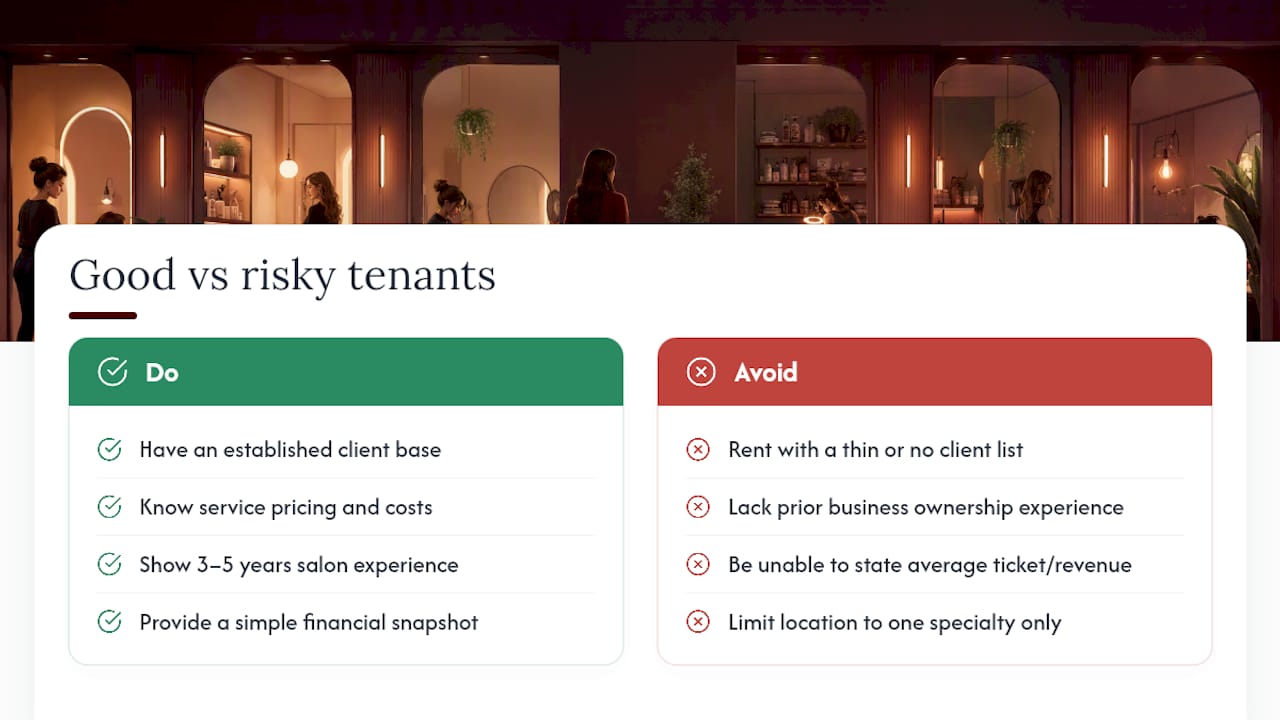
The strongest tenants share a few traits regardless of specialty. They already carry a client base large enough to sustain rent from day one, since a suite offers no walk-in traffic the way a storefront salon does. They understand basic business math, meaning they can look at their own service pricing and know it covers rent, product cost, and still leaves a livable income.
Licensed professionals in their second act of career, stylists, estheticians, or nail techs who’ve spent three to five years building clientele at a commission salon, tend to make the most reliable tenants. They’ve already proven they can retain clients and price their services correctly; a suite just removes the commission split.
Red flags for owners screening prospective tenants include a thin or nonexistent client list, no prior business ownership experience, and an inability to explain their own pricing when asked directly. A tenant who can’t tell you their average ticket price or monthly service revenue in an interview usually can’t cover rent reliably six months in. Requiring a simple financial snapshot, even informal, as part of the lease application filters out most of these risks before a signature happens.
Specialty diversity within a building also helps occupancy. A location with only nail techs competes for the same limited local demand, while a mix of hair, skin, nails, and brow or lash specialists cross-refers clients naturally and fills suites faster.
What Are the Exit Options for a Salon Suite Owner?
Selling the building outright to another operator is the most common exit, and buyers typically value the business on a multiple of net operating income, meaning your occupancy history and tenant retention records directly determine your sale price. A building with 90% occupancy and low churn commands a materially higher multiple than one limping along at 60%.
Some owners convert to a franchise conversion sale, bringing in a system like the ones covered earlier to take over branding and leasing support, which can raise occupancy and resale value before a final sale to a third party. Others structure a partial exit, selling a majority stake to a partner or investor while staying on as a managing operator for a transition period, which spreads out the payout and reduces the buyer’s risk.
A lease-to-tenant buyout is less common but happens when a long-term tenant wants to take over the entire building rather than continue renting, particularly in smaller two- or three-suite locations where the tenant has effectively run daily operations for years.
Whatever the exit path, buyers and appraisers want clean financial records: occupancy history, average tenant tenure, documented rent increases, and a clear separation between personal and business accounts. Owners who track these numbers from month one, rather than reconstructing them at sale time, consistently negotiate from a stronger position.
What Practitioners Get Wrong About Running a Salon Suite Business
The biggest mistake among new owners isn’t undercapitalization. It’s underestimating churn. Owners build a pro forma assuming stable, long-term tenants and then get blindsided when three suites turn over in the same quarter. Each requires marketing spend and vacant weeks to refill.
The second pattern is worse: owners who run their entire financial picture from a bank balance instead of a real dashboard. Connecting your point-of-sale system and QuickBooks to a single view of occupancy, collections, and cash position turns guesswork into a number you can act on before a shortfall becomes a crisis.
This is precisely the gap the LumariPRO platform was built to close, giving suite owners and independent renters the financial visibility and pricing playbooks that generic business software was never designed to handle.
— Oliver
Ready to Model Your Own Suite Economics?
Some platforms exist to support salon suite owners at this critical stage, offering real-time dashboards connected to POS and accounting systems, pricing playbooks designed for suite economics, and coaching from experienced beauty professionals.

If you’re still deciding whether a suite business or a suite tenancy makes sense for your numbers, run your scenario through the ROI calculator before you sign a single lease. It’s a faster gut check than a spreadsheet you built from scratch at midnight, and it plugs directly into the same financial thinking this entire guide walked through. Want a second set of eyes on your specific situation? Book a complimentary fit assessment and talk through your numbers with someone who actually understands suite economics.
Sources
- U.S. Bureau of Labor Statistics — Barbers, Hairstylists, and Cosmetologists
- How to start a salon suite business 2026 costs — HairSalonPro
- How to start a salon suite business and be your own boss — JIM
Recommended