A complete salon suite business plan must prove three things: there is real local demand for rentable suites, the pricing and operations model will work, and the numbers show a clear path to break-even. Every lender, landlord, and potential partner will look for those three answers before anything else.
Here is the one-page checklist of required sections your plan must include:
- Executive summary — one-page snapshot of the business, the ask, and the outcome
- Company description — legal structure, ownership model, mission, and suite type
- Market and customer analysis — local demand evidence, competitor map, and tenant personas
- Services and pricing — suite menu, rent tiers, and tenant revenue scenarios
- Operations and layout — daily workflows, booking systems, suite sizing, and vendor plan
- Legal and insurance — entity choice, licenses, permits, and insurance budget
- Five-year financials — startup costs, monthly cash flow, break-even, and projections
- Funding ask — amount needed, intended use, and repayment source
- Appendix — sample lease, pro forma rent roll, build-out quotes, and permits
Growthink’s salon suite template follows this same structure and recommends writing the executive summary last, after the financials are complete. That is the right order. Download a fillable version of this template, enter your own numbers in the highlighted fields, and you will have a working draft within a few hours.
Key Takeaways
| Point | Details |
|---|---|
| Write financials first | Build the rent roll and break-even math before any other section; every other claim depends on those numbers. |
| Six-month reserve is required | Budget at least six months of operating expenses in reserve; stabilization typically takes 12–24 months. |
| Market as B2B recruitment | Target licensed professionals with tour CTAs, floor plans, and pricing transparency, not consumer-facing salon ads. |
| LLC protects personal assets | Most new owners form a single-member LLC and require tenants to carry professional liability insurance. |
| Lumaripro tracks plan execution | The platform connects POS and QuickBooks to live dashboards, turning plan assumptions into monitored KPIs. |
Table of Contents
- Why a dedicated salon suite business plan matters more than you think
- What sections your salon suite business plan needs and in what order to write them
- How to write an executive summary that actually convinces someone
- How to research your market and build tenant profiles that hold up
- How to design your service menu, set rents, and model tenant revenue
- What your operations plan needs to cover
- Legal structure, licenses, and insurance: what you actually need
- Startup costs, financial projections, and your break-even number
- Marketing your suites: how to attract and keep the right tenants
- KPIs, milestones, and your 1–3 year growth roadmap
- What to put in your appendix and how to package it
- How Lumaripro helps you execute and track the plan you just built
- What most salon suite owners get wrong in their business plan
- Lumaripro gives suite owners the dashboards and playbooks the plan requires
- Sources
Why a dedicated salon suite business plan matters more than you think
A tailored plan does more than satisfy a bank. It gives you leverage in lease negotiations, helps you avoid the most expensive mistakes in the build-out phase, and creates a reference document you can update as the business matures.
The salon suite model works like a niche landlord arrangement: you provide private, rentable rooms to independent professionals who pay fixed weekly or monthly rent. That structure creates predictable cash flow and lower operating volatility than a traditional commission salon, where revenue swings with stylist performance. But that predictability only materializes if the plan is built on realistic occupancy assumptions and a clear rent-roll model from the start.
A written plan also reduces three specific risks that sink new suite owners. Overbuilding (leasing more space than local demand can absorb) is the most common. Zoning mistakes, where a space is permitted for retail but not for cosmetology services, are the most expensive to fix. Underestimating the timeline to full occupancy, which often takes over a year, is the most likely to cause a cash crisis.
Pro Tip: When preparing financials for a lender or investor, lead with three numbers: your projected rent roll at stabilized occupancy, your break-even occupancy percentage, and your working capital reserve. Those three figures answer the questions every lender asks first.
What sections your salon suite business plan needs and in what order to write them
Write the sections in this order. The financials come early because every other section depends on them for credibility.
- Financial model — build the rent roll, startup cost table, and break-even math first; these numbers will anchor every other section
- Market and customer analysis — validate local demand and document the competitor landscape
- Services and pricing — define suite types, rent tiers, and tenant revenue scenarios
- Operations plan — daily workflows, booking systems, suite layout, and vendor relationships
- Legal and insurance — entity choice, licenses, permits, and insurance line items
- Company description — ownership model, mission statement, and suite concept
- Funding ask — amount, use of funds, and repayment source (informed by the financial model)
- Executive summary — write this last; it summarizes everything above in one page
- Appendix — attach sample financials, lease templates, build-out quotes, and permits
Each section has a specific job. The market analysis must show a gap in local supply and quantify demand. The financials must show break-even and a cash buffer. The operations section must prove the business can run day-to-day without constant owner intervention. The executive summary must convince a reader in two paragraphs that the opportunity is real and the team can execute.
How to write an executive summary that actually convinces someone
The executive summary is the first thing a lender or landlord reads and the last thing you write. Keep it to two short paragraphs. Every sentence must carry weight.
Here is a sample paragraph you can adapt:
Fill in the bracketed fields from your financial model. The micro-template fields to complete are:
- Business type and legal structure (LLC, S-corp, sole proprietor)
- Target tenant profile (stylist, esthetician, nail tech, lash artist, or mixed)
- Number of suites and average weekly or monthly rent
- Projected first-year occupancy rate and total revenue
- Funding amount requested and its intended use
Tone should be direct and factual, not promotional. Lenders have read hundreds of these. A clean, specific summary with real numbers outperforms a polished one with vague projections every time.
How to research your market and build tenant profiles that hold up
Local demand validation is where most first-time owners cut corners, and it shows. Here is a step-by-step method that produces defensible numbers.
Step 1: Pull U.S. Census demographic data for your trade area (typically a 3–5 mile radius). Look at population density, median household income, and the number of licensed cosmetology professionals registered in the county. Your state cosmetology board publishes licensee counts by zip code.
Step 2: Run a Google Maps scan for existing salon suites, booth-rental salons, and traditional salons within that radius. Note their suite counts, price points (many post rates online), amenities, and vacancy signals (how many suites are advertised as available).
Step 3: Check commercial listings on LoopNet for recently leased and available retail spaces to understand rent comps and TI allowance norms in your submarket.
Step 4: Interview 10–15 local beauty professionals. Ask about their current work arrangement, what they pay, what they wish their current space offered, and how soon they would consider moving. These conversations are your primary demand signal.
Translate that research into target occupancy assumptions for the plan. If the market looks saturated, the plan needs to explain your differentiation clearly.
Your competitor mapping checklist should capture:
- Suite count and size range (sq ft)
- Weekly and monthly rent rates
- Included amenities (Wi-Fi, shampoo bowls, reception, parking)
- Online presence quality (Google rating, Instagram following, website tour CTA)
- Estimated current occupancy (vacancy ads are a proxy)
Build two or three tenant personas with these fields: license type, years of experience, current client base size, preferred move-in timeline, and price sensitivity. A persona for a newly licensed esthetician looks very different from one for a 10-year stylist with a full book. Both are valid tenants; your marketing and pricing need to speak to each.
How to design your service menu, set rents, and model tenant revenue
Price to market, but model what your tenants can realistically earn. That math is what makes your rent levels credible in the plan.
Start with a sample service menu and a per-service cost worksheet. For a hair stylist, list services (haircut, color, blowout, treatment), average price per service, and average time per service. From those inputs, calculate the target hourly rate and the maximum weekly revenue at full booking.
A simple example: a stylist charging $65 per cut and $180 per color service, seeing 20 clients per week at a blended average of $110 per visit, generates $2,200 per week or roughly $8,800 per month in gross service revenue. That math belongs in your plan. It shows lenders that your rent model is sustainable for tenants, which means your occupancy projections are credible.

Your plan should be built on the conservative scenario and funded to survive it.
On retail: a shared retail display or vendor partnership with a professional product line can generate passive revenue for the owner and add perceived value for tenants. Even a modest retail program across 10 suites adds meaningful margin without adding labor.
For social media presence that supports your suite brand and attracts professional tenants, social media branding tips for luxury boutiques offer a practical framework for building the kind of premium visual identity that converts browsing pros into tour requests.
What your operations plan needs to cover
The operations section of your salon suite business plan answers one question: how does this place actually run every day? Cover four areas.
Suite types and sizing. Common suite configurations and recommended square footage ranges:
- Hair stylist suite: 100–150 sq ft (shampoo bowl, styling chair, mirror, storage)
- Esthetician suite: 80–120 sq ft (treatment table, steamer, storage, sink)
- Nail tech suite: 80–100 sq ft (nail table, ventilation, client seating)
- Lash artist suite: 70–100 sq ft (lash bed, lighting, minimal storage)
Lead-to-lease workflow. Map the full sequence: inquiry → tour scheduled → application submitted → background/credit check → deposit collected → lease signed → move-in orientation. Assign responsibility for each step. If you are self-managing, build a checklist. If you plan to hire a community manager, define that role in the plan.
Booking and POS. Name the platforms you will use. Square, Vagaro, and GlossGenius are common choices for independent suite tenants. As the owner, you need a system to track rent payments, occupancy status, and maintenance requests separately from tenant-facing booking tools.
Vendor and supply management. List your key vendors (janitorial, HVAC, product suppliers for any shared amenities), note payment terms, and set reorder points for consumables. Even a small common-area supply budget needs a reorder trigger.
These three numbers will appear in your KPI dashboard later.
Legal structure, licenses, and insurance: what you actually need
Most new salon suite owners form an LLC. The liability protection is the main reason: if a tenant or client files a claim against the facility, the LLC structure keeps personal assets out of reach. An S-corp election on top of an LLC can reduce self-employment tax once the business is profitable, but that is a year-two conversation with a CPA.
The SBA’s licensing and permits guidance is clear: identify and apply for all required local, state, and federal licenses before opening. For salon suite facilities, that typically means a state cosmetology establishment license for the facility itself (separate from each tenant’s individual license), a local business license, and a Certificate of Occupancy confirming the space meets building and fire codes. Some jurisdictions also require signage permits and occupancy-limit compliance documentation.
Legal structure comparison:
| Structure | Liability protection | Tax treatment | Best for |
|---|---|---|---|
| Sole proprietor | None | Pass-through, self-employment tax on all profit | Testing concept only; not recommended for a facility |
| Single-member LLC | Yes | Pass-through by default; S-corp election available | Most new salon suite owners |
| S-corp | Yes | Salary + distribution split reduces SE tax | Profitable operations, typically year 2+ |
Insurance to budget for:
- Commercial general liability (covers slip-and-fall, property damage claims at the facility)
- Commercial property insurance (covers your build-out, furniture, and equipment)
- Workers’ compensation (required if you hire employees, even part-time)
- Require each tenant to carry professional liability (errors and omissions) as a lease condition
Budget insurance as a fixed monthly line item in the financial model. Skipping it to save money in year one is one of the most common and costly mistakes new owners make.
Startup costs, financial projections, and your break-even number
OGSCapital’s salon suite business plan guide documents that startup costs vary widely based on build-out condition and scale, with sample figures spanning from roughly $10,000 for a minimal conversion to $250,000 or more for a ground-up build-out. The table below reflects typical cost categories to include in your plan.
Break-even example. Assume 10 suites at an average rent of $1,200/month. Full occupancy generates $12,000/month. Fixed monthly costs (base rent, utilities, insurance, loan payment) total $8,500. That is a realistic target within the first 12 months if pre-leasing starts before the doors open.
For funding, GlossGenius outlines SBA 7(a) loans, microloans, and equipment financing as the most common routes for salon build-outs. Lenders typically require a written business plan, at least two years of personal credit history, and some personal investment in the project. Tenant improvement allowances negotiated into the lease can reduce the cash needed at close. Some owners have funded build-outs primarily through business credit, vendor net terms, and TI allowances rather than large personal cash outlays, making landlord negotiation and credit strategy core items in the plan.
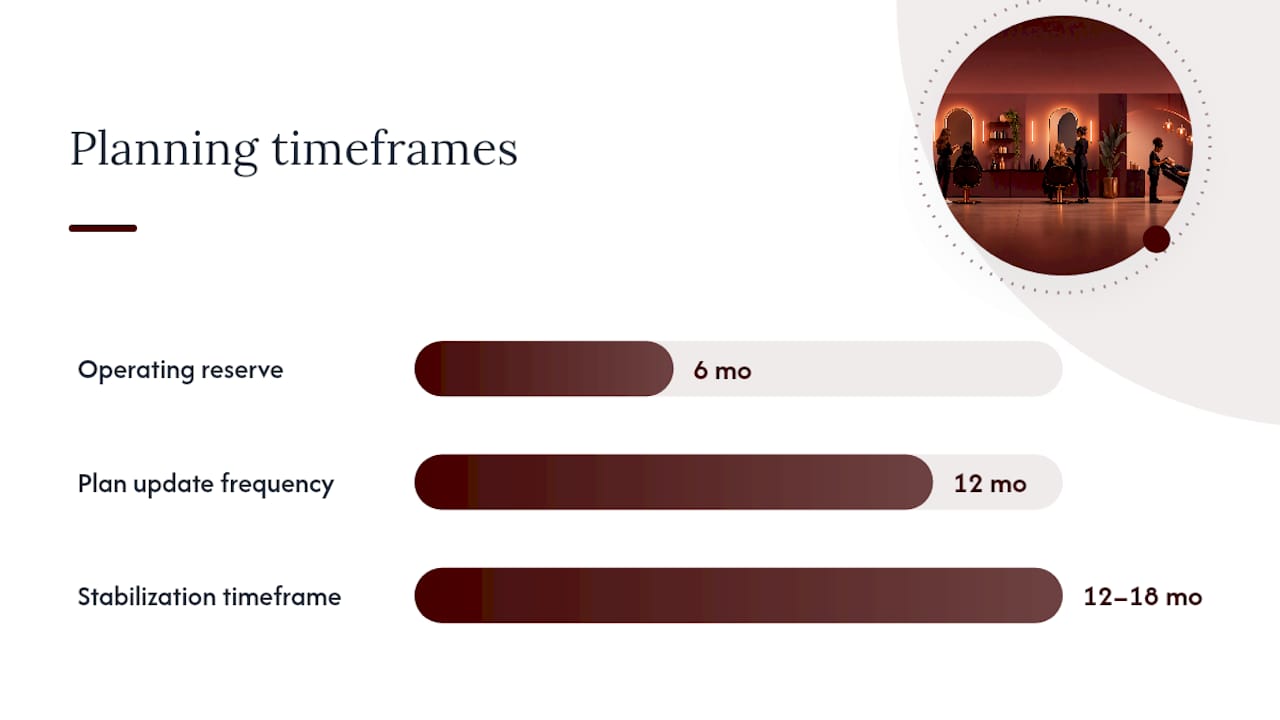
Build at least six months of operating expenses into your reserve. The timeline from lease signing to stabilized occupancy commonly runs 12–24 months, and undercapitalization during that window is the most frequent cause of early failure.
Key figure: Break-even occupancy in the example above is 71%. If your fixed costs are higher or your rents are lower, that threshold rises. Model it before you sign a lease.
Marketing your suites: how to attract and keep the right tenants
Suite marketing is B2B recruitment, not consumer advertising. You are not selling haircuts; you are recruiting licensed professionals. That distinction changes everything about your channel strategy and your messaging.
Bow Tie Social’s analysis confirms that priority channels for suite leasing are Google Business Profile for local discovery and targeted Meta ads aimed at licensed beauty professionals, combined with tenant-centric website content and clear tour scheduling CTAs. Your website should show floor plans, photos of furnished suites, transparent pricing, and a one-click tour booking button. Treat it like a leasing page, not a salon homepage.
Here is a 90-day launch sequence:
- Days 1–30 (pre-launch awareness): Claim and optimize your Google Business Profile. Launch a simple landing page with suite photos, pricing, and a tour request form. Begin organic Instagram and Facebook posts targeting local beauty pros. Reach out directly to cosmetology schools and local professional associations.
- Days 31–60 (tour weeks): Launch targeted Meta ads to licensed professionals within a 10-mile radius. Run an open-house event with light refreshments and a tour of furnished suites. Offer a move-in incentive (first week free, waived deposit) for leases signed during this window.
- Days 61–90 (move-in and referral activation): Onboard first tenants with a formal welcome packet and orientation. Ask early tenants for Google reviews and referrals. Launch a referral incentive (one week of free rent for each qualified referral who signs a lease).
Slick Marketers’ 2025 leasing data shows that higher-intent leads and improved tour-to-lease conversion outperformed raw lead volume. Practices that added pre-qualification steps and pricing transparency to their inquiry forms saw better lease-up results. Use conditional logic in your tour request form to filter out unqualified inquiries before they consume your time.
A consistent digital brand strategy across your website, social profiles, and ads reinforces those themes and builds the credibility that turns a browsing pro into a tour request.
Retention matters as much as acquisition. Tenant churn is expensive: every vacancy costs you rent revenue plus re-leasing time and marketing spend. Reduce churn by hosting quarterly tenant education events, offering content days (professional photography in the suites), and building a referral community among your tenants. These tactics cost little and signal that you are invested in their success.
KPIs, milestones, and your 1–3 year growth roadmap
Tracking the right numbers from day one keeps the plan from becoming a document you file and forget.
Core KPIs to monitor monthly:
- Occupancy rate: suites leased ÷ total suites. Target 80–85% at stabilization (typically month 12–18).
- Average rent per suite (ARPU): total monthly rent collected ÷ number of occupied suites. Track this to spot pricing drift.
- Tenant retention rate: percentage of tenants who renew at lease end. A rate below 70% signals a problem with the tenant experience or pricing.
- Tour-to-lease conversion rate: leases signed ÷ tours completed. Per Slick Marketers, improving this metric through pre-qualification and pricing clarity is more valuable than increasing raw tour volume.
- Customer acquisition cost (CAC) per lease: total marketing spend ÷ new leases signed in the period.
Milestone timeline:
- Months 1–3: pre-leasing begins; target 30–40% occupancy at open
- Months 4–6: active lease-up; target 60–70% occupancy
- Months 7–12: stabilization push; target 80%+ occupancy
- Year 2: TI allowance paydown begins; evaluate pricing for annual rent increases
- Year 3: assess expansion (additional suites, second location, or service add-ons)
Use these KPIs in monthly lender or investor updates. A simple one-page dashboard showing occupancy, ARPU, and cash position tells the story faster than a narrative report. When occupancy stalls, the dashboard tells you whether the problem is lead volume (fix marketing), conversion (fix the tour experience), or retention (fix the tenant experience).
What to put in your appendix and how to package it
The appendix is where lenders and partners verify the claims in the main plan. Include every document that backs up a number or a commitment.
Appendix checklist:
- Sample income statement (month-by-month for year one, annual for years two through five)
- Pro forma rent roll (suite-by-suite with rent rate, lease start date, and occupancy status)
- Build-out quotes from at least two licensed contractors
- Sample lease agreement (have an attorney review before using)
- Copies of or applications for required permits (business license, Certificate of Occupancy, establishment license)
- Tenant insurance requirement language (what coverage amounts you will require)
- Competitor analysis summary (the data from your Google Maps and LoopNet research)
- Owner resume or bio
For financials, export the rent roll and income statement as Excel or CSV files so lenders can run their own scenarios. Package the lease template and permits as PDFs. Label each appendix item with a letter (Appendix A, Appendix B) and reference those labels in the main plan body. For example: “Projected first-year cash flow is detailed in Appendix A.”
How Lumaripro helps you execute and track the plan you just built
Writing the plan is step one. Executing it without losing track of the assumptions is where most owners struggle. An implementation platform reduces that friction by turning plan assumptions into tracked metrics and automated workflows.
Lumaripro is built specifically for suite-based beauty professionals and owners. Its AI-powered dashboards connect to POS systems and QuickBooks, so the rent roll you modeled in the plan becomes a live report rather than a static spreadsheet. Here is how that maps to the plan sections you just built:
- Rent-roll tracking: Lumaripro pulls payment data and shows occupancy status in real time, flagging late payments before they become a cash flow problem
- Monthly occupancy report: automated reports replace manual spreadsheet updates and give you the data for lender updates
- Tenant onboarding checklist: the platform’s playbooks walk new tenants through move-in steps, reducing the time you spend on orientation
- Marketing funnel for tours-to-leases: track inquiry volume, tour completions, and conversion rate in one dashboard
The platform also includes business playbooks and expert coaching (group and 1:1) built around the realities of suite ownership, not generic small-business advice.
Pro Tip: Instrument occupancy rate, average rent per suite, and ARPU first. Those three metrics give you reliable early signals within 60–90 days of opening and tell you whether the plan’s assumptions are holding.
What most salon suite owners get wrong in their business plan
Most mistakes in a salon suite business plan come from one of three places: emotional decision-making during the build-out, underestimating how long lease-up takes, and weak pre-leasing discipline before the doors open.
The emotional build-out is the most expensive. Owners fall in love with a space and sign a lease before validating local demand. They spend on premium finishes before confirming tenants will pay the rent needed to cover them. The fix is simple: run the break-even math before you tour a single space, and do not sign a lease until you have had at least 10 genuine conversations with prospective tenants.
Common mistakes and their corrections:
- Overbuilding: leasing 20 suites when local demand supports 10. Use conservative occupancy assumptions (65% in year one) and scale up only when the data supports it.
- Ignoring zoning: assuming a retail space is automatically approved for cosmetology services. Verify with the local planning department before signing anything.
- Underfunding working capital: budgeting for build-out but not for the 12–18 months before stabilization. The six-month operating reserve is not optional.
- Weak lease terms: not requiring tenants to carry professional liability insurance or not including a clear default and cure clause. Have an attorney draft the lease.
- Writing the executive summary first: it reads as generic because the financials are not done yet. Write it last.
The plan is also a living document. Update it annually, or any time occupancy drops more than 10 points below target. The assumptions you made before opening will not all hold, and a plan that reflects reality is more useful than one that reflects optimism.
Lumaripro gives suite owners the dashboards and playbooks the plan requires
Most suite owners spend the first year managing their business in spreadsheets, text messages, and gut instinct. Lumaripro replaces that with real-time financial dashboards, POS and QuickBooks integrations, and proven business playbooks built specifically for suite-based professionals.

The platform connects directly to your existing tools, turning the rent-roll projections and KPIs from your business plan into live metrics you can check daily. When occupancy dips, you see it immediately. When a tenant’s payment is late, the dashboard flags it before it becomes a cash flow gap. The Lumaripro platform also includes onboarding checklists, tenant marketing templates, and expert coaching sessions that shorten the time between opening day and stabilization.
For owners evaluating the return on a platform subscription, the pricing page shows current plan options. To see how the platform maps to the specific workflows in your business plan, visit Lumaripro and request a walkthrough.
Sources
These are the authoritative sources to consult and cite when finalizing each section of your plan.
- U.S. Small Business Administration — Apply for licenses and permits
- Salon Suites business plan template & example — Growthink
- Salon suite business plan guide — OGS Capital
- Marketing a salon suite vs. a traditional salon — Bow Tie Social
- Salon Suite leasing in 2026: what worked in 2025 — Slick Marketers
Recommended