The single highest-impact focus for salon suite marketing is making yourself easy to find and easy to rebook: a claimed Google Business Profile with a working booking link, a habit of pre-booking every client before they leave your chair, and a steady stream of reviews and referrals. LumariPRO exists to help you operationalize exactly this. Expect fast wins from your Google profile and referral asks within weeks, but the profit comes later, once retention habits kick in and rebooking becomes routine.
TL;DR:
- Claiming a Google Business Profile with your own name and linking it to your booking system significantly improves local discoverability.
- Consistently pre-book clients and ask for reviews immediately after appointments to build credibility and increase search ranking within weeks.
- Focusing on four marketing channels—Google, Instagram, referrals, and targeted paid ads—maximizes growth while avoiding spreading effort too thin.
- Prioritizing client retention through pre-booking and follow-ups reduces costs and increases lifetime value, as acquiring new clients is five to seven times more expensive.
- Automating key outreach and tracking metrics like rebooking rates and source data enables steady growth without large marketing budgets or complex campaigns.
Table of Contents
- Your Salon Suite Marketing Checklist for This Week
- Which Marketing Channels Actually Grow a Salon Suite Business?
- Why Retention Matters More Than New Client Growth
- How Should You Price and Promote Without Devaluing Your Work?
- What Should You Actually Measure Every Month?
- Your 30/60/90-Day Salon Suite Marketing Plan
- What I’ve Learned Watching Suite Owners Build Their Client Base
- Run This Playbook Without Doing It All by Hand
- Useful Resources for Building Your Client Base
- Sources
Your Salon Suite Marketing Checklist for This Week
Before you touch social media strategy or ad budgets, knock out these five things. They take a few hours combined and they move the needle faster than almost anything else you could do this month.
- Claim your Google Business Profile under your own business name, not the suite facility’s name, and add your booking link, hours, and service menu.
- Put a “Book Now” link everywhere a stranger might find you: Instagram bio, GBP, text signature, even your car.
- Pre-book before the client stands up from the chair. Collect email and phone at checkout if you haven’t already.
- Ask for a Google review with a direct link sent by text right after checkout; aim for five or more in your first few weeks, since claiming your profile under your own name and hitting that early review threshold measurably improves local discoverability.
- Set up one automated follow-up that texts or emails clients after their visit asking them to rebook.
None of this requires a marketing budget. It requires about two hours and a willingness to ask.
Which Marketing Channels Actually Grow a Salon Suite Business?
Solo owners don’t have time to run six channels badly. Run four well: Google, Instagram, referrals, and one small paid test.
Google Business Profile does more heavy lifting than any other channel for a suite renter. Fill in every field: services with prices, business hours, your booking URL, and at least ten photos of finished work, not the suite hallway. Estheticians and solo beauty pros who rank the highest-return actions consistently put GBP visibility and fast inquiry response at the top of the list, ahead of paid ads or influencer outreach.
Instagram works as a verification layer more than a discovery engine. People find you on Google, then check your Instagram to confirm you’re legit. Post three times a week: before/after pairs, short process reels, and the occasional client testimonial repost. Process videos and before/after content posted with geotags and local hashtags consistently outperform daily low-effort posts, so cadence beats volume here.
Referrals convert best when you ask in person, right at the “mirror moment” when a client is admiring the finished result. Dual-sided incentives, where both the referrer and the new client get a discount, outperform one-sided offers because both people have a reason to act.
Local partnerships cost nothing but a conversation. Approach a nearby boutique, gym, or coffee shop with a simple line: “I’d love to trade flyers or a joint Instagram post, my clients shop your neighborhood too.”
Paid ads only make sense once the above is running. A tightly targeted Google Ads campaign aimed at people actively searching “[your service] near me,” pointed at a dedicated booking landing page rather than your homepage, tends to outperform broad Facebook campaigns for suite renters.
Pro Tip: Budget $100 to $300 a month for tools before you spend a dollar on ads. A modest tools budget prioritized toward booking automation and profile management earns better returns early than ad spend does.
Why Retention Matters More Than New Client Growth
Bringing in a new client costs five to seven times more than keeping an existing one, which is the entire argument for building rebooking into your service delivery rather than treating it as an afterthought.
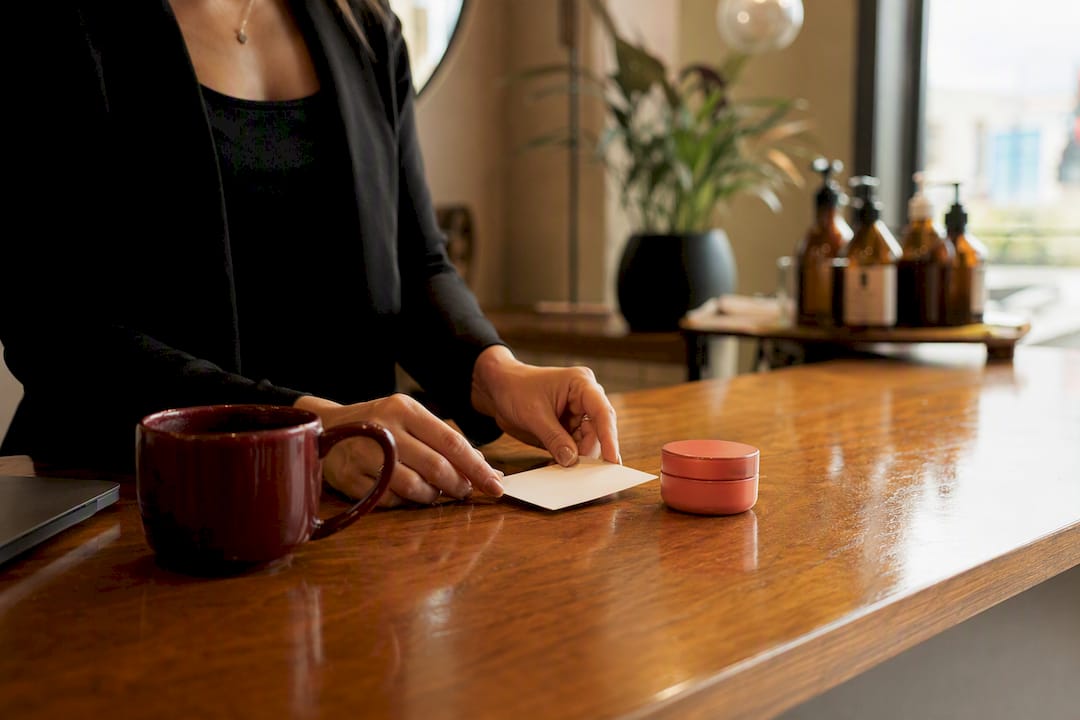
Pre-booking works best with choice language, not yes/no questions. Instead of “want to book your next appointment?” try “does four weeks or six weeks work better for your next color?” That framing assumes the booking happens and just settles a detail.
Follow-up timing matters as much as the message itself:
- 24 to 48 hours after the visit: a quick check-in text asking how the result is holding up.
- Two weeks out: a gentle rebooking nudge, especially for services with a known regrowth or fade cycle.
- Three months out: a win-back message for anyone who hasn’t returned, often paired with a small incentive.
Client notes make all of this personal instead of generic. Track allergies, preferred formulas, and life details (a wedding, a new job) so your next message references something specific. Documenting client history and surfacing it before the next appointment measurably improves upsells and rebooking rates. A loyalty structure, even something as simple as a punch card for a free add-on after five visits, gives clients a reason to stay loyal instead of chair-hopping.
How Should You Price and Promote Without Devaluing Your Work?
Introductory offers work when they have a hard expiration date and a clear purpose: getting a new client in the chair once, not training them to expect a permanent discount. “20% off your first visit, new clients only, through the end of the month” works. An ongoing “first-time discount” that never ends trains your entire client list to wait for a deal.
Packages and maintenance plans build predictable revenue better than one-off discounting ever will. A prepaid four-visit color package, or a monthly maintenance plan for brow or lash clients, locks in future bookings and cash flow at the same time.
A few pricing guardrails worth setting from day one:
- Require a deposit for new-client bookings to cut down on no-shows, typically 20 to 50% of the service cost.
- Publish a clear cancellation window, usually 24 to 48 hours, and enforce it consistently.
- Never run the same discount twice in a row for existing clients. It quietly resets their sense of your full price.
- Reward loyalty with perks, not price cuts: a free add-on or priority booking beats a permanent 15% discount.
Perpetual discounting is the single fastest way to shrink lifetime value. Once a client expects a lower price, raising it back feels like a loss to them, even though you’re just returning to normal.
What Should You Actually Measure Every Month?
You don’t need a dashboard full of vanity metrics. You need four numbers and a habit of checking them.
- Rebooking rate: the percentage of clients who book their next visit before leaving. A strong rebooking rate by day 60 is a realistic early target for a new independent.
- Source tracking: ask every new client “how did you hear about me?” at intake, then log it. This tells you whether Google, Instagram, or referrals are actually driving bookings, which matters before you spend a cent on ads.
- Average ticket: are add-ons and retail actually moving the number up?
- No-show rate: a rising number here usually means your deposit or reminder system needs a fix.
Booking software with automated SMS and email reminders removes most of the manual follow-up work. POS systems that sync with accounting tools like QuickBooks turn your revenue data into something you can actually act on instead of a shoebox of receipts.
The gap between owners who grow steadily and owners who plateau usually isn’t talent or even marketing spend. It’s whether anyone is tracking rebooking rate and source data closely enough to know what to fix.
LumariPRO’s dashboards pull directly from your POS and QuickBooks integrations so rebooking rate, source tracking, and revenue all live in one place, paired with AI coaching and playbooks that tell you what to do about the numbers, not just what they are. Learn more about how the platform connects your booking and financial data.
Your 30/60/90-Day Salon Suite Marketing Plan
- Days 1 to 30: Claim your Google Business Profile, hit a five-review target, add your booking link everywhere, personally reach out to every past client with a “come see my new space” message, and launch a simple dual-sided referral incentive.
- Days 31 to 60: Make pre-booking non-negotiable at checkout, automate your 24-hour and two-week follow-up messages, run one small paid test or approach one local business for a partnership, and start logging where every new client came from.
- Days 61 to 90: Introduce a package or membership option, review your first 60 days of KPIs, and put more time and money into whichever one or two channels produced the most bookings.
Weekly, no matter what week you’re in: two outreach or content posts, one batch of review requests, a quick check of your GBP insights, and updated client notes for anyone you saw that week. Small, repeated actions beat a big marketing push you can’t sustain.
What I’ve Learned Watching Suite Owners Build Their Client Base
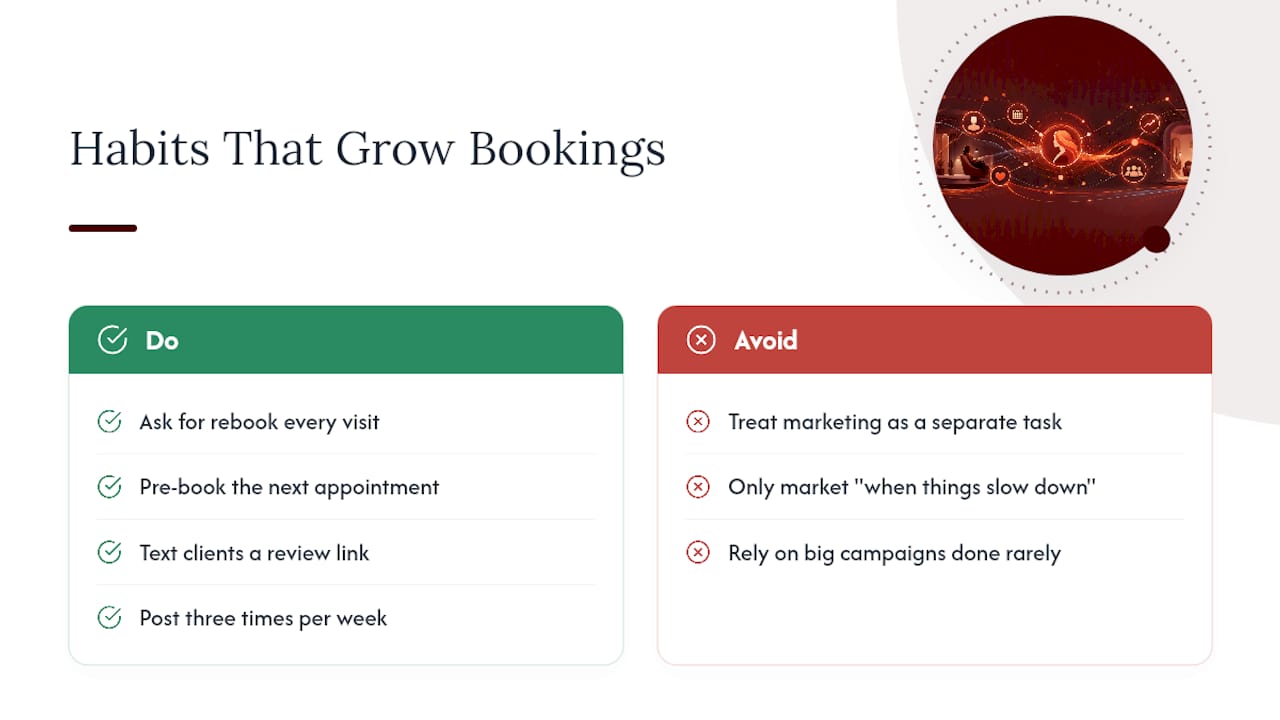
The stylists who grow fastest aren’t the ones with the best Instagram feed. They’re the ones who ask for the rebook every single time, without fail, even on a rushed Saturday. I’ve seen a nail tech go from patchy bookings to a three-week waitlist in about four months doing nothing fancier than pre-booking, texting a review link, and posting three times a week like clockwork.
The mistake I see constantly is treating marketing as a separate task from the service itself, something to squeeze in “when things slow down.” It never happens. The fix is designing the smallest possible habit, one text, one ask, one post, and doing it every time, not the biggest campaign you can imagine and doing it never.
— Oliver
Run This Playbook Without Doing It All by Hand
Everything in this article works better when the busywork is automated instead of tracked in your head or a notebook. LumariPRO is built for exactly the gap independent beauty professionals hit: booking reminders, rebook prompts, and KPI tracking that a generic scheduling app was never designed to handle.
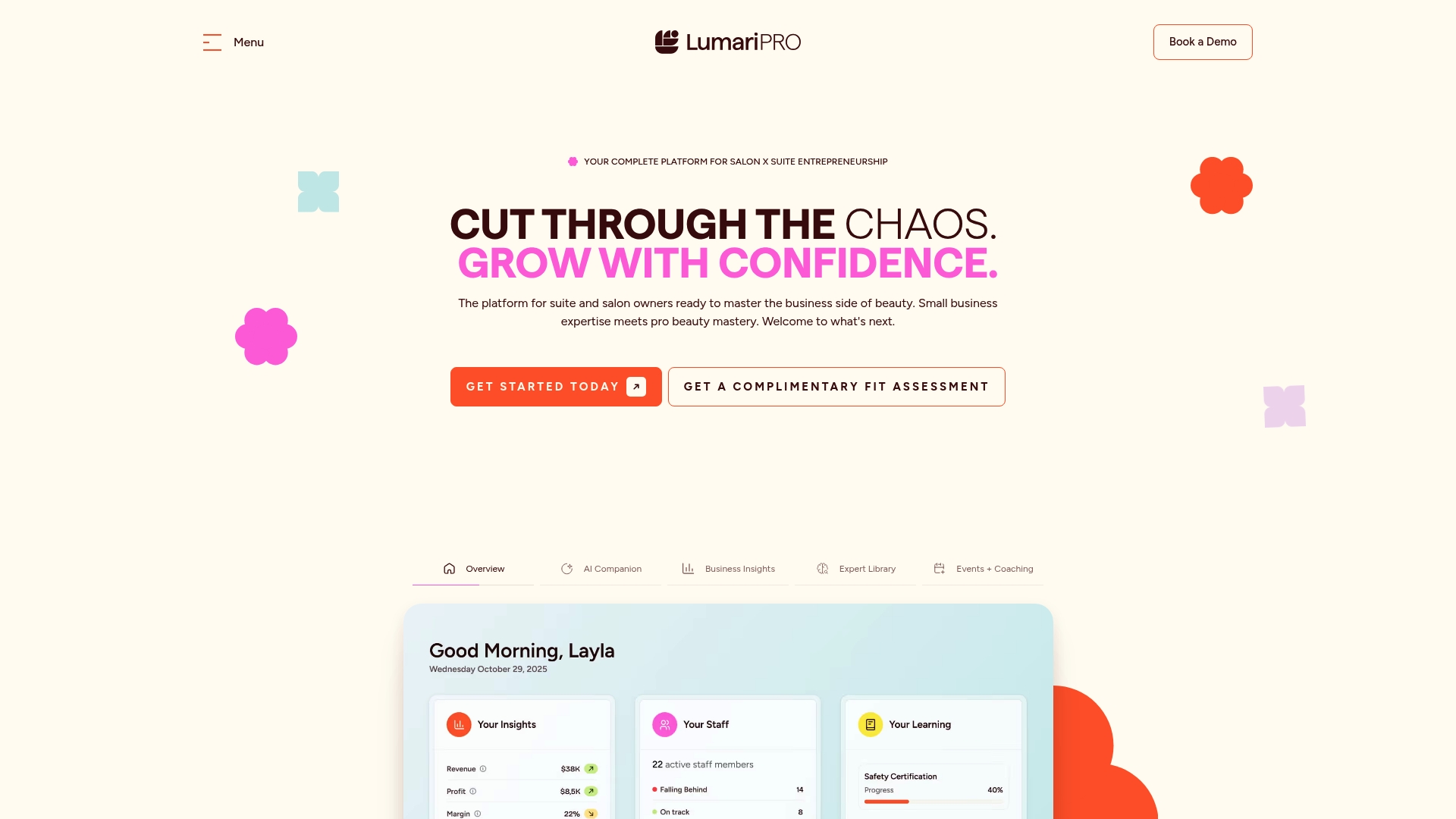
The platform connects to your POS and QuickBooks so your rebooking rate, source data, and revenue show up automatically instead of requiring a spreadsheet you’ll abandon by March. You also get AI coaching and practitioner-built playbooks that tell you which of the tactics above to prioritize based on your actual numbers, not generic advice borrowed from a corporate retail model. If you want hands-on guidance alongside the software, the coaching and playbook support option pairs a real plan with the dashboards. Check LumariPRO’s pricing and see which plan fits a one-person operation ready to stop guessing at what’s working.
Useful Resources for Building Your Client Base
For deeper reading on the tactics above: the first 90 days playbook for new suite owners, the 30/60/90 client acquisition framework, and a practical look at digital tools for growing a solo practice.
Sources
- Client Retention for Beauty Pros | ProBeauty AI
- How to Build Clientele as a Hairstylist: First 90 Days in Your Suite
- 15 Esthetician Marketing Ideas to Get More Clients in 2026
- Your First 50 Clients: Salon Playbook (2026) — Tavix Blog
Recommended