Salon owners and self-employed beauty professionals can deduct every ordinary, necessary business expense — tools, supplies, rent or booth fees, utilities, insurance, continuing education, marketing, payroll, inventory (COGS), depreciation under Section 179, home office when eligible, and vehicle mileage — and may qualify for the 20% Qualified Business Income deduction under Section 199A when material participation is met. The single action to take right now: open a dedicated business checking account and turn on tip tracking in your POS system. Both steps take under an hour and immediately close the two most common gaps that cost salon owners real money at tax time.
Two 2026 updates are worth flagging before anything else. The IRS standard mileage rate rose to 72.5¢ per business mile, and new “no tax on tips” guidance (capped at $25,000) offers a meaningful benefit for eligible beauty and wellness professionals — but only with rigorous daily tip documentation. Section 179 expensing limits also remain favorable for salon equipment purchases this year. These changes can materially shift your tax bill, so the timing of purchases and tip recordkeeping both matter more than usual.

Table of Contents
- Common salon tax deductions to check this year
- Who can claim which deductions: owner, booth renter, or W-2 employee
- Detailed walkthrough of every major deduction
- Depreciation, Section 179, and bonus depreciation: which saves you the most?
- Section 199A QBI and self-employment tax: what beauty pros need to know
- Vehicle use: standard mileage vs. actual expenses and how to stay audit-ready
- Payroll, 1099s, and tip reporting: what owners must get right
- Recordkeeping systems: what to save, how long, and how to organize it
- How to report deductions: forms, estimated payments, and the annual timeline
- Common filing mistakes and audit red flags to avoid
- How Lumaripro helps prevent missed deductions and simplify year-end filing
- Key Takeaways
- The habit that actually moves the needle
- Fewer tax headaches start with the right platform
- Authoritative sources and IRS references
Common salon tax deductions to check this year
Before diving into the details, run through this checklist. Check off every category that applies to your business, note what documentation you already have, and flag the gaps.
Deductible expense categories:
- Tools and small equipment (shears, clippers, blow dryers, styling irons) — keep receipts; items under $2,500 may qualify for the de minimis safe-harbor and can be expensed immediately
- Backbar supplies (color, developer, shampoo, conditioner used on clients) — immediate expense on Schedule C, Line 22 or 38
- Retail inventory (products sold to clients) — tracked as Cost of Goods Sold (COGS), not a direct supply expense
- Rent or booth fees — fully deductible for booth renters and salon owners paying commercial rent
- Utilities (electricity, water, internet at the salon) — deductible for owners; booth renters deduct only if separately billed
- Business insurance (general liability, professional liability, property) — deductible
- Continuing education and licensing fees — deductible when they maintain or improve existing skills, not when training for a new profession
- Marketing and booking software (social ads, website hosting, online scheduling tools) — deductible as advertising or operating expense
- Payroll and employee benefits — wages, payroll taxes (employer share), and qualifying benefit costs
- Vehicle mileage — 72.5¢ per business mile in 2026, or actual vehicle expenses with a mileage log either way
- Home office — only if a dedicated space is used exclusively and regularly for business
- Depreciation and Section 179 — for larger equipment (chairs, sinks, built-ins) placed in service during the year
- Tips and tip credits — reported as income by employees; Form 8846 tip credit available to qualifying employers
Immediate expense vs. capitalize: Consumable supplies and items under the de minimis threshold are expensed in the year purchased. Retail inventory flows through COGS. Equipment above $2,500 is typically capitalized and depreciated unless you elect Section 179 or bonus depreciation.
Pro Tip: Separate personal and business spending from day one. Dedicated business banking and a POS system that categorizes purchases in real time are the two fastest ways to stop missing deductions — and the first thing a CPA will ask about.

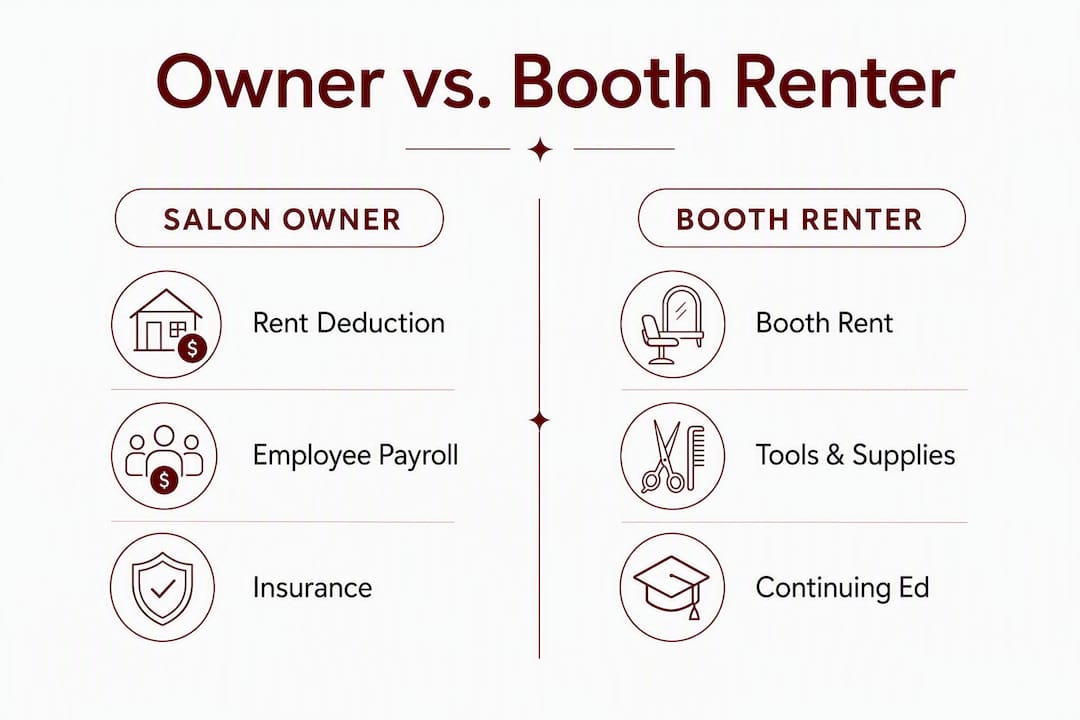
Who can claim which deductions: owner, booth renter, or W-2 employee
Your business model determines what you can deduct, what forms you file, and who owes self-employment tax. The three core models in the salon industry each carry different tax responsibilities.
Salon owner/employer: You own the business, employ or contract stylists, and report income and expenses on Schedule C (or a business return if structured as an S-corp or LLC taxed as one). You deduct rent, payroll, supplies, utilities, insurance, depreciation, and COGS. You also pay the employer share of FICA taxes and are responsible for issuing W-2s and 1099-NECs.
Booth renter/independent contractor: You rent a chair or suite, set your own prices, and run your own business. Your booth rent is a deductible expense on your Schedule C. You buy your own supplies, pay your own self-employment tax (15.3% on net profit), and report all income — including tips — on Schedule C. You do not receive a W-2 from the salon.
Commission or W-2 employee: You work for the salon and receive a W-2. You cannot deduct reimbursed business expenses on your federal return under current law (the Tax Cuts and Jobs Act eliminated that deduction for employees through 2025, and it has not been restored for 2026). Your employer withholds income tax and FICA.
| Expense category | Salon owner | Booth renter | W-2 employee |
|---|---|---|---|
| Booth/chair rent | Receives it as income | Deducts on Schedule C | N/A |
| Supplies and backbar | Deductible (Schedule C) | Deductible (Schedule C) | Not deductible federally |
| Payroll taxes (employer) | Pays and deducts | N/A | N/A |
| Self-employment tax | Yes (on net profit) | Yes (on net profit) | No (withheld by employer) |
| Tips | Reports and withholds | Reports on Schedule C | Reported to employer |
| COGS/retail inventory | Deductible | Deductible | Not deductible federally |
| Section 179/depreciation | Yes | Yes | Not deductible federally |
Example: A booth renter paying $1,500/month in chair rent deducts $18,000 annually on Schedule C. A salon owner with three W-2 stylists earning $45,000 each deducts $135,000 in wages plus the employer FICA share (7.65% of wages). The booth renter owes self-employment tax on net profit; the salon owner’s self-employment tax applies only to their own net earnings, not to employee wages.
When a salon owner pays an independent contractor $600 or more in a calendar year for services, the owner must issue Form 1099-NEC by January 31. Booth rent payments from renters to the salon owner are rental income to the owner but do not trigger a 1099-NEC requirement from the renter — that distinction trips up a lot of people.
Detailed walkthrough of every major deduction
Tools and small equipment
Scissors, clippers, blow dryers, flat irons, and similar tools are ordinary and necessary business expenses. Keep the receipt and note the business purpose. Items costing $2,500 or less per invoice can be expensed immediately under the de minimis safe-harbor election rather than depreciated over several years. Items above that threshold are capitalized and depreciated (or expensed under Section 179 — more on that below). On Schedule C, small tools typically go on Line 22 (supplies) or Line 27a (other expenses).
Backbar supplies vs. retail inventory
This distinction matters more than most stylists realize. Backbar supplies — color, developer, shampoo, conditioner, and other products you use on clients — are consumable business supplies, expensed when purchased. Retail products you sell to clients are inventory. Inventory flows through COGS (Schedule C, Part III): beginning inventory + purchases minus ending inventory = COGS. You cannot deduct retail inventory as a supply expense; it must go through the COGS calculation. Run a physical inventory count at year-end to get this right.
Rent and booth fees
Commercial rent for a salon space is fully deductible on Schedule C, Line 20b. Booth renters deduct their chair or suite rent the same way. Keep your lease or rental agreement and monthly payment records. If you prepay rent for a future period, you generally deduct it in the year to which it applies, not the year paid.
Utilities
Electricity, water, gas, and internet at the salon are deductible for owners who pay them directly. Booth renters can deduct utilities only if they are separately billed and not bundled into the booth fee. Schedule C, Line 25 covers utilities.
Insurance
General liability, professional liability (errors and omissions), and property insurance premiums are deductible on Schedule C, Line 15. Health insurance premiums for a self-employed owner (not eligible for employer-sponsored coverage) are deductible above-the-line on Form 1040, Schedule 1, which is even better than a Schedule C deduction because it reduces adjusted gross income.
Continuing education and licensing
Masterclasses, online workshops, advanced color certifications, and state-required CE hours are all deductible when they maintain or improve skills you already use in your business. Training for a completely new profession does not qualify. Licensing renewal fees and cosmetology board fees are deductible as professional expenses. Keep receipts and a brief note on the learning objective for each course — that note is your audit defense.
Marketing and booking software
Social media advertising, Google Ads, website hosting, email marketing tools, and online booking platforms are deductible as advertising (Schedule C, Line 8) or operating expenses (Line 27a). When a software subscription bundles booking, POS, and marketing in one fee, deduct the full cost as a business expense. The IRS allows deductions for ordinary advertising costs that are reasonable and directly related to your business.
Client amenities and uniforms
Coffee, tea, and snacks offered to clients in the salon are deductible as a business expense (subject to the 50% meals limitation if they have a personal component, though client amenities in a waiting area are generally fully deductible as a business cost rather than a meal). Branded uniforms or aprons with your salon’s logo are fully deductible. Personal clothing that doubles as workwear is not deductible — the IRS requires that the item be unsuitable for everyday wear.
Home office
The home office deduction requires a space used exclusively and regularly for business. A dedicated room used only for scheduling, bookkeeping, and client calls qualifies. A kitchen table does not. You can use the simplified method ($5 per square foot, up to 300 square feet, for a maximum of $1,500) or the regular method (actual home expenses prorated by the percentage of your home used for business), reported on Form 8829. The regular method often yields a larger deduction but requires more documentation.
Pro Tip: Before claiming a home office, confirm the space meets the exclusive-use test. A room with a guest bed fails, even if you also use it for bookkeeping. Photograph the space and keep a floor plan with square footage measurements.
Depreciation, Section 179, and bonus depreciation: which saves you the most?
Large salon purchases — styling chairs, shampoo bowls, reception desks, built-in cabinetry — are capital assets. You recover their cost over time through depreciation, or you can accelerate that recovery using Section 179 or bonus depreciation. All of this flows through Form 4562, which you attach to your return.
MACRS (standard depreciation): Most salon equipment falls into the 7-year MACRS class. You deduct a portion of the cost each year over seven years using IRS depreciation tables. Predictable, but slow.
Section 179: Lets you deduct the full cost of qualifying equipment in the year it is placed in service, up to the annual dollar limit (which remains favorable in 2026 with increased phase-out thresholds). The deduction cannot exceed your business taxable income for the year.
Bonus depreciation: Allows an additional first-year deduction on qualifying property. The percentage has been phasing down under current law — confirm the applicable rate with your CPA for 2026, as it depends on when the asset was placed in service and any legislative updates.
De minimis safe-harbor: Items at or below $2,500 per invoice (or $5,000 with an applicable financial statement) can be expensed immediately without going through depreciation at all.
Step-by-step decision checklist:
- Is the item $2,500 or less per invoice? If yes, use the de minimis safe-harbor and expense it now. Done.
- Is the item above $2,500 but clearly a business asset placed in service this year? Move to Step 3.
- Do you have sufficient business taxable income to absorb a Section 179 deduction? If yes, elect Section 179 on Form 4562 for the maximum current-year benefit.
- If Section 179 is limited by income, apply bonus depreciation to the remaining basis (subject to the current-year rate).
- For anything remaining, use standard MACRS depreciation over the applicable recovery period.
- Check your state’s conformity rules — some states do not follow federal Section 179 or bonus depreciation, which can create a state tax surprise.
Worked example: You buy two styling chairs at $1,800 each and a shampoo bowl at $2,200. Total: $5,800. The chairs fall under the de minimis threshold per item, so you expense both immediately — $3,600 off the top. The shampoo bowl also falls under the threshold per invoice, so it is expensed too. All $5,800 is deducted in the year of purchase with zero depreciation paperwork. If instead you bought a single styling station package invoiced at $6,500, you would use Section 179 to deduct the full $6,500 in year one, assuming sufficient taxable income. Under 7-year MACRS without any election, you would recover only a fraction of that cost in year one.
Pro Tip: Coordinate Section 179 elections with your CPA before December 31. If you are considering a large equipment purchase, buying before year-end and placing the asset in service before December 31 is what triggers the current-year deduction — not just signing the contract.
Section 199A QBI and self-employment tax: what beauty pros need to know
Many beauty professionals leave a significant deduction unclaimed simply because they have not heard of it. Under IRC Section 199A, qualifying self-employed individuals and pass-through business owners can deduct up to 20% of their Qualified Business Income. Beauty services are generally treated as a non-Specified Service Trade or Business (non-SSTB), which means most salon owners and independent stylists are eligible when material participation is met and income falls within applicable thresholds.
Short example: A solo stylist with $80,000 in net Schedule C profit may be able to deduct up to $16,000 (20% of $80,000) from taxable income before calculating income tax. That deduction does not reduce self-employment tax, but it meaningfully reduces the income tax bill. The QBI deduction is claimed on Form 8995 (simpler situations) or Form 8995-A (more complex), attached to your Form 1040.
Self-employment tax runs at 15.3% on net earnings up to the Social Security wage base, then 2.9% above it. The good news: you can deduct the employer-equivalent portion (half of self-employment tax) above-the-line on Schedule 1 of Form 1040, which reduces your adjusted gross income. This deduction is automatic — you calculate it on Schedule SE and carry it forward.
Retirement plans reduce taxable income further. Three options worth knowing:
- SEP IRA: Contributions up to 25% of net self-employment income, with a high annual dollar ceiling. Simple to set up, deadline is your tax filing date including extensions.
- Solo 401(k): Higher potential contributions than a SEP for many stylists because it allows both employee and employer contributions. Must be established by December 31 of the tax year.
- SIMPLE IRA: Works well for small salons with employees; lower contribution limits than a Solo 401(k) but easier administration.
Estimated tax payments are due quarterly (April 15, June 16, September 15, and January 15 of the following year) using Form 1040-ES. Missing these payments triggers underpayment penalties, which are avoidable with a little planning.
A note on complexity: If you operate multiple salon locations, aggregate activities for QBI purposes, or have income near the phase-out thresholds, the QBI calculation gets complicated fast. That is the point where a CPA familiar with beauty business structures earns their fee many times over.
Vehicle use: standard mileage vs. actual expenses and how to stay audit-ready
The rule is simple in principle: commuting from home to your regular workplace is not deductible. Driving between client locations, making supply runs, attending industry education events, and traveling to a second work location are deductible business miles.
The 2026 IRS standard mileage rate is 72.5¢ per business mile. A stylist who drives 6,000 business miles in 2026 deducts $4,350 (6,000 × $0.725). That figure covers fuel, maintenance, insurance, and depreciation — you cannot also deduct those actual costs if you use the standard rate. Parking fees and tolls are deductible separately regardless of which method you use.
Standard mileage vs. actual expenses:
- Standard mileage is simpler and often better for high-mileage drivers with fuel-efficient vehicles. You must choose this method in the first year you use the vehicle for business.
- Actual expenses (fuel, oil, tires, insurance, registration, depreciation) can yield a larger deduction for expensive vehicles with high operating costs. You prorate total costs by the business-use percentage.
- Once you use actual expenses, you cannot switch back to standard mileage for that vehicle.
Mileage recordkeeping checklist:
- Date of each trip
- Starting and ending odometer readings
- Business destination and purpose
- Total miles driven
- Receipts for parking and tolls (kept separately)
Pro Tip: Use a mileage tracking app (MileIQ, Everlance, or a simple spreadsheet logged daily) rather than reconstructing trips at year-end. The IRS requires contemporaneous records — a log created from memory in April does not meet that standard and will not survive an audit.
Payroll, 1099s, and tip reporting: what owners must get right
Tip reporting is the area where salon owners face the most audit exposure, and 2026 makes it more consequential than ever. The new “no tax on tips” guidance (capped at $25,000) is a real benefit for eligible beauty and wellness professionals, but it requires rigorous daily tip logs and clean POS/payroll reconciliation before you can claim it without IRS scrutiny.
Core payroll forms for salon owners with employees:
- Form 941: Quarterly payroll tax return (employer and employee FICA, income tax withheld)
- Form 940: Annual federal unemployment tax return (FUTA)
- W-2: Annual wage statement issued to each employee by January 31
- W-3: Transmittal form sent to the Social Security Administration with W-2s
- Form 1099-NEC: Issued to independent contractors paid $600 or more in the calendar year
Booth rent vs. contractor payments: Booth rent collected by the salon owner is rental income, reported on Schedule E or Schedule C depending on the level of services provided. The renter does not issue a 1099 to the salon for their own rent payments. But if the salon owner pays a contractor (say, a freelance colorist) $600 or more for services, the owner must issue Form 1099-NEC.
Tip reporting for employees: Employees must report tips to their employer by the 10th of the month following the month tips were received. Employers include reported tips in W-2 wages and withhold FICA accordingly. Large food or beverage establishments (which can include some salon-adjacent businesses) may need to file Form 8027 annually. Booth renters report all tips as self-employment income on Schedule C — there is no employer to report to.
Audit red flag: The IRS cross-references credit card tip data from payment processors against reported tip income on payroll returns. A salon where credit card tips are large but reported tip income is low will draw scrutiny. Reconcile POS tip reports against payroll every pay period, not just at year-end.
Recordkeeping systems: what to save, how long, and how to organize it
Good recordkeeping is not just about surviving an audit. It is how you find deductions you would otherwise miss. The IRS generally has three years to audit a return from the filing date, but that window extends to six years if you underreport income by more than 25%, and there is no limit for fraudulent returns. Keep most business records for at least three years; keep payroll records and employment tax returns for four years; keep records related to property (including depreciation schedules) until three years after you dispose of the asset.
Documents to keep:
- Receipts and invoices for all business purchases
- Bank and credit card statements (business accounts)
- POS reports (daily sales, tip reports, product sales)
- Inventory count worksheets and COGS reconciliations
- Payroll records, pay stubs, and tax deposit confirmations
- Tip logs (daily, per employee)
- Lease or booth rental agreements
- Form 1099s issued and received, W-2s
- Mileage logs
- Form 4562 depreciation schedules
- Home office square footage documentation and utility bills (if claiming Form 8829)
Digital organization: Create a folder structure by year, then by category (Payroll, Supplies, Equipment, Insurance, Marketing, Mileage, Rent). Name files with the date and vendor (e.g., “2026-03-15_Salon Centric_Color_Supplies.pdf”). Back up to a cloud service (Google Drive, Dropbox) monthly. Physical receipts fade — scan them within a week of purchase.
Integrated systems reduce the burden significantly. When your POS connects to your bookkeeping software and your business bank account, transactions are categorized automatically and tip data flows directly into payroll records. That integration creates an auditable trail from the point of sale through to your tax return, which is exactly what the IRS wants to see.
Pro Tip: Set a monthly closing date — the last business day of each month — and spend 30 minutes reconciling your bank statement to your bookkeeping software, reviewing uncategorized transactions, and confirming tip logs are complete. That habit alone prevents the year-end scramble that leads to missed deductions and filing errors.
How to report deductions: forms, estimated payments, and the annual timeline
Every deduction has a home on a specific form. Knowing where things go prevents errors and ensures nothing gets lost.
Deduction-to-form mapping:
| Deduction | Form / Schedule C line |
|---|---|
| COGS (retail inventory) | Schedule C, Part III |
| Supplies (backbar, small tools) | Schedule C, Line 22 |
| Rent (commercial or booth) | Schedule C, Line 20b |
| Advertising and marketing | Schedule C, Line 8 |
| Insurance | Schedule C, Line 15 |
| Utilities | Schedule C, Line 25 |
| Wages paid to employees | Schedule C, Line 27a |
| Depreciation / Section 179 | Schedule C, Line 15 + Form 4562 |
| Home office | Schedule C, Line 30 + Form 8829 |
| Vehicle expenses | Schedule C, Line 9 |
| Self-employment tax deduction | Schedule 1, Line 15 |
| QBI deduction | Form 8995 or 8995-A |
| Tip credit (employer) | Form 8846 |
Quarterly and annual timeline:
- January 15 — Q4 estimated tax payment due (Form 1040-ES)
- January 31 — Issue W-2s to employees and 1099-NECs to contractors
- February 28 / March 31 — File W-3 and 1099 transmittals (paper vs. electronic deadlines differ)
- April 15 — File Form 1040 (or extension) and Q1 estimated payment due; SEP IRA contributions due (or by extension deadline)
- June 16 — Q2 estimated payment due
- September 15 — Q3 estimated payment due
- December 31 — Last day to place assets in service for current-year Section 179; establish Solo 401(k)
Step-by-step filing checklist for salon owners:
- Reconcile all bank and credit card statements to your bookkeeping software.
- Run a year-end POS report: total sales, tips collected, product sales (for COGS).
- Perform a physical inventory count and calculate COGS (beginning inventory + purchases minus ending inventory).
- Compile all equipment purchases; decide on de minimis, Section 179, or MACRS for each.
- Issue all required 1099-NECs and W-2s by January 31.
- Calculate home office square footage and gather utility bills if claiming Form 8829.
- Total business miles from your mileage log; calculate the vehicle deduction.
- Prepare Schedule C, attach Form 4562 (depreciation) and Form 8829 (home office) as needed.
- Calculate self-employment tax on Schedule SE; carry the deductible half to Schedule 1.
- Calculate QBI on Form 8995 or 8995-A.
- Review estimated tax payments made; calculate any balance due or refund.
Common filing mistakes and audit red flags to avoid
Most of the errors that trigger IRS scrutiny or cost salon owners money are preventable. Here are the ones that show up most often, and what to do about each.
Mixing personal and business expenses. Using a personal credit card for salon supplies and a business card for personal purchases creates a recordkeeping nightmare and guarantees missed deductions. Open a dedicated business checking account and use it exclusively for business. This is the single highest-return action most salon owners can take.
Treating retail inventory as a supply expense. Products you sell to clients are inventory, not supplies. Deducting them as supplies overstates your expense deduction in the purchase year and understates it in the sale year. Run a proper COGS calculation at year-end.
Weak or missing tip logs. Tip income is taxable, and the IRS knows what credit card processors report. A daily tip log reconciled against POS data is your protection. With the 2026 tip-related guidance in play, documentation requirements are stricter, not looser.
Claiming a home office without exclusive use. A room that also serves as a guest bedroom, playroom, or general storage does not qualify. The exclusive-use test is binary — the space either qualifies or it does not. IRS scrutiny is higher on returns with modest gross receipts claiming relatively large home office deductions, so document carefully or skip the deduction.
Failing to issue 1099-NECs. If you paid a contractor $600 or more and did not issue a 1099-NEC, you may lose the deduction for that payment and face penalties. Set a reminder for January and collect W-9s from contractors before paying them, not after.
Ignoring estimated tax payments. Self-employed beauty pros who skip quarterly payments face underpayment penalties on top of the tax owed. Use Form 1040-ES and pay quarterly.
Pro Tip: Automated bookkeeping that connects your POS, bank account, and accounting software does not just save time. It creates a consistent, timestamped record that is far harder for the IRS to challenge than a spreadsheet assembled at tax time. Consistency is the audit defense.
How Lumaripro helps prevent missed deductions and simplify year-end filing
Most salon owners do not lose money at tax time because they are doing something wrong. They lose it because the right information was never captured in the first place. Lumaripro is built specifically to close that gap, connecting the data points that matter for tax purposes into one place designed for how beauty businesses actually operate.
Platform capabilities that directly protect deductions:
- POS and bank integrations that pull transactions automatically, categorize them by expense type (supplies vs. COGS vs. equipment), and flag uncategorized items for review
- Automatic tip logs that reconcile credit card tips, cash tips, and service charges daily, creating the contemporaneous documentation the IRS requires
- Backbar usage reports that separate client-service supplies from retail inventory, making the COGS calculation straightforward at year-end
- Depreciation helpers that track asset purchase dates, costs, and placed-in-service dates so you and your CPA can make informed Section 179 decisions before December 31
- QuickBooks integration that keeps your bookkeeping current without requiring manual data entry after every appointment
- End-of-year tax summary reports that map income and expenses to Schedule C lines, reducing the time your CPA spends reconstructing the year
The audit trail Lumaripro creates runs from the point of sale through to your bookkeeping records, with timestamps and source data at every step. That is exactly the kind of documentation that makes an IRS inquiry a manageable inconvenience rather than a crisis.
Pro Tip: Connect Lumaripro to your business bank account and POS system in the first week of the tax year, not the last. Every month of clean, categorized data you build is a month you do not have to reconstruct in April.
Key Takeaways
Salon owners and self-employed beauty professionals who separate business finances, document tips daily, and make deliberate Section 179 decisions before December 31 consistently capture the largest available deductions and face the least IRS scrutiny.
| Point | Details |
|---|---|
| Separate finances immediately | Open a dedicated business account; it is the single fastest way to stop missing deductions. |
| Document tips daily | The 2026 “no tax on tips” guidance (capped at $25,000) requires contemporaneous tip logs to withstand IRS review. |
| Use Section 179 and de minimis elections | Items under the de minimis threshold expense immediately; larger assets may qualify for full Section 179 expensing in the year placed in service. |
| QBI deduction is often available | Beauty services are generally non-SSTB, meaning many solo stylists and owners can deduct up to 20% of net profit under Section 199A. |
| Lumaripro integrates POS, banking, and bookkeeping | The platform automates tip logs, expense categorization, and COGS tracking so deductions are captured throughout the year, not reconstructed in April. |
The habit that actually moves the needle
The conventional wisdom on salon taxes focuses on the list: know your deductions, keep your receipts, hire a CPA. All of that is correct, and none of it is the real problem. The real problem is that most salon owners run their finances reactively. They collect receipts in a shoebox, reconcile nothing until March, and then hand a CPA a pile of disorganized data and hope for the best.
The owners who consistently pay less in taxes are not smarter about tax law. They are more consistent about one thing: closing the books monthly. A 30-minute month-end review — reconciling the bank statement, confirming tip logs, reviewing uncategorized transactions — catches errors while they are still fixable and builds the kind of clean record that makes year-end filing fast and audit-proof.
Consider what happens when a salon owner reviews purchases in November rather than April. They can still decide to buy that second styling chair before December 31 and elect Section 179, turning a $3,200 purchase into a $3,200 current-year deduction. The same purchase made in January costs the same money but yields only a fraction of that deduction in the current year under standard depreciation. The deduction did not change. The timing did.
The tools exist to make this easy. Lumaripro’s platform integrations connect POS data, bank transactions, and bookkeeping in real time, so the monthly close takes minutes instead of hours. The owners who use it are not doing more work. They are doing the right work at the right time.
Fewer tax headaches start with the right platform
Running a solo beauty business means wearing every hat, and tax prep is the hat nobody wants. Lumaripro gives independent beauty professionals and salon owners a concrete alternative to the year-end scramble: real-time financial dashboards, automatic tip logs, POS and QuickBooks integrations, and expense categorization that maps directly to Schedule C lines.

Two features make the biggest difference at tax time. First, automatic tip reconciliation creates the daily documentation the IRS expects, which is now more critical than ever given 2026 tip-credit guidance. Second, the backbar vs. retail inventory split keeps COGS accurate without manual sorting at year-end. Both run in the background while you focus on clients.
If you are ready to stop reconstructing your finances in April, see how Lumaripro works and find the plan that fits your business.
Authoritative sources and IRS references
The following primary sources and IRS publications support the guidance in this article. State tax rules vary significantly — always confirm your state’s conformity with federal Section 179, bonus depreciation, and home office rules with a local CPA or your state’s department of revenue.
IRS forms and publications referenced:
- Schedule C (Form 1040) — Profit or Loss from Business
- IRS Publication 535 — Business Expenses
- IRS Topic 509 — Business Use of Home
- IRS Topic 510 — Business Use of Car
- IRS Topic 513 — Work-Related Education Expenses
- IRS Credits and Deductions for Businesses — General business deduction guidance
- IRS: Advertising and Marketing Costs — Deductibility of marketing expenses
Additional reading:
- Tax Write-Offs for the Beauty Industry — LegalClarity
- Salon Tax Deductions 2026 — Mindspace Outsourcing
- Tax Filing Tips for Hair Stylists — TurboTax
- Salon & Barbershop Owner Tax Deductions — Taxstra
- Tax for Beauty Professionals — TaxKiln
This article is general information, not professional tax advice. Tax rules change and individual situations vary. Confirm current rules and how they apply to your business with a qualified CPA or tax professional.
Recommended