A salon training program for suite renters and solo beauty pros is a business and operations curriculum, not a technical skills course. It covers pricing, client retention, appointment flow, and retail margins, delivered through short workshops, one on one coaching, and repeatable checklists. The best programs get you to five outcomes fast: prices that cover rent and taxes, a rebooking system that runs without you thinking about it, faster turnover between clients, retail sales that actually add profit, and a dashboard that tells you where the money went. Some salon training programs build their coaching and playbooks around these five targets.
TL;DR:
- Most small salon programs focus on business management outcomes like pricing, rebooking, and retail margins, not technical skill development.
- Essential modules include a pricing formula, retention scripts, quick turnover routines, retail tracking, and scheduling rules based on actual demand.
- Delivery works best with micro-modules, templates, and live coaching, structured over a 90-day plan that builds momentum gradually.
- Accurate KPIs for success are rebooking rate, retail attachment, chair utilization, and gross margin, tracked daily, weekly, and monthly with automated software.
- Legal, lease, and compliance considerations vary by state and directly impact marketing, client agreements, and operational restrictions for booth and suite renters.
Table of Contents
- Core Modules Every Salon Training Program Should Cover
- Delivery Formats That Fit a One-Person Business
- How Much Should a Salon Training Program Cost, and What’s the Payback?
- Which KPIs Actually Tell You the Program Is Working
- Lease and Suite Terms That Shape Your Training Choices
- Figuring Out Where Your Skills Actually Need Work
- In-House Training vs. Buying an External Program
- Keeping Your Training Materials From Going Stale
- Legal and Compliance Basics Every Solo Pro Needs Training On
- Getting Yourself (and Any Team) to Actually Show Up for Training
- Software and Tools That Make Training Stick
- Why Most Training Advice Ignores the Real Constraint
- Ready to Turn This Into a Real Plan for Your Suite?
- Sources
Core Modules Every Salon Training Program Should Cover
Most beauty professionals learn a craft in cosmetology school and then get handed a chair with zero instruction on how to run it like a business. A real salon training program fills that gap with modules built around cash flow, not technique.
Pricing that covers your real costs. Your price needs to account for product cost, your labor, rent, and taxes, then still leave you a target take home number. A useful pricing formula separates product cost from labor price so you can see your actual margin per service instead of guessing based on what the salon down the street charges.
Retention and rebooking. This means scripts you actually say out loud at checkout, a referral system that rewards clients for bringing friends, and a simple version of the DRIP framework (Draw attention, Reveal value, Inspire trust, Prompt action) applied to every client touchpoint.
Micro-SOPs. The 5-Minute Flip is a short reset routine between clients that keeps your chair time high without hiring help. Pair it with a FEFO (first expired, first out) inventory rotation so product doesn’t sit and spoil.
A functional training program should give you:
- A written pricing formula that separates product cost from labor
- Two or three retention scripts for checkout and no-show follow-up
- A turnover checklist you can run in under five minutes
- A retail cost-per-unit tracking method
- Scheduling rules tied to actual demand patterns, not guesswork
- Automated appointment reminders to cut no-shows
Retail deserves its own line item here. Tracking cost per unit against what you actually sell tells you which products earn their shelf space and which ones just look nice.
Delivery Formats That Fit a One-Person Business
You don’t have an HR department to sit through a two-day seminar. Training for solo operators works best in small doses you can apply the same day.
Recorded micro-modules paired with fill-in templates work well for anything mechanical, like building your pricing sheet or setting up a booking calendar. Live coaching earns its place for anything with nuance, like handling a client who pushes back on a price increase or figuring out why your Tuesday afternoons are always empty.
A 90-day rollout gives you enough runway to see real change without losing momentum:
- Weeks 1 and 2: Stabilize the basics. Claim your Google Business Profile, audit your monthly expenses, and reconnect with clients who haven’t booked in 60 days.
- Weeks 3 through 6: Rebuild your client base and fix your pricing. Send reactivation messages, roll out your new price list, and start the retention scripts at checkout.
- Weeks 7 through 12: Optimize retail and automate what you can. Set reminder sequences, review your retail attach rate, and adjust inventory based on what’s actually moving.
Connecting your booking software to your point of sale and QuickBooks removes a lot of manual entry that eats into the time you’d rather spend with clients or, frankly, resting.
Pro Tip: Pick one accountability partner or a small peer group and commit to a 15-minute check-in every Monday. Reviewing last week’s numbers together for even a few minutes keeps a 90-day plan from quietly dying in week three, which is where most solo efforts stall.
How Much Should a Salon Training Program Cost, and What’s the Payback?
Before buying any program, line up the real costs: the subscription or course fee, the hours you’ll spend learning instead of booking clients, and any one-time setup cost like new software or printed materials.
Now run conservative numbers. Say your average ticket is $65 and you see 15 clients a week. If a training program helps you lift your average ticket by just $5 through better retail attachment and add one extra rebooking per week, that’s roughly $340 in added monthly revenue from two small, believable changes. Compare that to a monthly program cost and you get a payback window in weeks, not years.
To forecast honestly, track:
- Rebooking rate before and after
- Average ticket
- Retail attach rate
- Monthly retention percentage
The LumariPRO ROI calculator lets you plug in your own numbers before committing to a subscription. If you’re choosing between a one-time course and ongoing coaching, think about which matches your actual gap: a single course fixes a knowledge hole, while a subscription model fits better if you need accountability and evolving support as your business grows.
Which KPIs Actually Tell You the Program Is Working
Six numbers matter more than the rest: rebooking rate, average ticket, retail attach rate, cancellation and no-show rate, chair utilization, and gross margin per appointment. Everything else is noise for a solo operator.
Build the habit in three layers:
- Daily: A one-minute note after your last client. What worked, what didn’t, anything to fix tomorrow.
- Weekly: A five-minute glance at your dashboard for rebooking and cancellation trends.
- Monthly: A profit-first snapshot covering revenue, product costs, rent, and what actually landed in your pocket.
Software that syncs with your POS and QuickBooks pulls most of these numbers automatically, which matters when you’re the only person keeping the books.
Lease and Suite Terms That Shape Your Training Choices
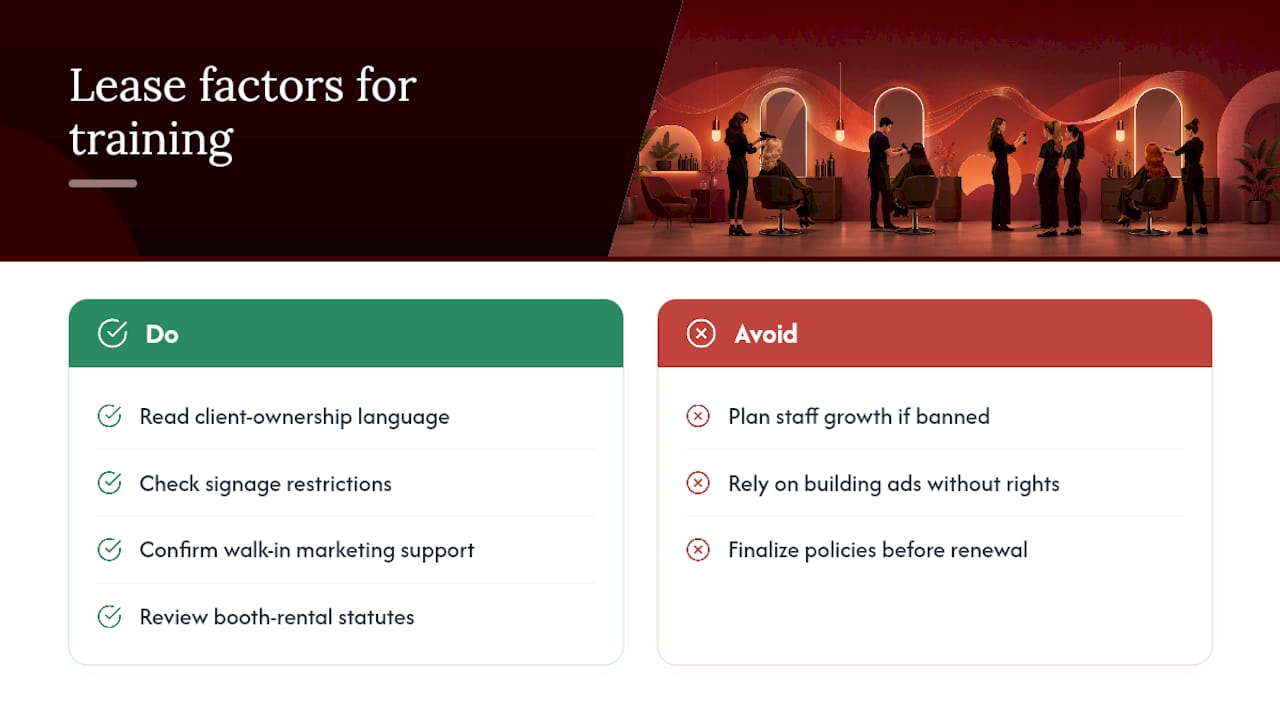
Your lease dictates what training even applies to you. Before you build out a marketing module or a signage strategy, check your lease for client ownership language, signage restrictions, and whether the suite operator provides any walk-in traffic or marketing support. Some suite agreements limit how you can advertise from the building itself, which changes how much weight your training should put on referral systems versus paid ads.
Booth rental in particular functions as a landlord tenant relationship governed by state law, not an employment arrangement. That distinction affects your insurance needs and how you structure client agreements, and it’s worth a quick read through your state’s specific booth rental statutes before you finalize any policy training for yourself.
Suite terms also affect your scheduling module. If your lease caps your hours in the building or restricts subleasing your chair to an assistant, your training needs to account for that ceiling rather than building a growth plan around adding staff you’re not permitted to add. Review your lease renewal date too. If it’s coming up within your 90-day training window, use that leverage to negotiate better signage rights or marketing support before you sign again, not after.
Figuring Out Where Your Skills Actually Need Work
Most independent pros overestimate their strengths in areas they enjoy and underestimate gaps in areas they avoid. A quick self-audit fixes this before you waste time on a module you don’t need.
Start with your last 90 days of booking data. If your average ticket has been flat for six months while your service menu has grown, your gap is pricing or upselling, not marketing. If you’re fully booked but not profitable, your gap is almost certainly cost control.
A simple three-question checklist works better than a formal assessment for a solo operator:
- Which KPI have I not looked at in the past month?
- Which client conversation makes me nervous every time (price increases, declining an appointment, upselling retail)?
- Where does my calendar show gaps that shouldn’t exist given my location and hours?
Whatever surfaces from those three questions tells you which training module to prioritize first. Skipping this step is why so many people buy a full curriculum and only ever finish the first section.
In-House Training vs. Buying an External Program
Building your own training from scratch means piecing together advice from social media, other stylists, and trial and error. It costs nothing upfront but costs you months of inefficient guessing, and mistakes in pricing or retention compound every week you don’t catch them.
External programs bring tested frameworks; the tradeoff is fit. A generic small business course won’t touch the specifics of booth rental economics, retail margins on professional product lines, or the realities of building a client list without a corporate marketing budget behind you. That’s the gap a beauty-specific program is meant to close.
The practical middle ground for most solo operators: buy the framework (pricing formula, retention scripts, KPI structure) and customize the details yourself. You don’t need someone to write your Instagram captions. You need someone to hand you a pricing formula on day one instead of making you reinvent it after a year of underpricing.
Keeping Your Training Materials From Going Stale
A pricing sheet built two years ago is probably wrong today. Product costs shift, rent increases, and your own skill level (and what you can charge for it) climbs, but most solo operators never revisit their original training materials once they’ve internalized them.
Set a quarterly review on your calendar for three things: your pricing formula against current product costs, your retention scripts against what’s actually converting, and your KPI targets against your last three months of real numbers. If your rebooking scripts still reference a promotion you ran last year, they need an update.
Treat your micro-SOPs the same way. The 5 Minute Flip that worked when you offered four services might not fit once your menu has grown to twelve. Revisit the checklist every time you add a new service category, not just annually.
Legal and Compliance Basics Every Solo Pro Needs Training On
Booth and suite renters operate under a landlord tenant relationship, which means state cosmetology board rules, sanitation codes, and your local business license requirements all apply to you directly, not to a salon owner covering it for you. Training that skips this is incomplete.
At minimum, your compliance module should cover your state’s license renewal timeline, required continuing education hours if applicable, sanitation and disposal rules for your specific service category, and your own liability insurance coverage. Consult your state cosmetology board’s website directly for your exact requirements, since these rules vary significantly by state and change periodically.
Contract literacy matters just as much. Read every clause in your suite lease about client data ownership; some agreements claim your client list belongs to the suite operator if you leave, which affects how you build and protect your own retention systems from day one.
Getting Yourself (and Any Team) to Actually Show Up for Training
If you work solo, motivation is a matter of building habits into your calendar rather than relying on willpower after a long day standing at the chair. Tie training time to a fixed slot, like the first 20 minutes of your slowest day of the week, so it competes with nothing else on your schedule.
If you have a booth mate or work near other renters in the same suite, shared accountability beats solo effort. A short weekly text thread reporting one number each (rebooking rate, average ticket, whatever you’re each working on) creates light social pressure that keeps people honest without turning into a mandatory meeting nobody wants to attend.
Small incentives help too. Set a personal reward tied to hitting a KPI target for four consecutive weeks, not just for finishing a training module. Modules finished don’t pay rent; behavior change does. If you’re managing a small team of renters or employees in a shared space, consider a modest bonus tied to their most impactful bookable behavior (upsells, rebooking rate) rather than attendance at training sessions themselves.
Software and Tools That Make Training Stick
Training that lives only in your memory fades within weeks. The professionals who keep their new habits use a tool that surfaces the numbers automatically instead of asking them to remember to check.
A platform that connects to your point of sale and QuickBooks turns your KPIs into a live dashboard instead of a monthly spreadsheet chore. That matters because the entire point of training is behavior change, and behavior change needs a feedback loop faster than “check in three months from now and hope you remember what you changed.”
Look for software that does three things: pulls your booking and revenue data automatically, flags anomalies like a sudden spike in cancellations, and stores your playbooks (pricing formula, scripts, checklists) somewhere you’ll actually reopen them. A binder full of good advice you never touch again isn’t training. It’s a paperweight.
Why Most Training Advice Ignores the Real Constraint
Here’s the uncomfortable truth about most business training aimed at beauty professionals: it’s written by people who’ve never had to hit a rent number by the first of the month with only their own two hands generating revenue. Generic small business courses assume you have a team, a marketing budget, or at least a business partner to split the mental load. Suite renters and solo operators have none of that, and pretending otherwise is why so much training gets bought and never finished.
The fix isn’t more content. It’s fewer, sharper tools built for exactly this constraint: one person, one chair, finite hours. Pricing formulas, retention scripts, and micro-SOPs like the 5 Minute Flip work because they respect that reality instead of asking you to run your suite like a mini franchise.
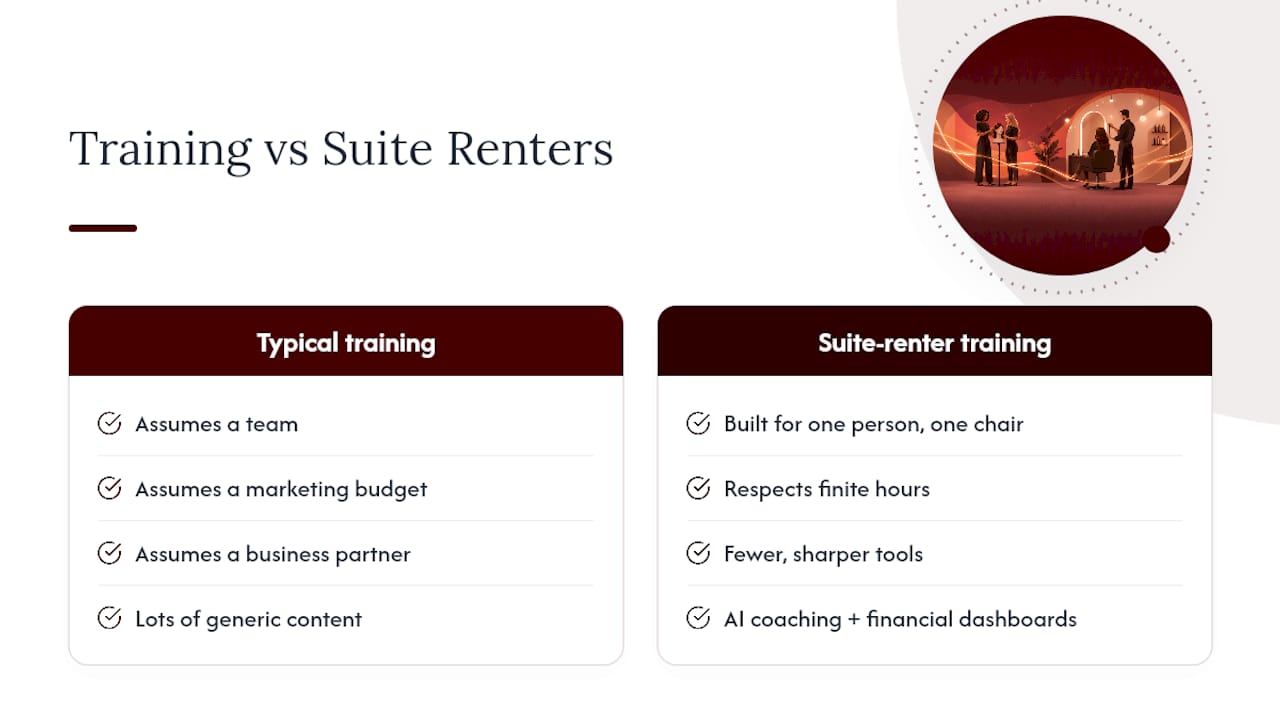
LumariPRO’s approach reflects that same logic: AI coaching paired with financial dashboards and direct integrations with the platforms you already use, built specifically around the operating system suite renters actually need. The pricing module maps to a real formula, the retention scripts appear as templates you can copy into a text message, and the KPI dashboard pulls from your POS instead of asking you to build a spreadsheet at 11 p.m. after a full day of clients.
None of this replaces your own judgment about your clients, your market, or your prices. What it does is remove the guesswork from the parts of the business that don’t require your artistry at all, just consistency.
— Oliver
Ready to Turn This Into a Real Plan for Your Suite?
Reading about pricing formulas and rebooking scripts is one thing. Having them built into software that already talks to your booking system and QuickBooks is another. This platform exists for suite renters or solo owners who want pricing, retention, and KPI structures without having to build them from scratch or hire a business coach who’s never rented a chair.
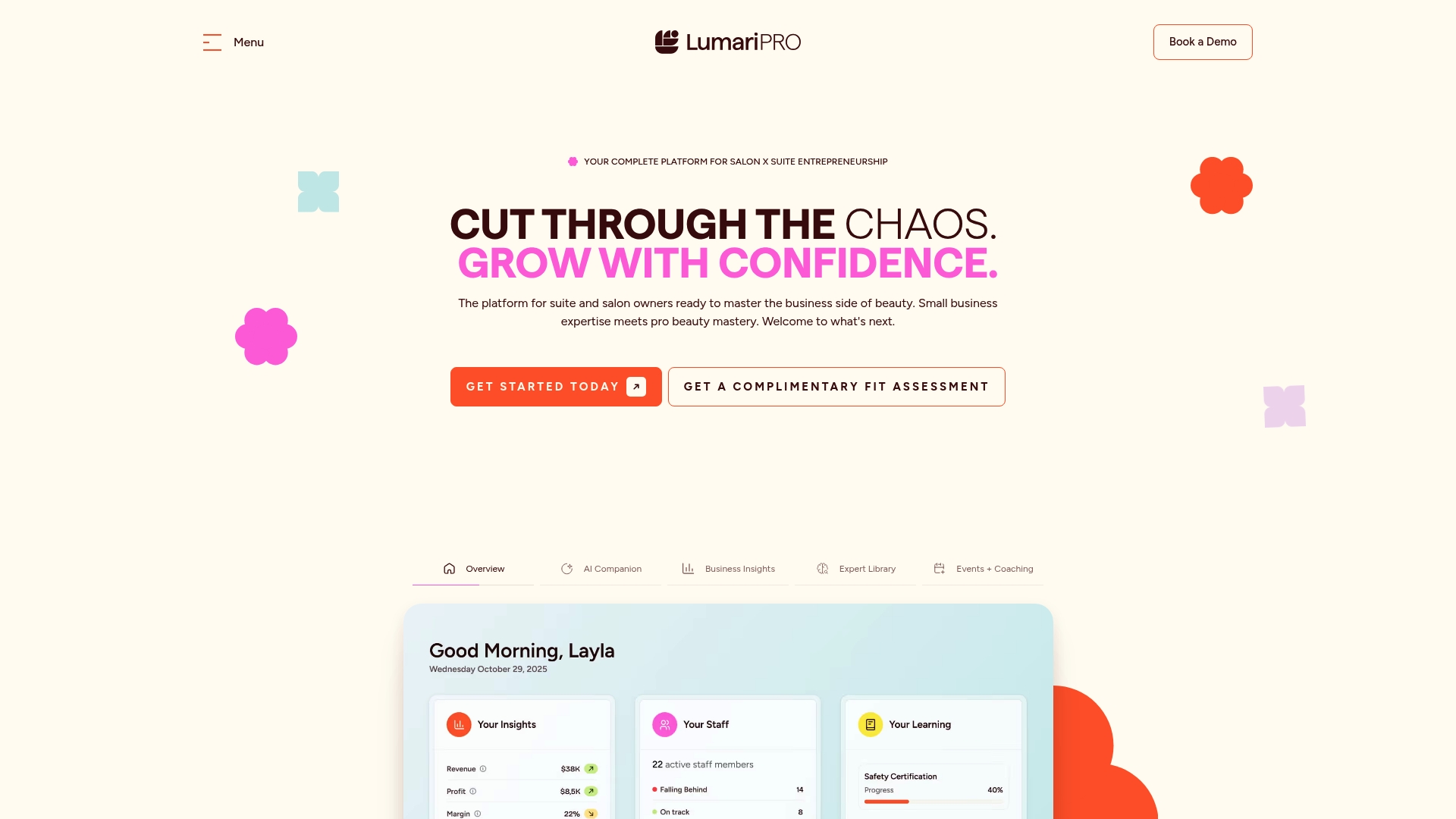
A platform may offer features such as:
- A pricing formula built into a dashboard
- Retention scripts and micro-SOPs ready to customize
- Real-time financial data pulled from POS and accounting systems
- Coaching support, both group and one on one
The fastest way to see if it fits your specific situation is a complimentary fit assessment, a short audit of your current numbers, a quick ROI check against your actual ticket average and client volume, and a clear next step whether that’s a full platform subscription or just a starting point you can act on this week. If you’d rather run your own numbers first, the ROI calculator takes five minutes and shows you the payback math before you commit to anything.
Sources