Here is a staff meeting agenda for your salon that you can copy, print, and run this week. The 45-minute version is the sweet spot for most teams:
- 0:00–0:05 — Welcome, one win from last week (owner names it)
- 0:05–0:15 — Scorecard review: rebooking rate, retail per guest, average ticket, new guest count
- 0:15–0:30 — One focused topic (training, ops, retail, or culture — pick one only)
- 0:30–0:38 — Round-robin: each team member shares one idea or concern in 60 seconds
- 0:38–0:45 — Action items: name, task, deadline — then close
That structure works because repetition and accountability create forward motion. When your team sees the same agenda every week, they come prepared. When every action has a named owner and a date, things actually get done.
Key Takeaways
A repeatable, time-boxed salon staff meeting agenda with a single focused topic, a live scorecard, and named action items is the fastest way to turn weekly meetings into measurable business results.
| Point | Details |
|---|---|
| Use a time-boxed agenda | The 45-minute format with five blocks covers metrics, one topic, and action items without running long. |
| One topic per meeting | Limiting the deep discussion to one subject produces decisions; multiple topics produce drift. |
| Name every action item | Every task needs a single owner and a deadline — “the team will handle it” means no one will. |
| Review the scorecard weekly | Rebooking rate, retail per guest, and average ticket are the three numbers that move revenue fastest. |
| Lumaripro | Provides real-time scorecards, action-tracker storage, and template libraries built for salon meeting workflows. |
Table of Contents
- Why regular salon staff meetings pay off
- Copyable 45-minute salon staff meeting agenda (with 30 and 60-minute variants)
- 50+ salon staff meeting topic ideas, grouped by purpose
- Meeting rules and facilitation tips that keep things short and fair
- Which salon numbers to review each meeting and what to do with them
- How to capture decisions, assign owners, and ensure follow-up
- Pre-meeting checklist and roles to assign
- The research-backed 5-block weekly meeting adapted for salons
- Printable one-page agenda, scorecard, and action tracker templates
- What actually works in real salons
- Lumaripro makes the scorecard and action tracker part of your workflow
- Sources
Why regular salon staff meetings pay off
Most salon owners skip meetings because the last one ran long and nothing changed. That is a facilitation problem, not a meeting problem. A well-run weekly or biweekly meeting tied to real numbers does three things a group chat cannot: it surfaces problems before they cost you clients, it aligns the team on what matters this week, and it creates a coaching rhythm that builds retention.
The business case is specific:
- Retention: Stylists who feel heard and coached stay longer. Turnover in the beauty industry is expensive, and a consistent meeting rhythm is one of the lowest-cost retention tools available.
- Revenue alignment: Reviewing rebooking rate, retail attach, and average ticket every week keeps those numbers in front of the people who move them.
- Problem prevention: A slow Tuesday that shows up in your numbers this week is fixable. The same pattern ignored for six weeks becomes a revenue hole.
- Operational clarity: Scheduling conflicts, product shortages, and policy confusion get resolved in 10 minutes at a meeting instead of in a string of texts over three days.
One honest caveat: a meeting with no agenda and no outcomes is worse than no meeting. It wastes time your team could spend behind the chair and signals that leadership is not organized. Run it right or skip it.
Copyable 45-minute salon staff meeting agenda (with 30 and 60-minute variants)
The 45-minute standard agenda
This is the format most salon teams can sustain weekly. Print it, paste it into a calendar invite, or drop it into your shared folder.
| Time Block | Agenda Item | Facilitator Notes |
|---|---|---|
| 0:00–0:05 | Welcome + one team win | Name a specific win — a client compliment, a rebooking milestone, a retail record |
| 0:05–0:15 | Scorecard review | Read the numbers aloud; note what moved and what did not |
| 0:15–0:30 | One focused topic | Training demo, policy update, retail push, or ops issue — one only |
| 0:30–0:38 | Round-robin | 60 seconds per person; no interrupting; facilitator captures ideas |
| 0:38–0:45 | Action items + close | Name, task, deadline for every item; read them back before ending |

The 30-minute stand-up variant
For smaller teams or weeks with no major topic, a 30-minute standing meeting keeps energy high and cuts the tendency to drift. Stand-ups work best when the team gathers around the front desk or a central station rather than sitting in a back room.
- 0:00–0:03 — One win
- 0:03–0:10 — Numbers: rebooking and retail only
- 0:10–0:20 — One focused topic (keep it tight)
- 0:20–0:27 — Round-robin (30 seconds per person)
- 0:27–0:30 — Action items
The 60-minute CEO hour variant
Reserve this for quarterly planning, a major policy rollout, or a team training session. The extra 15 minutes go into the focused topic block, not into more discussion time for everything else.
Facilitator reminders for all three formats:
- Circulate the agenda 24–48 hours in advance so the team comes prepared
- Start on time, even if two people are still walking in
- End with every action item read aloud: name, task, and date
- If there is nothing meaningful to discuss, cancel the meeting and send a three-line update instead
Pro Tip: Put the agenda in the calendar invite body, not just as an attachment. When someone opens the invite on their phone the morning of the meeting, the agenda is right there.
50+ salon staff meeting topic ideas, grouped by purpose
Pick one topic per meeting. That single-focus rule is the difference between a meeting that produces a decision and one that produces a headache.
Training and skill development
- Introduce a new cutting or color technique (prompt: “Who wants to demo this on a mannequin head?”)
- Upselling language practice (prompt: “Role-play recommending a treatment add-on”)
- Product knowledge refresh on a new retail line (outcome: every stylist can name three benefits)
- Consultation skills: how to ask better intake questions
- Handling a difficult client scenario (outcome: agreed team script)
Promotions and marketing
- Upcoming seasonal promotion: who owns what
- Social media content: which services to highlight this month
- Referral program: how to mention it naturally at checkout
- Email or text campaign: what the offer is and when it runs
- Google review strategy: how and when to ask
Service quality and client experience
- Beverage and welcome ritual consistency (outcome: written standard)
- Checkout experience: are we rebooking every client?
- Client complaint debrief (no names, just the pattern)
- Sanitation and station presentation audit results
- Consultation card completion rate
Scheduling and coverage
- Upcoming PTO and coverage plan
- Slow day strategy: what to do when the book is light
- Walk-in handling protocol
- Late client policy reminder
- Holiday schedule and team availability
Retail and product
- Current retail-to-service ratio and the weekly target
- Which products are moving and which are not
- Retail display refresh: who owns it this week
- Backbar inventory and reorder timing
- Incentive structure for retail this month
Policy and safety
- Chemical safety refresh (OSHA-aligned)
- Emergency procedure walkthrough
- New policy rollout (tip reporting, booking deposits, cancellation fee)
- Dress code or brand standards reminder
- HIPAA-adjacent client privacy practices
Culture and morale
- Peer recognition: each person names one teammate who helped them
- Team goal for the month and progress check
- Feedback on the physical space: what would make your station better?
- Celebrating a milestone (anniversary, certification, first big color correction)
- Open floor: what is one thing we could do better?
Parking lot rule: When a topic comes up mid-meeting that is not on the agenda, write it on a visible notepad or whiteboard labeled “Parking Lot.” Acknowledge it out loud (“Great point — that goes in the parking lot for next week”) and move on. This keeps the meeting on track without dismissing the idea.
Meeting rules and facilitation tips that keep things short and fair
The agenda is the skeleton. Facilitation is what keeps it alive.
Core rules:
- Timebox every agenda item before the meeting starts, not during it
- One deep-dive topic per meeting, no exceptions
- Every action item gets a name and a date before the meeting ends
- Rotate the “metric spotlight” role so one team member presents a number each week
- Try standing meetings for the 30-minute format; the physical posture alone shortens conversations
Facilitator phrases that actually work:
Opening: “We have 45 minutes. Let’s start with a win — [name], what’s one thing that went well this week?”
Redirecting a tangent: “That’s worth discussing. I’m putting it in the parking lot so we can give it proper time. Back to [topic].”
Eliciting solutions instead of complaints: “We’ve named the problem. What’s one thing we could try differently this week?”
Closing with decisions: “Before we wrap, let me read back the action items. [Name], you’re handling [task] by [date]. [Name], you’ve got [task] by [date]. Everyone good?”
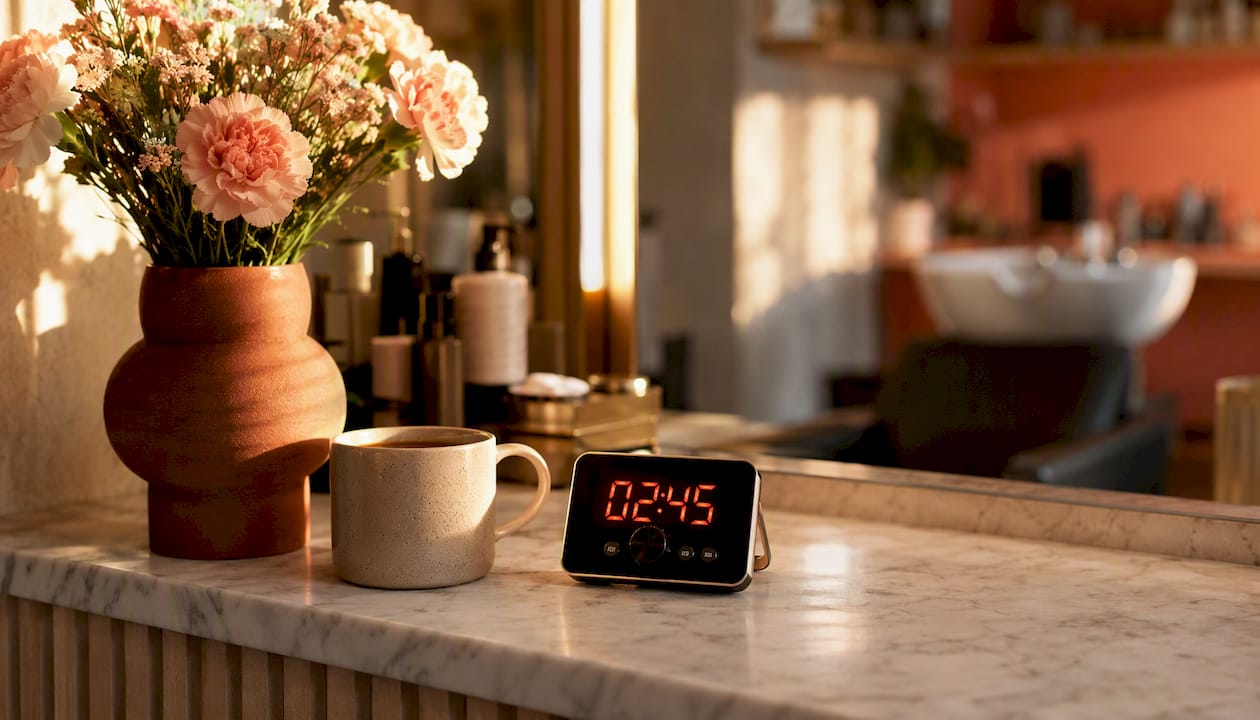
Pro Tip: Set a visible timer on a phone or tablet at the front of the room. When the team can see the clock counting down, conversations self-regulate. You will not need to cut people off nearly as often.
If a meeting is clearly habit-driven with nothing real to discuss, cancel it and send a three-line update instead. Your team will respect the decision.
Which salon numbers to review each meeting and what to do with them
Numbers depersonalize feedback. Using meetings as a coaching tool around numbers shifts the room from defensive to problem-solving.
| Metric | What to watch for | Meeting response |
|---|---|---|
| Weekly revenue | Below target two weeks in a row | Review the schedule; run a fill-the-book promotion |
| Average ticket | Flat or declining | Add an upsell script to the next training topic |
| Rebooking rate | Below 65% | Role-play the rebooking ask at checkout |
| Retail per guest | Below 15% of service revenue | Rotate retail spotlight; refresh the display |
| New guest count | Dropping | Review referral program and Google review asks |
| Cancellations/no-shows | Spiking | Revisit deposit policy and reminder timing |
| Station utilization | Uneven across stylists | Adjust scheduling or cross-promote lighter books |
Top-performing salons often target rebooking rates above 65% and a retail-to-service ratio considered healthy by industry examples as starting benchmarks. These are useful reference points, not universal mandates. Your salon’s baseline matters more than an industry average.
Scorecard rule: Read the numbers aloud, name what moved, and assign one action. Do not spend more than 10 minutes on metrics in a 45-minute meeting — the numbers inform the topic, they are not the topic.
You can also track treatment and service effectiveness metrics alongside financial ones. Resources on measuring beauty treatment outcomes offer a useful framework for connecting service quality to the numbers you review each week.
How to capture decisions, assign owners, and ensure follow-up
A meeting without a written action tracker is just a conversation. Action items work only when they include a specific task, a single named owner, and a concrete deadline — “the team will handle it” is how nothing gets done.
Action tracker format
Keep this tracker in a shared Google Doc or a pinned note in your team group chat. Review it at the top of the next meeting before you open the scorecard.
Post-meeting follow-up in three steps:
- Send a three-line group message within one hour of the meeting: what we decided, who owns it, and when it is due.
- Update the action tracker with any status changes.
- At the next meeting, open the tracker first and confirm completion before moving to new items.
The three-line follow-up method is low-friction enough that it actually happens. A full meeting summary that takes 30 minutes to write does not.
Pre-meeting checklist and roles to assign
Good meetings are built before the room fills up. Here is what needs to happen in the 24–48 hours before the meeting:
- Pull the scorecard: weekly revenue, rebooking rate, retail per guest, new guest count, cancellations
- Circulate the agenda via calendar invite or group message
- Collect topic nominations from the team (a quick “What should we cover this week?” in the group chat works)
- Prepare any training material for the focused topic block
- Confirm the action tracker is updated from last week
- Set up the room: visible timer, notepad for the parking lot, scorecard printed or on screen
Roles to assign before the meeting starts:
- Facilitator (usually the owner or manager): runs the agenda, keeps time, redirects tangents
- Timekeeper: watches the clock and gives a 2-minute warning for each block
- Minute-taker/action-tracker owner: captures decisions and action items in real time
- Rotating presenter: one team member presents a retail highlight or metric spotlight each week
Rotating the presenter role builds ownership and keeps the meeting from becoming a one-person show. When a stylist presents the retail numbers, they are far more invested in moving them.
Tech setup (keep it simple):
- Calendar invite with the agenda in the body
- Shared Google Doc for the action tracker
- One-page scorecard (printed or on a tablet)
The research-backed 5-block weekly meeting adapted for salons
For owners who want a longer, more strategic weekly meeting, the five-block CEO hour framework offers a repeatable structure built around numbers, people, and decisions. The same weekly time slot and agenda structure reduces team anxiety and becomes the salon’s operational heartbeat within a few weeks.
The framework works because it forces the owner to name one bottleneck instead of trying to fix everything at once. That constraint is what makes the meeting productive rather than exhausting.
Printable one-page agenda, scorecard, and action tracker templates
These are copy-paste ready. Drop them into a Google Doc, print them, or attach them to your calendar invite.
One-page agenda (45-minute format):
Weekly scorecard fields:
For a ready-to-edit version, Template.net’s free salon agenda and meeting minute template is a fast starting point you can customize in minutes.
Storing and sharing templates:
- Save all three documents in a shared Google Drive folder labeled “Team Meetings”
- Pin the action tracker in your team group chat for easy weekly updates
- Attach the agenda to every calendar invite so it is visible before the meeting starts
What actually works in real salons
The conventional wisdom says you need a long meeting to cover everything. Salons that run the tightest, most productive meetings do the opposite: they cover less, more consistently.
The shift that changes things is not the agenda format. It is the decision to protect the single-topic rule. Every owner I have seen try to cover training, retail, scheduling, and a policy update in one 45-minute meeting walks out with four half-finished conversations and zero completed action items. The team leaves unclear on priorities, and nothing moves.
When you commit to one focused topic per meeting and let the scorecard drive the rest, the meeting becomes a coaching tool rather than a status update. Numbers stop feeling like judgment and start feeling like shared information. That shift in tone is what gets stylists engaged instead of defensive.
The other thing that gets underestimated: the follow-up message. Three lines sent within an hour of the meeting does more for accountability than any elaborate minute-taking system. It is fast enough to actually happen, and it puts the decisions in writing before anyone forgets them.
Lumaripro makes the scorecard and action tracker part of your workflow
Running a tight meeting is easier when the numbers are already pulled and the action tracker is already open. Lumaripro’s real-time financial dashboard gives salon owners the scorecard fields covered in this guide — rebooking rate, retail per guest, average ticket, new guest count — without manual data entry before every meeting.
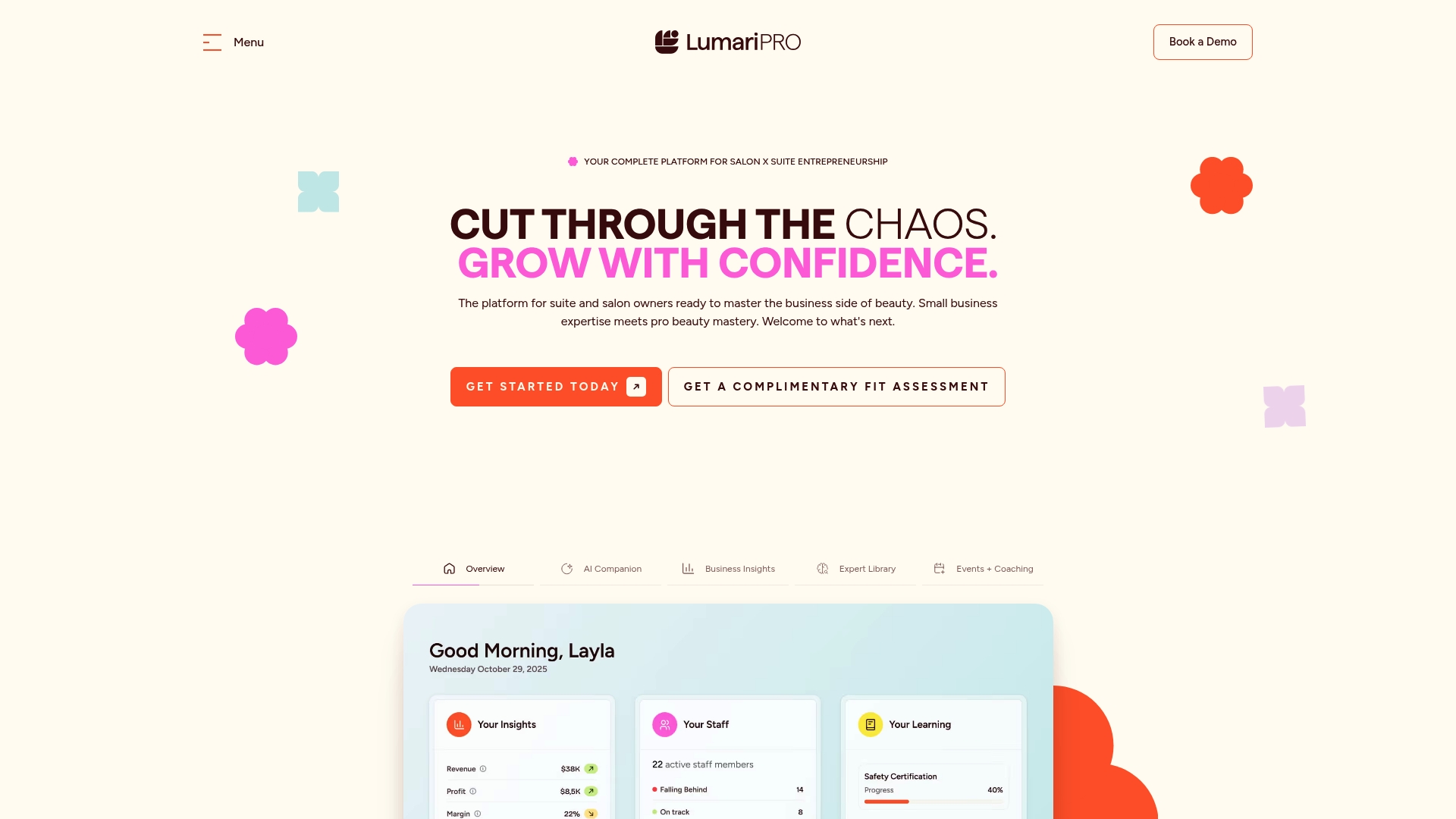
The platform also stores your meeting templates, action trackers, and coaching playbooks in one place, so the prep work that usually takes 30 minutes takes five. Three things it does directly for your meeting rhythm:
- Metrics on one page: pull your weekly scorecard from the dashboard instead of assembling it from three different reports
- Assign owners and deadlines: track action items inside the platform so nothing falls through between meetings
- Share templates easily: store your agenda, scorecard, and action tracker in a shared workspace your whole team can access
If you want the meeting structure in this guide running on a real platform built for salon owners, see how Lumaripro works and start with a plan that fits your team size.
Sources
The resources below informed the frameworks, templates, and meeting rules in this guide. Each one is worth a direct read if you want to go deeper on a specific element.
- The Weekly Team Meeting That Actually Runs Your Salon – Free Salon Education
- Salon Staff Meeting Ideas: The 30-Minute Format — Lutily Blog
- Action item management — MeetingNotes blog
Recommended