Yes, tiered salon pricing is worth building if you have stylists with different skill levels, different demand, or both. It’s the standard fix for the awkward problem of charging a brand new stylist the same $85 as your fully booked senior colorist. The salons that benefit most run a mix of experience levels and see meaningfully different rebooking rates and demand across their team.
The fastest path to a working model is a starter ladder with three or four levels. Junior, Stylist, Senior, and Creative Director works for most shops, with each step up carrying a 10% to 20% price premium over the level below it. Before you announce anything, your first move is math, not messaging.
- Calculate the floor price for your top three services (the price below which you lose money)
- Set your entry tier at or slightly above floor price, then build premiums upward
- Check your average ticket against industry percentile benchmarks before locking in numbers
Quick benchmark: Salons that price strategically rather than ad hoc report roughly 32% higher income than those pricing by guesswork, and a well-run pilot typically shows its signal (rebooking, attach rate, complaint volume) within 30 to 90 days.
Key Takeaways
Tiered salon pricing works when floor-price math, objective promotion criteria, and a measured pilot come before any client-facing announcement.
| Point | Details |
|---|---|
| Start with three to four tiers | Junior, Stylist, Senior, and Creative Director covers most salons without confusing clients. |
| Calculate floor price first | Use (cost per minute × duration + product cost) ÷ (1 − target margin) before setting any tier price. |
| Set premiums at 10% to 20% per level | Test whether bookings hold steady at each tier before locking premiums in. |
| Document promotion criteria | Objective metrics like rebooking rate and booking volume reduce turnover and disputes. |
| Track contribution margin, not just revenue | Lumaripro’s dashboards connect POS and QuickBooks data to show per-stylist contribution during a pilot. |
Table of Contents
- What Is Tiered Salon Pricing and How Does It Work?
- How Do You Calculate the Right Price for Each Tier?
- Designing Tier Levels and Aligning Stylist Pay
- What’s the Best Way to Roll Out Tiered Pricing?
- Building a Menu That Supports Tiered Pricing
- Which KPIs Tell You Your Tiers Are Working?
- A Practitioner’s Checklist Before You Launch
- How Tiered Pricing Changes Who Books With You
- Are There Legal or Ethical Issues With Charging Different Prices?
- What Does Successful Tiered Pricing Actually Look Like?
- How Does Tiered Pricing Shape Your Salon’s Position in the Market?
- What Owners Get Wrong About Rolling This Out
- How LumariPRO Helps You Implement Tiered Pricing Faster
- Sources
What Is Tiered Salon Pricing and How Does It Work?
Tiered salon pricing means charging different prices for the same service based on who performs it, usually tied to a stylist’s experience level, technical skill, or demand. A client who books a haircut with a Junior stylist pays less than a client who books the same haircut with the Creative Director. It’s the same service on paper. The price reflects who’s holding the scissors.
Three or four tiers is the sweet spot. Two tiers rarely capture enough of a skill or demand gap to matter financially, and anything beyond four gets confusing for clients trying to book online and for front-desk staff trying to explain the difference between “Senior” and “Master” at 8 a.m. on a Saturday. A four-tier structure with clear promotion criteria tends to reduce turnover because stylists can see exactly what separates their pay from the next level up.
Here’s how it plays out at the point of booking:
- The client selects a service (say, a haircut) from your online booking system or menu.
- They then either pick a specific stylist by name or choose a tier level if they don’t have a preference.
- The system displays the price tied to that stylist’s tier, so there’s no surprise at checkout.
- Front-desk staff or the booking software route the appointment to a stylist matching that tier and time slot.
Operationally, this means your scheduling software needs to support stylist-level pricing rather than one flat service price, and your receptionists need a quick, confident way to explain the difference when a client asks “what’s the difference between a $45 cut and a $85 cut?” without making the Junior stylist sound like a lesser choice.
How Do You Calculate the Right Price for Each Tier?
Every tier price should trace back to one number: your floor price. That’s the minimum you can charge without losing money on a service, and it’s calculated with a straightforward formula.
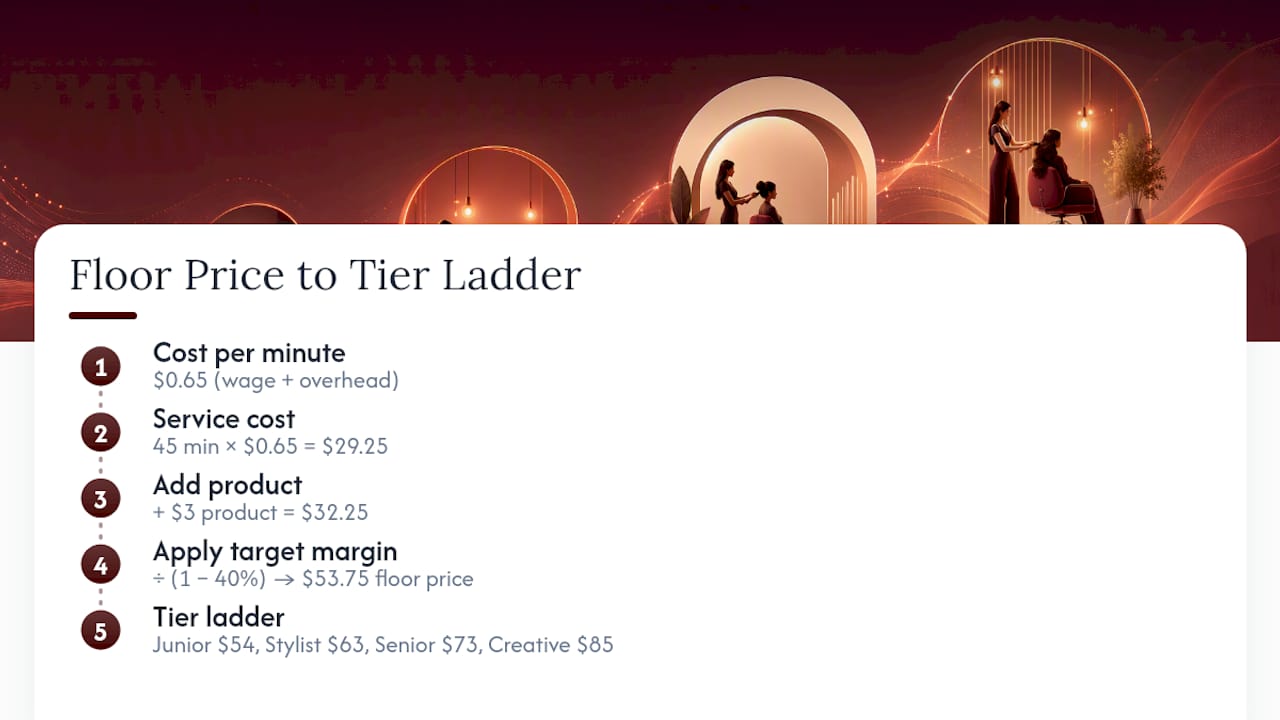
Floor price = ((cost per minute × service duration) + product cost) ÷ (1 − target margin)
Cost per minute includes the stylist’s hourly wage or commission cost, plus a share of fixed overhead (rent, utilities, software, insurance) divided by total available service minutes in a pay period. Say a stylist costs your salon $0.65 per minute in wages and overhead, a 45-minute haircut uses $3 in product, and you want a 40% target margin. The math looks like this:
That $53.75 becomes your entry-tier price. Everything above it is where tiering earns its keep. A Formula-based pricing guide recommends layering 10% to 20% premiums per tier from that floor, so your ladder might run Junior at $54, Stylist at $63, Senior at $73, and Creative Director at $85.
One wrinkle worth knowing: chair time often shrinks as skill goes up. A senior stylist may complete the same cut in 30 minutes that takes a junior 45. That lower labor cost per service can let you hold a smaller premium than you’d expect and still protect margin, since the senior tier’s actual cost per minute is offset by speed. Test any premium by watching booking behavior for two to three weeks. If the top tier stays consistently booked out and the entry tier fills fast too, your gaps are calibrated correctly. If clients cluster entirely at one tier, the premium is either too small to matter or too large to justify.
Designing Tier Levels and Aligning Stylist Pay
Naming tiers well matters more than owners expect. “Junior, Stylist, Senior, Creative Director” reads as a growth path. “Level 1, Level 2, Level 3” reads as a spreadsheet. Whatever names you choose, the promotion criteria behind them need to be objective, or you’ll spend more time managing hurt feelings than managing appointments.
Reasonable promotion criteria include:
- Years of experience or hours behind the chair
- Booking volume and calendar utilization over a rolling period
- Rebooking rate (the percentage of clients who book their next visit before leaving)
- A technical skill assessment, ideally judged by someone outside the stylist’s direct reporting line
Run promotions on a fixed annual review cycle, but track the underlying metrics continuously so nobody’s blindsided. A one-page promotion criteria document, shared with every stylist at hire, removes most of the “why did she get promoted before me” friction before it starts. Clear, objective promotion criteria paired with transparent communication is one of the more reliable ways to cut stylist turnover.
Compensation has to move in step with tier. If a Junior earns 40% commission and a Senior earns 50%, and the Senior also charges 20% more per service, that stylist’s per-appointment take grows on two fronts at once. Model it before you announce it: a $54 haircut at 40% commission pays the stylist $21.60; an $85 haircut at 50% commission pays $42.50. That gap is what motivates stylists to chase the next tier, and it’s what makes the tier system self-funding rather than a pay cut disguised as a promotion.
Pro Tip: Put the promotion criteria and the pay table in the same document. Stylists trust the system more when they can see exactly how skill translates to dollars, not just title.
What’s the Best Way to Roll Out Tiered Pricing?
Don’t flip the switch on your entire menu overnight. Pick a pilot: one service category (haircuts are the easiest starting point), a subset of stylists, or a 60-day trial window you can walk back if it flops.
- Choose your pilot scope and set a clear end date so staff know it’s a test, not a permanent shock.
- Train staff before clients hear anything. Cover the “why” behind tiers, not just the price list, and role-play how to answer “why does she cost more than you?” without sounding defensive.
- Give front-desk staff a script. Something as simple as “our pricing reflects each stylist’s experience and specialty, and you’re always welcome to choose the level that fits your budget” handles most pushback.
- Announce to clients through email, a printed card at checkout, and signage at the front desk, at least two to three weeks before the new prices take effect.
- Track bookings daily during the first two weeks. A sudden drop in bookings for one tier is your earliest warning sign.
Sequencing operational fixes before pricing changes tends to produce better results than raising prices cold, since a salon running efficiently already has more room to absorb the transition.
Building a Menu That Supports Tiered Pricing
Your menu is where tiering succeeds or confuses everyone. Show tier names and prices side by side, not buried in fine print. A simple format works: Junior Cut $54, Senior Cut $73, Creative Director Cut $85, listed the same way both on your printed menu and in your online booking flow.
Surcharges need standardizing before you launch, not after your first angry client dispute. The usual suspects:
- Extra-long or extra-thick hair (add a flat fee or percentage, not a vague “may vary”)
- Additional bowl for multi-step color processes
- Correction services, priced separately from standard color to reflect the added time and product
Bundles are where tiered pricing can actually grow your average ticket instead of just redistributing it. Price bundles from your cost stack, not from an arbitrary discount off the top. An 8% to 14% discount versus à la carte pricing tends to stay margin-accretive when the underlying components are already priced correctly. A cut-and-color bundle scripted at checkout (“would you like to add a gloss treatment for $15 off the standalone price?”) converts better than a static menu line nobody notices.
Pro Tip: Train front-desk staff to offer the bundle before the client asks about add-ons. The upsell lands better as a suggestion than as a response to a question.
Which KPIs Tell You Your Tiers Are Working?
Watch five numbers after launch, not just total revenue:
- Average ticket across the whole salon and broken out by tier
- Utilization rate per stylist, since a senior tier stylist sitting idle defeats the purpose
- Per-stylist contribution margin, which accounts for their actual cost against what they bring in
- Rebooking rate by tier, a strong early signal of client satisfaction with the price they paid
- Retail attach rate, since tiered clients often spend differently on take-home product
Give the pilot 30 to 90 days before drawing conclusions. Red flags worth acting on immediately include a tier sitting empty for two consecutive weeks, a spike in cancellations concentrated in one tier, or front-desk staff reporting the same objection over and over. Tiered pricing is now a common response to rising labor and product costs across the industry, but that doesn’t mean your specific numbers will match someone else’s case study. Let your own contribution margin data drive whether you adjust premiums, shift promotion thresholds, or leave the model alone.
A Practitioner’s Checklist Before You Launch
Before announcing anything to clients, confirm you’ve covered the basics:
- Floor price validated for every service in every tier
- Industry benchmark check completed against your local market
- Pilot scope, duration, and success metrics defined in writing
- Staff trained on scripts, objection handling, and the promotion criteria document
Connecting your point-of-sale and accounting systems is what turns raw sales data into per-stylist contribution numbers, which is the actual basis for fair promotion decisions rather than gut feel.
A tiered pricing system only stays fair as long as the data behind it is visible. Owners who can see per-stylist contribution margin in real time make better promotion calls than owners relying on end-of-year guesswork.
Lumaripro’s dashboards pull directly from POS and QuickBooks data to surface exactly that: contribution by stylist, not just total revenue by day. Paired with AI coaching and business playbooks built for suite-based and salon professionals, the manual spreadsheet work of tracking a pilot mostly disappears.
How Tiered Pricing Changes Who Books With You
Tiered pricing sorts your client base without you having to guess who wants what. Price-sensitive clients gravitate toward your entry tier, and they tend to stay loyal there as long as the experience matches the price they paid. Clients chasing a specific stylist’s reputation or technical specialty happily pay the premium tier, often becoming your most reliable rebookers because they’ve already decided the relationship is worth the cost.
The retention effect works in both directions. A junior stylist building a book of price-sensitive regulars gets steady chair time and real experience, which is exactly what moves them toward promotion. A senior stylist commanding premium prices attracts clients less likely to shop around on price alone, since they’ve already signaled they value expertise over savings. That’s a more stable client relationship than one built purely on discounting.
Where salons get this wrong is treating tiers as a one-way ladder up. Some clients deliberately choose a lower tier even when they could afford more, because they’re new to your salon and testing the waters, or because a particular service (like a basic blowout) doesn’t feel worth premium pricing to them regardless of who’s doing it. Don’t read every entry-tier booking as a signal you’ve priced someone out. Segment your retention data by tier and watch rebooking rate specifically, not just headcount, since a client who books entry-tier services every six weeks might be worth more over a year than one who books a premium service once.
Are There Legal or Ethical Issues With Charging Different Prices?
Tiered pricing based on stylist skill, experience, or demand is standard business practice and legally sound, since you’re charging different prices for genuinely different labor inputs, not for the same service performed identically by two people. The distinction that matters legally is what the tier is actually based on. Pricing by demonstrable factors like years of experience, technical certifications, or booking volume holds up fine. Pricing that correlates with a protected characteristic of the stylist, even unintentionally, is where salons can run into trouble.
The practical fix is documentation. If your promotion criteria are written down, applied consistently, and based on measurable inputs (bookings, rebooking rate, skill assessments), you have a clear paper trail showing the tier reflects merit, not bias. Salons that promote informally, based on manager preference or tenure alone, are the ones most likely to face a client or employee dispute they can’t easily defend.
On the ethics side, transparency is the whole game. Clients don’t object to paying more for a specialist. They object to feeling like the pricing was hidden or sprung on them at checkout. Publish your tier structure clearly, explain the reasoning at booking, and never let a client discover the price gap for the first time when they’re already in the chair. The salons that get complaints aren’t usually the ones charging the highest premiums. They’re the ones who didn’t communicate the system existed.
What Does Successful Tiered Pricing Actually Look Like?
The clearest pattern among salons that get tiering right isn’t a specific price point. It’s sequencing. Salons that fix scheduling inefficiency and booking utilization first, then layer in tiered pricing from a position of operational strength, see better results than salons that raise prices to solve a revenue problem they haven’t diagnosed. That’s consistent with the broader pricing sequencing guidance that treats pricing as the second move, not the first.
A common success story looks like this: a salon with five stylists notices two of them are consistently booked three weeks out while two others have same-week openings. Instead of raising every price equally, the owner builds a three-tier ladder, prices the in-demand stylists 15% to 20% above the newer stylists, and watches utilization even out across the team within a couple of months. The newer stylists get more first-time clients willing to try a lower price point, and the salon captures revenue from clients who were already willing to pay more for the popular stylists.
The failure pattern is just as consistent. Salons that announce a full menu-wide tier system in one email, with no pilot and no staff buy-in, tend to see a spike in cancellations and stylist friction in the first month. The pricing math wasn’t the problem. The rollout was. A four-tier model with objective criteria, introduced gradually and explained clearly, is what separates the salons that stick with tiered pricing from the ones that quietly roll it back after one bad quarter.
How Does Tiered Pricing Shape Your Salon’s Position in the Market?
Tiered pricing lets a single salon occupy multiple market positions at once, something a flat-rate salon can’t do. Your entry tier competes on accessibility with budget-friendly shops down the street. Your top tier competes on prestige with high-end salons across town. You’re not choosing between being the affordable option or the premium one. You’re being both, under one roof, without diluting either message.

That matters competitively because most local markets are crowded with salons picking one lane and staying in it. A salon that only prices premium loses price-sensitive clients to competitors. A salon that only prices low struggles to retain top talent, since skilled stylists eventually want compensation that reflects their skill. Tiering solves both problems simultaneously: it gives your business a reason to keep senior talent (they earn what they’re worth) while still capturing the broader client base a single flat price would exclude.
The brand story also gets easier to tell. “We have stylists at every experience level, so there’s a fit for every budget” is a stronger pitch than a flat price list that says nothing about who’s actually doing the work. Clients researching salons online respond to that kind of specificity, and it gives your top-tier stylists a public signal of status that a flat-rate structure never provides.
What Owners Get Wrong About Rolling This Out
The mistake I see most often isn’t the pricing math. Owners usually get the floor price and the premiums close enough. It’s treating the announcement as the finish line instead of the start of a measurement period. A big reveal email feels like progress, but it tells you nothing about whether the tiers actually reflect real demand.
Run the pilot smaller than feels comfortable, and watch contribution margin per stylist before you watch total revenue. Revenue can rise for reasons that have nothing to do with your pricing being right. Contribution margin tells you the truth.
— Oliver
How LumariPRO Helps You Implement Tiered Pricing Faster
Running the floor price formula by hand for every service and every tier gets tedious fast, especially once you factor in product cost, chair time, and commission by level. Lumaripro’s pricing calculators do that math automatically, pulling real cost data from your connected POS and QuickBooks accounts instead of a spreadsheet you have to update manually every time labor costs shift.

The bigger advantage shows up after launch. Per-stylist contribution dashboards give you the exact metric this article keeps coming back to: not just revenue by tier, but what each stylist actually contributes after cost. Pair that with AI coaching and business playbooks built specifically for suite renters and independent beauty professionals, and a 30 to 90 day pilot stops being guesswork and starts being a tracked experiment with real numbers behind it. If you’re ready to test a tier structure without building the tracking system from scratch, Lumaripro’s platform is built for exactly this kind of rollout, and you can see how the dashboards and pricing tools work before you commit your whole menu to the change.
Sources
- How to Price Salon Services: The Formula-Based Guide for Profit (2026)
- Pricing Salon Services: The Four-Tier Strategy
- Salon Pricing Trends 2026 | BizMetricsHQ
- Service-line pricing for boutique salons: cuts, colour, blow-dries and the bundle
Recommended