Require staff to report tips of $20 or more monthly by the 10th, withhold income and FICA taxes on those reported tips, and log everything through payroll into W-2s. Pair that with a written policy, POS-based tracking, and monthly reconciliations comparing service revenue to reported tips. Do this and you avoid personal liability for unpaid payroll taxes while protecting your team’s Social Security credits and their access to the new tip deduction.
TL;DR:
- Accurate monthly tip reporting by the 10th is essential to qualify for the new tax deductions and avoid personal liability for unpaid payroll taxes.
- Employers must withhold and deposit payroll taxes on reported tips, including the employer FICA match, and ensure W-2 boxes align correctly with tip data.
- Linking POS tip capture to payroll and reconciling monthly reduces errors, simplifies compliance, and creates a reliable digital audit trail.
- Misclassified workers and discrepancies between merchant processor data and reported tips are common audit triggers that require prompt correction.
- Implementing automated workflows through systems like LumariPRO helps ensure consistent reporting, reduces manual workload, and keeps tip records audit-ready.
Table of Contents
- Tip Reporting Salon Basics: Definitions, Forms, and Deadlines
- Employee Reporting Obligations: What Counts and When
- Employer Payroll Duties: Withholding, W-2s, and Deposits
- FICA Tip Credit vs. the New Employee Tip Deduction
- A Compliance Checklist You Can Run This Week
- State Rules, Misclassification, and What Actually Triggers Audits
- How LumariPRO Supports Audit-Ready Tip Reporting
- Why Simple Systems Beat Perfect Intentions
- Put Your Tip-Reporting Checklist on Autopilot
- Sources
Tip Reporting Salon Basics: Definitions, Forms, and Deadlines
A recent federal change lets eligible tipped employees deduct a substantial amount in reported tips from taxable income, according to industry summaries of the legislative update. That deduction only works off what employees actually report, which is exactly why Box 7 accuracy on the W-2 matters more than ever this year.
Two categories get confused constantly in salons:
- Voluntary tips are employee income, reported and taxed under normal tip rules.
- Mandatory service charges (an automatic 20% added to a bridal party invoice, for example) count as employer wages, not tips, and don’t qualify for the FICA tip credit.
- Employees report tips using Form 4070 or an equivalent electronic statement, due by the 10th of the following month.
Employee Reporting Obligations: What Counts and When
Any employee who collects tips during a calendar month must report the full amount to you by the 10th day of the next month. That threshold catches nearly every stylist, colorist, and nail tech working a normal client schedule, not just your top earners.
Reportable tip income includes:
- Cash handed directly to the stylist
- Credit and debit card tips processed through your point-of-sale system
- Digital tips sent through Venmo, Cash App, or PayPal for services rendered
- Any share received through a tip pool or tip-out arrangement
Noncash tips, like a bottle of wine or event tickets, get valued and reported differently and rarely show up in a salon setting, but it’s worth knowing the distinction exists.
Daily recordkeeping through Form 4070A makes the monthly total easy to verify, and it matters even more in tip-pool shops where one employee’s daily entries have to reconcile against what the whole pool collected before it’s split. Employees who skip reporting face significant penalties based on the Social Security and Medicare tax owed on the unreported amount, on top of the income tax due.
Pro Tip: Build the daily tip entry into your closing checklist, right next to counting the drawer. If it’s not part of the shift-close ritual, it gets forgotten within a week.
Employer Payroll Duties: Withholding, W-2s, and Deposits
Once an employee reports tips to you, the tax obligations become yours to manage. You must withhold federal income tax and the employee’s share of Social Security and Medicare on those reported amounts, and you owe the employer match on top of it. This is where a lot of small salons get caught flat: the employer FICA match on tips is real payroll tax, due on money the business never actually held.
W-2 reporting has specific boxes that need to line up correctly:
- Box 1 includes wages plus reported tips as taxable income
- Box 5 shows Medicare wages, which also includes tips
- Box 7 reports Social Security tips specifically, the figure the new employee deduction is built around
- Box 12, code TP flags uncollected tax on tips in certain situations
- Box 8 shows allocated tips if your salon falls under IRS allocation rules
Payroll filing follows the standard quarterly rhythm: Form 941 reports wages and tips each quarter, and deposit timing depends on your total payroll tax liability. Keep tip reports and payroll records for four years, since that’s the window the IRS typically looks back during an inquiry.
The cleanest way to stay ahead of all this is linking your POS tip capture directly to payroll, then reconciling merchant processor tip totals against reported tips every month. A dedicated ROI calculator can help you see what that kind of automated reconciliation actually saves in staff time and error correction.
FICA Tip Credit vs. the New Employee Tip Deduction
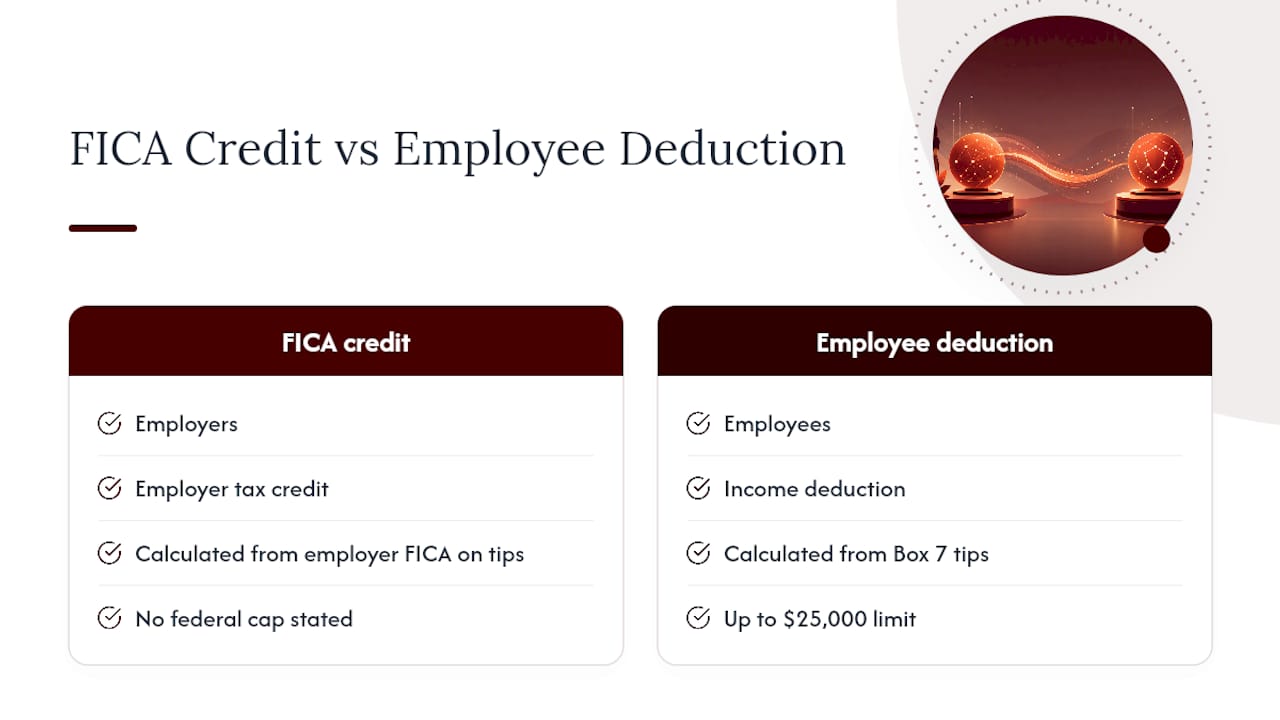
These two provisions get mixed up often, and they shouldn’t. The FICA tip credit is an employer-side benefit, letting eligible businesses claim a credit for the employer FICA taxes paid on tips above the federal minimum wage floor. The employee deduction is separate: it lets a tipped worker deduct up to $25,000 in reported tips from their own taxable income, based on the figure reported by industry sources covering the recent legislative change.
Neither one works without accurate reporting. The deduction calculates off Box 7. The credit calculates off what you actually paid in employer FICA on tips. Sloppy numbers on either side shrink both benefits.
States don’t automatically follow federal tax changes. Some states haven’t conformed to the new deduction or FICA credit provisions, which means an employee’s federal savings might not carry through to their state return. Confirm your state’s position with a CPA before promising staff a specific outcome.
A Compliance Checklist You Can Run This Week
You don’t need a consultant to get the basics locked down. Start here:
- Write the policy. A one-page document requiring Form 4070 or its electronic equivalent by the 10th, signed by every employee, gives you a documented “good faith” compliance record if the IRS ever asks.
- Turn on POS tip capture. Card and digital tips should flow automatically into your system; require cash tips to be entered at shift close using a digital version of Form 4070A.
- Reconcile monthly. Compare each stylist’s service revenue against their reported tips. A colorist doing $4,000 in services who reports $80 in tips is a red flag worth a conversation, not an audit.
- Keep the paper trail organized. Tip logs, payroll registers, and deposit receipts should live somewhere searchable, and a yearly mock audit with your CPA catches gaps before the IRS does.
Pro Tip: Run your mock audit in January, right after year-end W-2s go out. Errors are still fresh and fixable before they compound through another twelve months of payroll.
State Rules, Misclassification, and What Actually Triggers Audits
Federal rules are the floor, not the whole picture. Several states haven’t conformed to the newest federal tip deduction, so what an employee saves federally may not translate to state tax savings, and you shouldn’t assume it does without checking your state agency’s guidance.
A few patterns consistently draw IRS attention:
- Reported tips that are unusually low relative to a stylist’s booked service revenue
- Form 941 totals that don’t match year-end W-2 totals
- Missing or inconsistent Form 4070 records across the shop
- Worker misclassification, where someone treated as a 1099 booth renter is functionally supervised like a W-2 employee, which changes who’s responsible for tip reporting entirely
Merchant processors see every card tip in real time, so a gap between processor data and your written tip reports is one of the easiest mismatches for an auditor to spot. Fix errors through payroll corrections as soon as you catch them rather than letting a small discrepancy sit for a full tax year.
How LumariPRO Supports Audit-Ready Tip Reporting
Manual reconciliation works until it doesn’t, usually right around the month you’re too busy to catch a missing entry. Connecting your point-of-sale system to payroll and QuickBooks creates a continuous digital trail instead of a monthly scramble, which is the difference between finding a discrepancy in week one versus finding it during an actual audit.
Inside LumariPRO, that shows up as:
- Automated monthly reconciliation between reported tips and processed sales, flagged before they become a pattern
- Staff-facing reporting workflows that make Form 4070 submission part of the normal shift routine rather than an extra task
- AI-guided coaching for rolling out a written tip policy across a team that’s never had one before
- Real-time dashboards that connect your POS, payroll, and QuickBooks data so owners see the numbers without reconstructing them by hand
Why Simple Systems Beat Perfect Intentions
I’ve seen the pattern play out the same way in shop after shop: an owner with genuinely good intentions who never wrote anything down, and a stylist who quietly stopped reporting cash tips two years before anyone noticed. Nobody meant for it to happen. It happened anyway, because there was no system forcing it to happen differently.
Tip reporting isn’t paperwork for its own sake. It’s how your staff builds Social Security credits and qualifies for mortgages down the line, and it’s how you avoid becoming personally liable for taxes the business never had. If you want a guided way to put these workflows in place, LumariPRO’s coaching resources walk owners through the rollout step by step.
— Oliver
Put Your Tip-Reporting Checklist on Autopilot
Everything in that checklist, the written policy, the POS capture, the monthly reconciliation, is exactly what Lumaripro was built to run in the background instead of on a sticky note. Connect your point-of-sale system and QuickBooks once, and reported tips, processed sales, and payroll numbers stay reconciled automatically instead of waiting for you to notice a gap.

Staff-facing workflows keep Form 4070 submissions on schedule, and the dashboards give you a live view of where each stylist’s reported tips stand against their booked revenue, before a discrepancy turns into a quarter-long problem. If you want to see what automated tip reconciliation would actually save your shop in staff time and correction costs, run your numbers through the Lumaripro ROI calculator, or visit the platform overview to see how the integrations fit into your existing setup.
Sources
- Tip recordkeeping and reporting | Internal Revenue Service
- Publication 531 (12/2024), Reporting Tip Income | Internal Revenue Service
- Salon payroll tips: 2026 tax compliance guide for pros – Uncle Kam
Recommended